Skip to main content
Anatomy & Physiology
Il mio corso
Impara
Preparazione agli esami
AI Tutor
Guide di studio
Soluzioni per libri di testo
Flashcard
Esplora
Prova l'app
Il mio corso
Impara
Preparazione agli esami
AI Tutor
Guide di studio
Soluzioni per libri di testo
Flashcard
Esplora
Prova l'app
Indietro
Anatomy & Physiology: Proteins and Amino Acids
Puoi toccare per girare la carta.
What are proteins made of?
Puoi toccare per girare la carta.
👆
What are proteins made of?
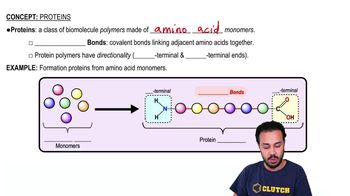
Proteins are polymers made of
amino acid
monomers linked by
peptide bonds
.
Avanzamenti del tracciato
I pulsanti di controllo sono stati cambiati in modalità "navigazione".
1/20
Video consigliati
VideoThumbView.guidedCourse
04:53
Protein Structure
25127
views
336
rank
VideoThumbView.guidedCourse
04:37
Amino Acids
25798
views
452
rank
VideoThumbView.guidedCourse
02:50
Proteins
31390
views
596
rank
Termini in questo insieme (20)
Nascondere definizioni
What are proteins made of?
Proteins are polymers made of
amino acid
monomers linked by
peptide bonds
.
What type of bond links amino acids in a protein?
Covalent peptide bonds
link adjacent amino acids together.
What are the two ends of a protein polymer called?
Proteins have directionality with an
amino (N)-terminal
and a
carboxyl (C)-terminal
end.
What are amino acids in relation to proteins?
Amino acids are the
monomers
or building blocks of proteins.
What common components do all amino acids have?
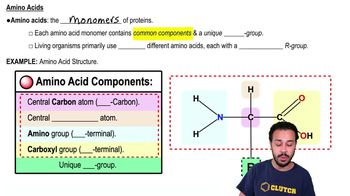
Each amino acid contains a central carbon, an amino group (N-terminal), a carboxyl group (C-terminal), and a unique
R-group
.
How many different amino acids do living organisms primarily use?
Living organisms primarily use
20 different amino acids
, each with a unique R-group.
What term describes an amino acid chain with fewer than 50 amino acids?
A chain with fewer than 50 amino acids is called a
peptide
.
What term describes an amino acid chain with more than 50 amino acids?
An amino acid chain with more than 50 amino acids is called a
protein
or
polypeptide
.
What is the primary structure of a protein?
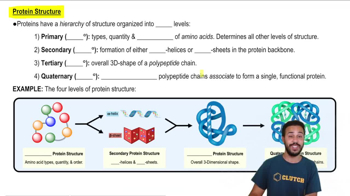
The primary structure is the
sequence and number of amino acids
in a protein.
What characterizes the secondary structure of a protein?
Secondary structure involves
alpha-helices
and
beta-sheets
formed by hydrogen bonding in the protein backbone.
What is the tertiary structure of a protein?
Tertiary structure is the
overall 3D shape
of a single polypeptide chain.
What is the quaternary structure of a protein?
Quaternary structure is when
multiple polypeptide chains
associate to form a functional protein.
What causes secondary protein structures like alpha-helices and beta-sheets?
Secondary structures are caused by
hydrogen bonding
between atoms of the peptide backbone.
What is protein denaturation?
Denaturation is when a protein loses its
functional shape
due to environmental changes like heat, pH, or salt concentration.
What is the role of chaperone proteins?
Chaperone proteins assist in
protein folding
or
re-naturing
after denaturation.
Which functional groups are always found in amino acids?
Amino acids always have
amino
and
carboxyl
functional groups.
What determines all other levels of protein structure?
The
primary structure
(amino acid sequence) determines all other levels of protein structure.
What happens to a protein when it is denatured?
A denatured protein is
non-functional
because its shape is altered.
What is the difference between a peptide and a protein?
A
peptide
is a short chain of amino acids (2-50), while a
protein
is a longer chain or multiple polypeptides folded into a functional form.
What is the significance of the R-group in amino acids?
The
R-group
gives each amino acid its unique chemical properties.
 IndietroIndietro
 04:53