Includes the nose, nasal cavity, paranasal sinuses, pharynx, larynx, trachea, bronchi, and lungs containing alveoli.
Respiratory system functional zones
The respiratory zone (respiratory bronchioles, alveolar ducts, alveoli) is for gas exchange; the conducting zone includes all other respiratory passageways.
Function of the larynx
Provides an open airway, routes food and air into proper passageways, and produces sound via vocal cords.
Structure supporting the trachea
C-shaped cartilaginous rings prevent collapse and allow esophagus expansion during swallowing.
Respiratory membrane composition
Formed by alveolar epithelium and capillary endothelium; site of gas exchange.
Pulmonary ventilation principle
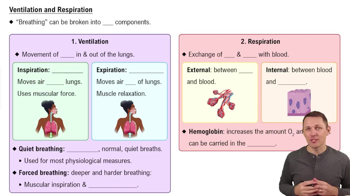
Gas flows into and out of lungs due to volume changes in thoracic cavity, explained by Boyle's law.
Boyle's law in respiration
At constant temperature, gas pressure varies inversely with volume; increased thoracic volume lowers pressure causing inspiration.
Surfactant role in lungs
Produced by type II alveolar cells; reduces alveolar surface tension to prevent alveolar collapse.
Tidal volume (TV)
Amount of air moved in and out of lungs during quiet breathing, about 500 ml per breath.
Vital capacity (VC)
Sum of tidal volume, inspiratory reserve volume, and expiratory reserve volume; total exchangeable air.
Anatomical dead space
Volume (~150 ml) of conducting airways that does not participate in gas exchange.
Dalton's law of partial pressures
Total pressure of a gas mixture equals the sum of the partial pressures of each gas.
Henry's law
Gas dissolves in liquid proportionally to its partial pressure when in contact.
Ventilation-perfusion coupling
Matching of alveolar ventilation and pulmonary blood flow to optimize gas exchange.
Oxygen transport in blood
About 1.5% dissolved in plasma; 98.5% bound reversibly to hemoglobin.
Carbon dioxide transport methods
7–10% dissolved in plasma, 20% bound to hemoglobin, 70% as bicarbonate ions.
Haldane effect
Lower oxygen saturation of hemoglobin increases blood's capacity to carry CO2.
Medullary respiratory centers
Dorsal respiratory group controls basic rhythm; ventral respiratory group controls forced breathing.
Factors influencing breathing rate and depth
Levels of CO2, O2, and H+ in arterial blood; CO2 is the most potent stimulus.
Digestive system main groups
Alimentary canal (mouth to anus) and accessory organs (teeth, tongue, salivary glands, liver, pancreas).
Six major digestive processes
Ingestion, propulsion, mechanical digestion, chemical digestion, absorption, and defecation.
Layers of alimentary canal
Mucosa, submucosa, muscularis externa, and serosa.
Function of the stomach
Temporary food storage, initiates protein digestion, converts food to chyme.
Small intestine adaptations for absorption
Circular folds, villi, and microvilli increase surface area.
Liver digestive function
Produces bile, which emulsifies fats.
Pancreatic juice components
Water, digestive enzymes for all food categories, and electrolytes.
Nutrient definition
Substance used by the body to promote normal growth and development.
Complete vs incomplete proteins
Complete proteins contain all essential amino acids; incomplete lack one or more.
Aerobic respiration overall formula
Glucose plus oxygen yields carbon dioxide, water, and ATP: \(C_6H_{12}O_6 + 6O_2 \rightarrow 6CO_2 + 6H_2O + ATP\)
Three stages of aerobic respiration
Glycolysis, Krebs cycle, and electron transport chain.
Absorptive state hormone
Insulin promotes glucose uptake, glycogen and fat storage, and protein synthesis.
Postabsorptive state metabolism
Catabolism predominates; glycogenolysis, lipolysis, and gluconeogenesis maintain blood glucose.
Body temperature regulation center
Hypothalamus contains heat-loss and heat-promoting centers to maintain homeostasis.
 Indietro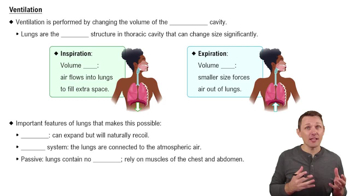
 4:28
4:28