Skip to main content
Anatomy & Physiology
Il mio corso
Impara
Preparazione agli esami
AI Tutor
Guide di studio
Soluzioni per libri di testo
Flashcard
Esplora
Prova l'app
Il mio corso
Impara
Preparazione agli esami
AI Tutor
Guide di studio
Soluzioni per libri di testo
Flashcard
Esplora
Prova l'app
Indietro
Anatomy & Physiology: Skeletal and Muscular System Overview
Puoi toccare per girare la carta.
What are the main divisions of the axial skeleton?
Puoi toccare per girare la carta.
👆
What are the main divisions of the axial skeleton?
Vertebral Column
(cervical, thoracic, lumbar vertebrae, sacrum, coccyx),
Ribs
,
Sternum
, and
Skull & Mandible
.
Avanzamenti del tracciato
I pulsanti di controllo sono stati cambiati in modalità "navigazione".
1/20
Video consigliati
VideoThumbView.guidedCourse
02:05
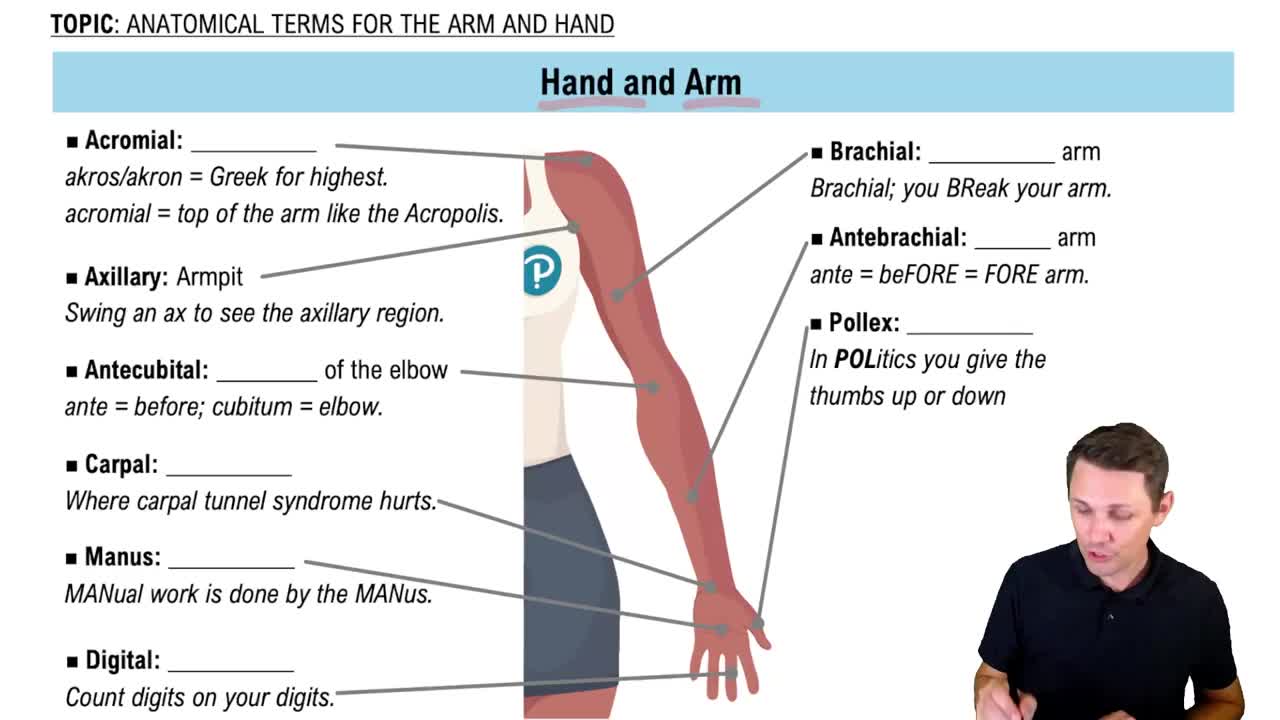
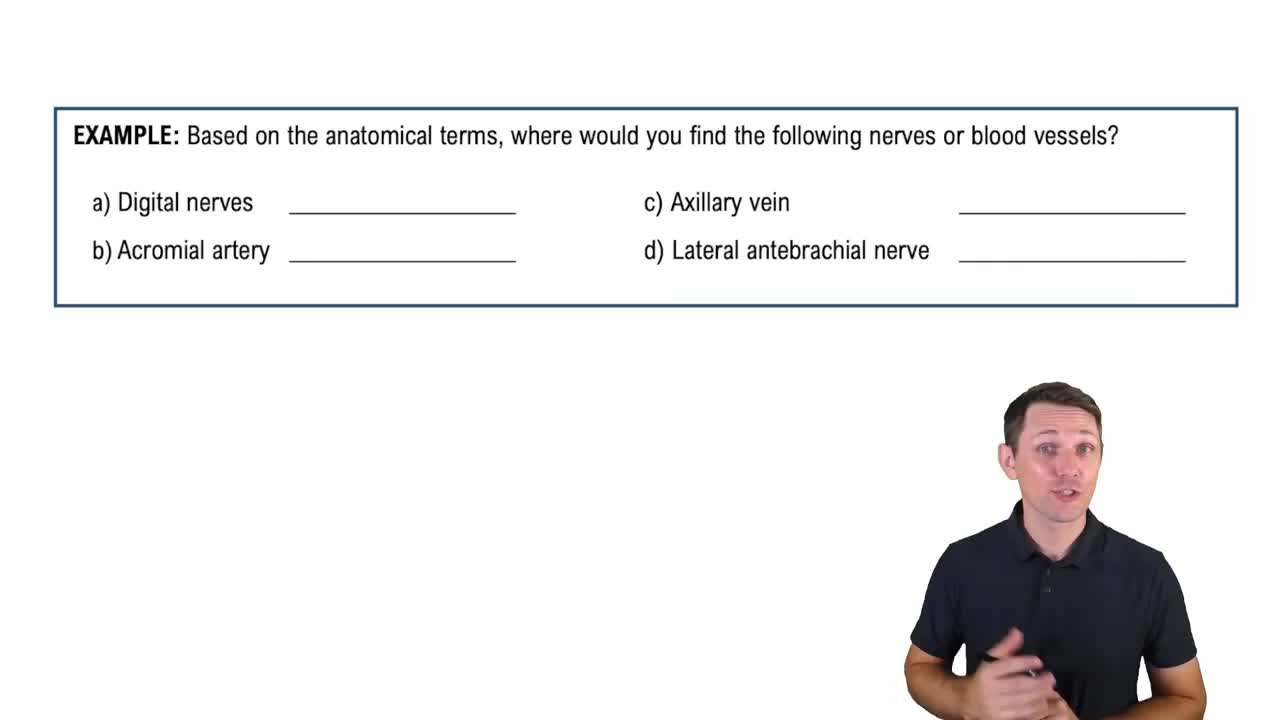
Anatomical Terms for the Arm and Hand Example 1
7141
views
166
rank
VideoThumbView.guidedCourse
03:17
The Arm and Hand
10075
views
209
rank
3
comments
Termini in questo insieme (20)
Nascondere definizioni
What are the main divisions of the axial skeleton?
Vertebral Column
(cervical, thoracic, lumbar vertebrae, sacrum, coccyx),
Ribs
,
Sternum
, and
Skull & Mandible
.
What bones make up the appendicular skeleton?
Upper extremity bones: clavicle, scapula, humerus, radius, ulna, carpals, metacarpals, phalanges. Lower extremity bones: ilium, ischium, pubis, femur, patella, tibia, fibula, tarsals, metatarsals, phalanges.
Name the three parts of the scapula relevant to the shoulder joint.
Acromion, coracoid process, and glenoid cavity (articulates with humerus).
What are the key landmarks of the humerus?
Head, anatomical neck, surgical neck, greater and lesser tubercles, deltoid tuberosity, and epicondyles.
List the bones of the upper limb from proximal to distal.
Humerus, radius and ulna, carpals, metacarpals, phalanges.
What are the three parts of the pelvic girdle?
Ilium, ischium, and pubis.
Name the bones of the lower extremity from proximal to distal.
Pelvic girdle, femur, patella, tibia and fibula, tarsals, metatarsals, phalanges.
What is the function of the patella?
Protects the knee joint and improves leverage of the thigh muscles.
Identify the main bones of the skull visible in the study materials.
Frontal, parietal, occipital, temporal, sphenoid, ethmoid, nasal, maxilla, mandible.
What are the major sutures of the skull?
Sagittal, coronal, lambdoid, and squamous sutures.
Name the four groups of muscles of the upper limb listed.
Muscles of the superficial back, shoulder, anterior compartment of the arm, and anterior compartment of the forearm.
Which muscles are included in the anterior compartment of the arm?
Biceps brachii, brachialis, and coracobrachialis.
What muscles are part of the superficial back muscles?
Trapezius, rhomboids, latissimus dorsi, levator scapulae.
List the muscles of the anterior compartment of the forearm.
Superficial group: pronator teres, flexor carpi radialis, palmaris longus, flexor carpi ulnaris. Deep group: flexor digitorum profundus, flexor pollicis longus, pronator quadratus.
What are the four compartments of the thigh muscles?
Anterior, posterior, medial, and lateral compartments.
Name the muscles of the anterior compartment of the thigh.
Quadriceps femoris (rectus femoris, vastus lateralis, vastus medialis, vastus intermedius) and sartorius.
Which muscles belong to the posterior compartment of the thigh?
Hamstrings: biceps femoris, semitendinosus, semimembranosus.
What muscles are found in the medial compartment of the thigh?
Adductor longus, adductor brevis, adductor magnus, gracilis.
Identify the bones forming the knee joint.
Femur, tibia, and patella.
What are the main bones of the foot?
Tarsals, metatarsals, and phalanges.
 IndietroIndietro
 02:05