 Indietro
Anatomy & Physiology: The Skeletal System and Hematopoiesis
 3:56

Termini in questo insieme (22)
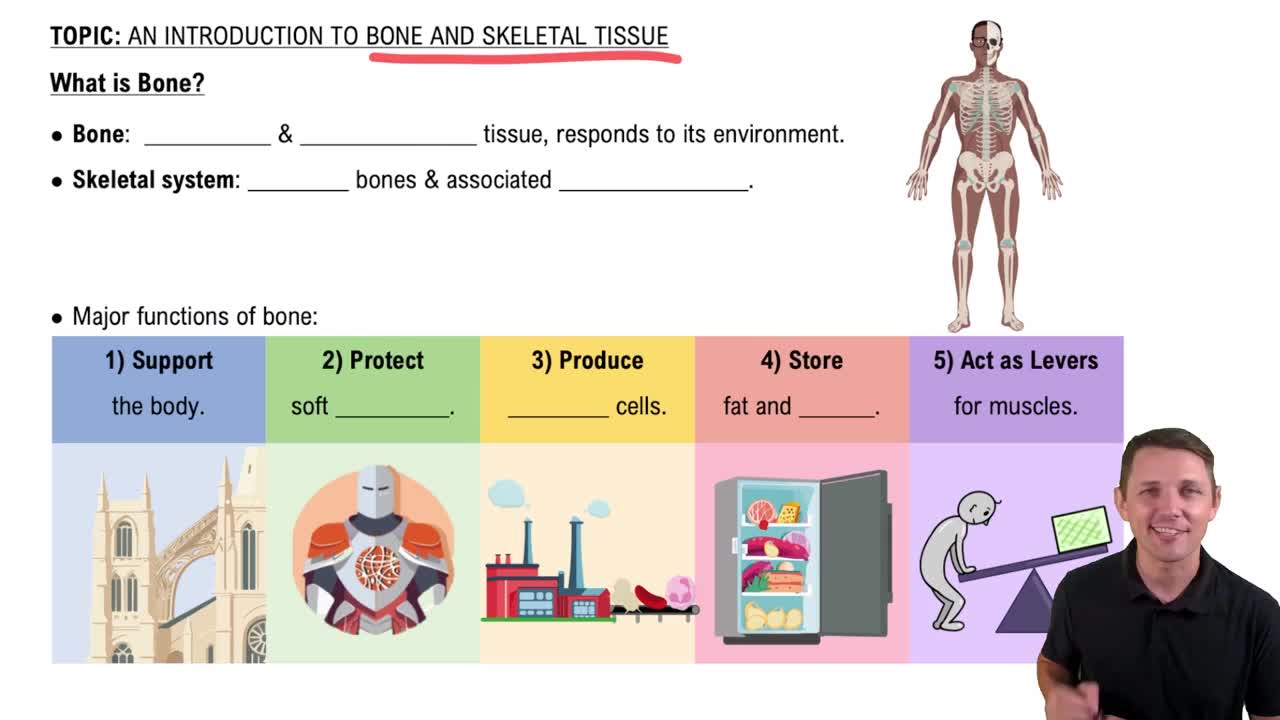
Protection, mineral storage, blood cell formation, fat storage, movement, and support.
65% of bone is inorganic mineral salts, mainly hydroxyapatite crystals composed of calcium and phosphate.
35% organic components including cells, collagen fibers (type 1), and extracellular matrix providing flexibility and strength.
Dense bone tissue made of osteons with central (Haversian) canals, lacunae housing osteocytes, canaliculi for nutrient exchange, and concentric lamellae.
Trabeculated bone with trabeculae supporting weight shifts and containing red bone marrow for hematopoiesis.
Includes osteoblasts (build bone), osteocytes (maintain bone), and osteoclasts (resorb bone).
Production of blood cells occurring in red bone marrow, producing erythrocytes, leukocytes, and platelets.
Biconcave discs lacking organelles, containing hemoglobin for oxygen transport, lifespan ~120 days, produced at ~100 billion/day.
Defend against pathogens; include granulocytes (neutrophils, eosinophils, basophils) and agranulocytes (monocytes, lymphocytes).
Cell fragments from megakaryocytes involved in blood clotting, lifespan 7-10 days, regulated by hormone thrombopoietin.
Hollow cavities lined with mucous membrane in skull bones (frontal, ethmoid, sphenoid, maxillary) that lighten the skull and produce mucus.
Epiphysis is the wide end of a long bone filled with spongy bone; diaphysis is the tubular shaft containing the medullary cavity.
Hollow space within the diaphysis filled with yellow marrow (fat storage).
Fibrous membrane covering the outer surface of bone, continuous with ligaments and tendons, containing osteoblasts for growth and repair.
Continuous process where osteoclasts resorb old bone and osteoblasts form new bone, influenced by mechanical stress (Wolff's law).
Includes comminuted (3+ fragments), compression, depressed, epiphyseal, greenstick (incomplete), and spiral fractures.
Where two bones meet; types include immobile, slightly movable, and freely movable (synovial) joints with articular cartilage and synovial fluid.
Includes articular cartilage, articular capsule (fibrous and synovial membrane), synovial fluid, bursae, ligaments, and tendons.
Avascular, resilient connective tissue that provides flexibility and smooth surfaces for movement; types include hyaline, fibrocartilage, and elastic cartilage.
Includes osteoporosis (low bone density), rickets (vitamin D deficiency), osteogenesis imperfecta (brittle bone disease), and spinal curvatures like scoliosis.
Includes arthritis (osteoarthritis, rheumatoid), bursitis, dislocations, sprains, and tendinitis.
Protein in erythrocytes with four polypeptide chains each containing a heme group with an iron ion (Fe2+) that binds oxygen.