 Indietro
Anatomy & Physiology: Vertebral Column and Thoracic Cage
 6:29

Termini in questo insieme (20)
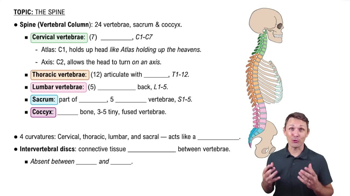
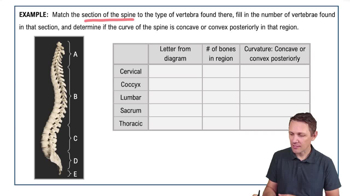
The vertebral column has five regions: cervical (C1–C7), thoracic (T1–T12), lumbar (L1–L5), sacrum, and coccyx.
Cervical vertebrae have transverse foramina for vertebral arteries and veins. The first two are specialized as atlas (C1) and axis (C2).
The odontoid process (dens) is a peg-like projection on the axis (C2) that allows rotation of the head.
Parts include the vertebral body, vertebral foramen, vertebral arch (with laminae and pedicles), spinous process, transverse processes, and articular processes with superior and inferior facets.
The vertebral arch consists of laminae and pedicles, forming the sides and roof of the vertebral foramen.
Intervertebral discs act as cushions between vertebrae, composed of an outer annulus fibrosus and an inner gel-like nucleus pulposus.
The intervertebral foramen is the opening between adjacent vertebrae through which spinal nerves exit the spinal cord.
Major ligaments include the anterior longitudinal, posterior longitudinal, ligamentum flavum, and ligamentum nuchae.
Lordosis is an abnormal inward curvature of the lumbar spine, often called swayback.
Kyphosis is an excessive outward curvature of the thoracic spine, causing a hunchback appearance.
Scoliosis is a lateral (sideways) curvature of the spine, often with vertebral rotation.
The sternum consists of the manubrium, body (gladiolus), and xiphoid process.
True ribs are ribs 1–7 that attach directly to the sternum via their own costal cartilages (vertebro-sternal ribs).
False ribs are ribs 8–12; ribs 8–10 attach indirectly to the sternum via cartilage of rib 7 (vertebro-chondral), and ribs 11–12 are floating ribs with no anterior attachment.
The transverse foramen allows passage of the vertebral artery, vein, and sympathetic nerves supplying the brain.
Articular facets are smooth surfaces on the superior and inferior articular processes that form joints between adjacent vertebrae.
The ligamentum nuchae is a strong ligament in the cervical region that supports the head and limits flexion.
The ligamentum flavum connects adjacent laminae of vertebrae and helps maintain posture by preserving spinal curvature.
The sacrum is formed by the fusion of five sacral vertebrae and connects the spine to the pelvis.
The coccyx is the small, fused tailbone at the base of the vertebral column, composed of 3-5 fused vertebrae.