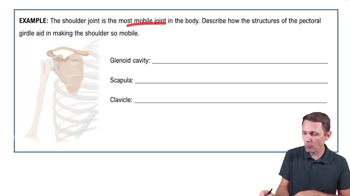
The pectoral girdle consists of one clavicle and one scapula on each side, connecting the arm to the trunk.
What is the function of the pectoral girdle?
It connects each arm to the trunk and provides a basis for arm movement, offering high mobility but less strength.
Describe the clavicle and its key features.
The clavicle is an S-shaped bone with a sternal end articulating with the manubrium and an acromial end articulating with the scapula. It has the conoid tubercle and costal tuberosity for muscle and ligament attachment.
What is the scapula and its main borders?
The scapula is a flat, triangular bone with superior, medial (vertebral), and lateral (axillary) borders.
Name the three angles of the scapula.
Superior angle, inferior angle, and lateral angle.
What is the glenoid cavity of the scapula?
A cup-shaped surface at the lateral angle that articulates with the humerus to form the shoulder joint.
What are the scapular processes and their functions?
The coracoid process (smaller, anterior) and acromion (larger, posterior) provide attachment points for ligaments and tendons; the acromion articulates with the clavicle.
What is the spine of the scapula?
A ridge on the posterior surface dividing it into the supraspinous fossa (above) and infraspinous fossa (below).
What bones make up the upper limb?
The upper limb includes the humerus (arm), radius and ulna (forearm), carpals (wrist), metacarpals (hand), and phalanges (fingers).
Describe the humerus and its key features.
A long bone with a head articulating with the scapula, greater and lesser tubercles for muscle attachment, anatomical and surgical necks, and a shaft with the deltoid tuberosity.
What is the significance of the surgical neck of the humerus?
It corresponds to the metaphysis of the growing bone and is a common site of fractures.
What are the medial and lateral epicondyles of the humerus?
Side projections on the distal shaft; the medial epicondyle is known as the 'funny bone'.
What bones form the forearm?
The forearm consists of two long bones: the ulna (medial) and the radius (lateral).
What is the interosseous membrane?
A fibrous sheet connecting the lateral margin of the ulna to the radius, stabilizing the forearm bones.
Describe the olecranon of the ulna.
The proximal end forming the point of the elbow, fitting into the olecranon fossa of the humerus during extension.
What is the trochlear notch of the ulna?
A U-shaped notch that articulates with the trochlea of the humerus, formed by the olecranon and coronoid process.
Describe the head of the radius and its articulation.
The disc-shaped proximal end articulates with the capitulum of the humerus and fits into the radial fossa during elbow flexion.
How many carpal bones are in the wrist and how are they arranged?
There are eight carpal bones arranged in two rows: four proximal and four distal bones.
Name the proximal carpal bones.
Scaphoid, lunate, triquetrum, and pisiform.
Name the distal carpal bones.
Trapezium, trapezoid, capitate, and hamate.
What bones make up the pelvic girdle?
Two hip bones (coxal bones), each formed by the fusion of the ilium, ischium, and pubis.
What is the acetabulum?
A socket on the lateral surface of the hip bone where the ilium, ischium, and pubis meet; articulates with the femur head.
What is the obturator foramen?
A large opening encircled by the ischial and pubic rami, closed by collagen fibers for muscle attachment.
Ischial spine, ischial tuberosity, lesser sciatic notch, and ischial ramus.
What are the key features of the pubis?
Superior and inferior pubic rami, pubic symphysis.
What bones form the lower limb?
Femur, patella, tibia, fibula, tarsal bones, metatarsals, and phalanges.
Describe the femur and its important landmarks.
The longest bone with a head articulating with the hip, greater and lesser trochanters for muscle attachment, linea aspera, and medial/lateral condyles for knee articulation.
What is the patella and its function?
A sesamoid bone within the quadriceps tendon that protects the knee joint and improves leverage.
Describe the tibia and its key features.
The large medial bone of the leg with medial and lateral condyles, tibial tuberosity, anterior margin, and medial malleolus.
Describe the fibula and its function.
A smaller lateral bone that stabilizes the ankle and serves as muscle attachment; it does not articulate with the femur.
What bones make up the ankle (tarsus)?
Seven tarsal bones: talus, calcaneus, cuboid, navicular, and three cuneiform bones (medial, intermediate, lateral).
What are the arches of the foot and their function?
Longitudinal and transverse arches transfer weight and are maintained by ligaments and tendons.
What are the sex differences in the pelvis?
Female pelvis is broader, smoother, lighter with a wider pelvic outlet and pubic angle ≥100°; male pelvis is narrower, rougher, more robust with a pubic angle ≤90°.
 Indietro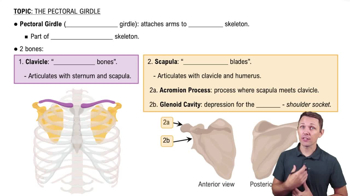
 6:23
6:23