Indietro

Appendicular Skeleton - Anatomy & Physiology

I pulsanti di controllo sono stati cambiati in modalità "navigazione".
1/20
  • What type of bones are the clavicles?

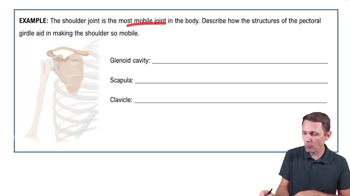
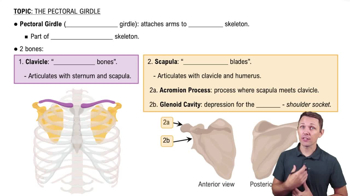
    long bones that articulate with the sternum and scapula.

  • What are the scapulae commonly called?

    shoulder blades and articulate with the clavicle and humerus.

  • What is the function of the glenoid cavity?

    depression in the scapula that forms the shoulder socket for the humerus.

  • What is the pectoral girdle and its function?

    The pectoral girdle attaches the arms to the axial skeleton and consists of two bones: the clavicle and scapula.
  • Which bone does the medial end of the clavicle articulate with?

    The medial end of the clavicle articulates with the sternum.
  • Which bone articulates with the glenoid cavity of the scapula?

    The humerus articulates with the glenoid cavity of the scapula.
  • What are the two bones of the forearm and their relative positions?

    The forearm contains the radius (lateral, same side as thumb) and the ulna (medial, forms a 'U' with the humerus).
  • Which forearm bone is most commonly fractured and why?

    The radius is most commonly fractured because it is larger at the wrist and absorbs more force during falls.
  • What are the three groups of bones in the hand?

    The hand consists of carpals (wrist bones), metacarpals (palm bones), and phalanges (finger bones).
  • How many phalanges does each finger have, and how is the thumb different?

    Each finger has three phalanges: proximal, middle, and distal. The thumb has only two: proximal and distal.
  • What bones make up the pelvic girdle?

    The pelvic girdle is made of two coxal bones, each formed by the fusion of the ilium, ischium, and pubis.
  • What is the acetabulum and which bones contribute to it?

    The acetabulum is the hip socket formed by the ilium, ischium, and pubis bones.
  • What is the function of the pubic symphysis?

    The pubic symphysis is a cartilaginous joint that connects the right and left pubic bones.
  • How does the pelvic girdle differ from the pectoral girdle in terms of articulation and mobility?

    The pelvic girdle has a larger articulation with the axial skeleton and a deeper socket, allowing less mobility but more stability than the pectoral girdle.
  • What are the general differences between male and female pelvises?

    Male pelvises are narrower and heavier with a more acute pubic arch angle; female pelvises are wider, lighter, and adapted for childbirth with a wider pubic arch.
  • What are the four main bones of the lower limb?

    The lower limb includes the femur (thigh), patella (kneecap), tibia (larger shin bone), and fibula (smaller lateral bone).
  • Which bone is known as the shin bone and contributes to the knee joint?

    The tibia is the larger, medial bone of the leg and contributes to the knee joint.
  • What bones make up the ankle and foot?

    The ankle and foot are made of tarsals (ankle bones), metatarsals (foot bones), and phalanges (toe bones).
  • What is the difference between the talus and calcaneus bones?

    The talus articulates with the tibia and forms the ankle joint; the calcaneus is the heel bone and largest tarsal.
  • How many phalanges are in the toes, and how does the big toe differ?

    There are 14 phalanges in the toes; each toe has proximal, middle, and distal phalanges except the big toe, which lacks a middle phalanx.