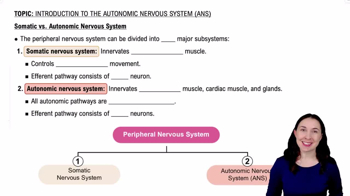
Difference in sensory input between somatic and autonomic nervous systems
Somatic sensory neurons receive input from special senses, general somatic senses, and proprioceptors. Autonomic sensory neurons receive input from special senses, general visceral senses, and general somatic senses.
Control of somatic vs autonomic nervous systems
The somatic nervous system operates under conscious control, while the autonomic nervous system (ANS) operates without conscious control.
Motor neuron pathways in somatic vs autonomic nervous systems
Somatic motor neurons extend directly from CNS to effector and release acetylcholine. ANS pathways have two motor neurons: preganglionic (releases acetylcholine) and postganglionic (releases acetylcholine or norepinephrine).
Effectors of somatic vs autonomic nervous systems
Somatic nervous system effectors are skeletal muscles. ANS effectors include cardiac muscle, smooth muscle, and glands.
Response to neurotransmitters in somatic vs autonomic nervous systems
Somatic nervous system responses are always excitatory. ANS responses can be excitatory or inhibitory.
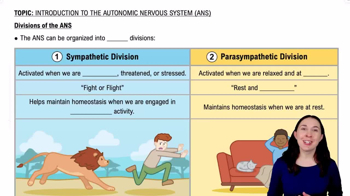
Two principal divisions of the autonomic nervous system
The ANS is divided into the sympathetic and parasympathetic divisions.
Definition of dual innervation
Organs receiving impulses from both sympathetic and parasympathetic fibers have dual innervation.
Characteristics of preganglionic and postganglionic neurons
Preganglionic neurons are myelinated; postganglionic neurons are unmyelinated.
Location of preganglionic neuron cell bodies in sympathetic division
Sympathetic preganglionic neuron cell bodies are in the lateral gray horns of the 12 thoracic and first 2-3 lumbar spinal cord segments (thoracolumbar outflow).
Location of preganglionic neuron cell bodies in parasympathetic division
Parasympathetic preganglionic neuron cell bodies are in cranial nerve nuclei (III, VII, IX, X) and lateral gray horns of the 2nd to 4th sacral spinal cord segments (craniosacral outflow).
Types of autonomic ganglia
Sympathetic trunk (paravertebral) ganglia, prevertebral (collateral) ganglia, and parasympathetic terminal ganglia near or inside visceral effectors.
Where do sympathetic preganglionic neurons synapse?
Sympathetic preganglionic neurons synapse with postganglionic neurons in sympathetic trunk or prevertebral ganglia.
Where do parasympathetic preganglionic neurons synapse?
Parasympathetic preganglionic neurons synapse with postganglionic neurons in terminal ganglia near or inside the effector.
 Indietro
 1:10