Indietro

Axial Skeleton Anatomy & Physiology

I pulsanti di controllo sono stati cambiati in modalità "navigazione".
1/24
  • What components make up the skeleton?

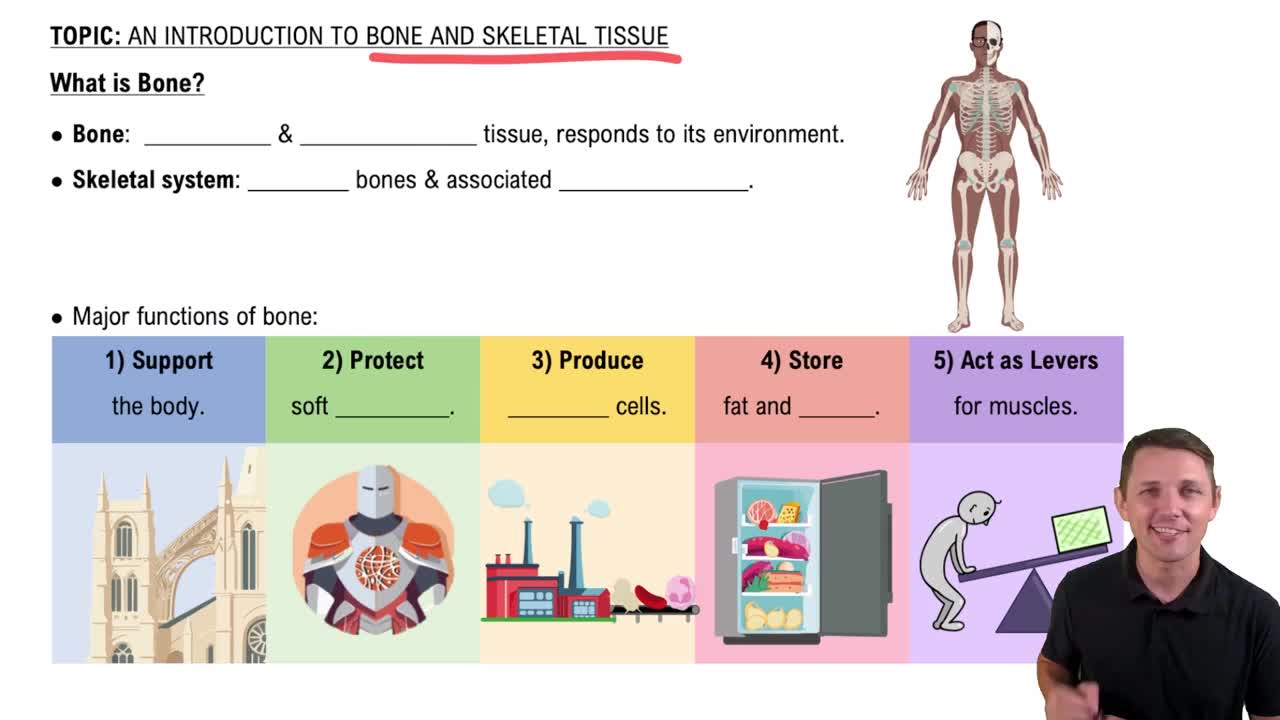
    The skeleton consists of bones, cartilage, joints (articulations), and ligaments.
  • How many bones are in the axial skeleton and what does it include?

    The axial skeleton has 80 bones including the skull, vertebral column, and thoracic cage; it protects the CNS and organs of the head and trunk.
  • What is the main functional difference between the axial and appendicular skeleton?

    The axial skeleton is for protection and support of midline structures, while the appendicular skeleton is for movement.
  • Name the two functional groups of skull bones and their functions.

    Cranial bones enclose and protect the brain and provide muscle attachment; facial bones frame the face, form cavities for senses, and anchor teeth and muscles.
  • List the 8 cranial bones.

    Paired: Temporal, Parietal; Unpaired: Frontal, Occipital, Sphenoid, Ethmoid.
  • What are the four cranial sutures and their locations?

    Coronal: frontal to parietal; Squamous: parietal to temporal; Sagittal: between parietals; Lambdoid: parietal to occipital.
  • What is the significance of the foramen magnum?

    It is the opening in the occipital bone through which the spinal cord passes.
  • Why is the sphenoid bone called the 'keystone' of the cranium?

    Because it spans the width of the cranial floor and articulates with all other cranial bones, providing central support.
  • Name the five important openings of the sphenoid bone.

    Optic canal, superior orbital fissure, foramen rotundum, foramen ovale, and foramen spinosum.
  • What is unique about the mandible among facial bones?

    It is the largest, strongest facial bone and the only movable skull bone.
  • Why are the maxillae called the 'keystone bones of the face'?

    Because they articulate with every facial bone except the mandible and contain the largest paranasal sinuses.
  • What are paranasal sinuses and where are they located?

    Air-filled, mucous-lined spaces that lighten the skull; located in the frontal, ethmoid, sphenoid, and maxillary bones.
  • What is special about the hyoid bone?

    It is the only bone with no direct articulation to other bones, suspended by ligaments and muscles; supports the tongue.
  • How many vertebrae are in the adult vertebral column and what are its functions?

    There are 26 bones in adults; functions include transmitting body weight, protecting the spinal cord, and muscle attachment.
  • Name the five regions of the vertebral column and their vertebra counts.

    Cervical (7), Thoracic (12), Lumbar (5), Sacral (5 fused), Coccygeal (3–5 fused).
  • What are the two main parts of an intervertebral disc?

    The nucleus pulposus (gelatinous core) and the anulus fibrosus (fibrous outer ring).
  • What features are common to all vertebrae?

    Body, vertebral arch, spinous process, transverse processes, superior and inferior articular processes, and intervertebral foramina.
  • What unique feature do cervical vertebrae have?

    They have transverse foramina for vertebral arteries and a generally large vertebral foramen.
  • What is the function of the atlas (C1) vertebra?

    It has no body or spinous process and allows yes nodding by articulating with occipital condyles.
  • What is the dens (odontoid process) and which vertebra has it?

    A peg-like projection on the axis (C2) that acts as a pivot for head rotation ('no' movement).
  • How are ribs classified and what defines each type?

    True ribs (1–7) attach directly to sternum; false ribs (8–10) attach indirectly; floating ribs (11–12) have no sternal attachment.
  • What are the three parts of the sternum?

    Manubrium (superior), body (middle), and xiphoid process (inferior tip).
  • What is the sacral promontory and its clinical significance?

    The anterior bulge of S1 into the pelvic cavity; an important obstetric landmark.
  • What are fontanelles and why are they important in newborns?

    Unossified membrane areas in the infant skull that allow flexibility during birth and brain growth.