Skip to main content
Anatomy & Physiology
Il mio corso
Impara
Preparazione agli esami
AI Tutor
Guide di studio
Soluzioni per libri di testo
Flashcard
Esplora
Prova l'app
Il mio corso
Impara
Preparazione agli esami
AI Tutor
Guide di studio
Soluzioni per libri di testo
Flashcard
Esplora
Prova l'app
Indietro
Biomolecules in Anatomy & Physiology
Puoi toccare per girare la carta.
What are the four important classes of biological molecules?
Puoi toccare per girare la carta.
👆
What are the four important classes of biological molecules?
Carbohydrates, proteins, nucleic acids, and lipids
.
Avanzamenti del tracciato
I pulsanti di controllo sono stati cambiati in modalità "navigazione".
1/20
Video consigliati
VideoThumbView.guidedCourse
03:35
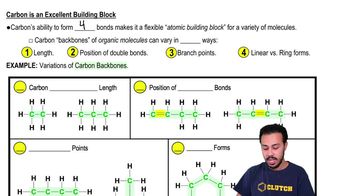
Carbon is an Excellent Building Block
23180
views
916
rank
VideoThumbView.guidedCourse
04:19
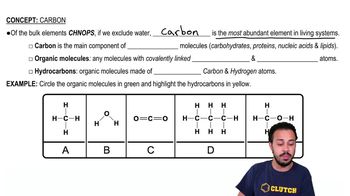
Carbon
30494
views
719
rank
1
comments
Termini in questo insieme (20)
Nascondere definizioni
What are the four important classes of biological molecules?
Carbohydrates, proteins, nucleic acids, and lipids
.
What is the structural basis of biological molecules?
Carbon forms the skeletons of biological molecules by bonding with hydrogen, oxygen, nitrogen, and other atoms.
How do carbon skeletons vary?
They vary in
length, branching, double bond position, and presence of rings
.
What are hydrocarbons?
Organic molecules consisting only of
carbon and hydrogen
, often found in fats and can release large energy.
What is dehydration synthesis?
A reaction where two monomers bond by
removal of a water molecule
.
What is hydrolysis?
The breakdown of polymers into monomers by
adding a water molecule
.
What are carbohydrates composed of?
They contain
carbon, hydrogen, and oxygen
with hydrogen and oxygen in a 2:1 ratio.
What are the three classes of carbohydrates?
Monosaccharides (single sugars), disaccharides (two sugars), and polysaccharides (many sugars)
.
What is the general formula for monosaccharides?
CH2O (n)
, where n is the number of carbon atoms.
Name important monosaccharides.
Ribose, deoxyribose (pentose sugars), and glucose (hexose sugar)
.
What are disaccharides?
Double sugars formed by
dehydration synthesis of two monosaccharides
, e.g., sucrose, maltose, lactose.
What are polysaccharides?
Polymers of monosaccharides formed by
dehydration synthesis
, e.g., starch (plants) and glycogen (animals).
What are lipids?
Hydrophobic molecules mostly made of hydrocarbons, including
fats, phospholipids, and steroids
.
What are triglycerides composed of?
Three fatty acids bonded to a glycerol molecule by
dehydration synthesis
.
Difference between saturated and unsaturated fatty acids?
Saturated have
single bonds
and pack tightly (solid at room temp); unsaturated have
double bonds
causing kinks (liquid at room temp).
What are phospholipids?
Modified triglycerides with two fatty acids and a phosphorus-containing group; have
hydrophilic heads and hydrophobic tails
.
Why are phospholipids important?
They form the
bilayer structure of cell membranes
.
What is the structure of steroids?
Consist of
four interlocking hydrocarbon rings
.
What is the most important steroid?
Cholesterol
, which is a precursor for vitamin D, steroid hormones, and bile salts.
How do dehydration synthesis and hydrolysis relate?
Dehydration synthesis
builds polymers
by removing water; hydrolysis
breaks polymers
by adding water.
 IndietroIndietro
 03:35