Skip to main content
Anatomy & Physiology
Il mio corso
Impara
Preparazione agli esami
AI Tutor
Guide di studio
Soluzioni per libri di testo
Flashcard
Esplora
Prova l'app
Il mio corso
Impara
Preparazione agli esami
AI Tutor
Guide di studio
Soluzioni per libri di testo
Flashcard
Esplora
Prova l'app
Indietro
Blood: Anatomy & Physiology Key Concepts
Puoi toccare per girare la carta.
Five major functions of blood
Puoi toccare per girare la carta.
👆
Five major functions of blood
Transport substances
,
regulate pH and ions
,
restrict fluid loss
,
defend against pathogens and toxins
, and
stabilize body temperature
.
Avanzamenti del tracciato
I pulsanti di controllo sono stati cambiati in modalità "navigazione".
1/35
Video consigliati
VideoThumbView.guidedCourse
2:36
Introduction to Blood Example 1
10901
views
327
rank
VideoThumbView.guidedCourse
7:49
Composition of Blood
11501
views
330
rank
VideoThumbView.guidedCourse
1:55
Introduction to Blood Example 2
9023
views
219
rank
Termini in questo insieme (35)
Nascondere definizioni
Five major functions of blood
Transport substances
,
regulate pH and ions
,
restrict fluid loss
,
defend against pathogens and toxins
, and
stabilize body temperature
.
Substances transported by blood
Oxygen, carbon dioxide, nutrients, hormones, and metabolic wastes.
How blood restricts fluid loss after injury
Blood initiates
clotting
, forming a temporary patch to prevent further blood loss.
How blood defends the body
White blood cells fight infections and remove debris; antibodies attack invading pathogens.
How blood helps regulate body temperature
Blood absorbs and redistributes heat throughout the body.
Normal temperature of blood
About
38°C
or
100.4°F
.
Viscosity of blood compared to water
Blood is about
five times as viscous
as water.
Definition of viscosity
Resistance to flow
.
Normal pH range of blood
Between
7.35 and 7.45
, making blood slightly alkaline.
Approximate percentage of body weight that is blood
About
7%
of body weight in kilograms.
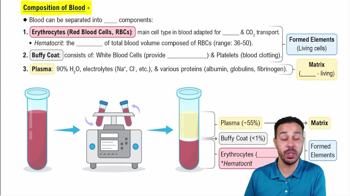
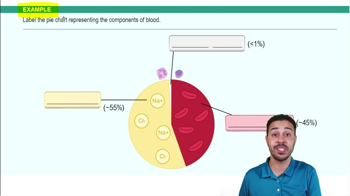
Two major components of whole blood
Plasma
and
formed elements
.
What is plasma?
The
fluid matrix
of blood.
Approximate percentage of plasma in whole blood
About
55%
(range 46–63%).
What are formed elements?
Blood cells and cell fragments suspended in plasma.
Three types of formed elements
Red blood cells
,
white blood cells
, and
platelets
.
Approximate percentage of formed elements in whole blood
About
45%
(range 37–54%).
Three major types of plasma proteins
Albumins
,
globulins
, and
fibrinogen
.
Most abundant plasma protein
Albumin
.
Major functions of albumin
Maintains plasma
osmolarity
and
osmotic pressure
, transports fatty acids and hormones.
Function of globulins
Help with
defense
and
transport
; some are antibodies.
Function of fibrinogen
Involved in
blood clotting
.
Where are most plasma proteins produced?
The
liver
synthesizes and releases over 90% of plasma proteins.
Why can liver disease cause abnormal bleeding?
It reduces production of
fibrinogen
and other clotting proteins.
What is serum?
Fluid remaining after clotting removes clotting proteins from plasma.
What is hematopoiesis?
The process producing the formed elements of blood; also called hemopoiesis.
Two stem cell populations producing formed elements
Myeloid
and
lymphoid
stem cells.
What is hematocrit?
Percentage of
red blood cells
in a blood sample.
What is packed cell volume (PCV)?
Percentage of
all formed elements
in a blood sample.
Difference between hematocrit and PCV
Hematocrit measures red blood cells; PCV measures all formed elements.
Main function of red blood cells
Transporting
oxygen
in the blood.
Another name for white blood cells
Leukocytes
.
Main function of white blood cells
Defense of the body.
Number of leukocyte classes
Five.
What are platelets?
Small membrane-bound
cell fragments
.
Major function of platelets
Contain enzymes and substances important for
blood clotting
.
 IndietroIndietro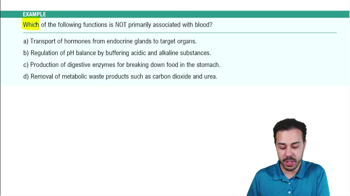
 2:36
2:36