Skip to main content
Anatomy & Physiology
Il mio corso
Impara
Preparazione agli esami
AI Tutor
Guide di studio
Soluzioni per libri di testo
Flashcard
Esplora
Prova l'app
Il mio corso
Impara
Preparazione agli esami
AI Tutor
Guide di studio
Soluzioni per libri di testo
Flashcard
Esplora
Prova l'app
Indietro
Blood Composition and Blood Typing in Anatomy & Physiology
Puoi toccare per girare la carta.
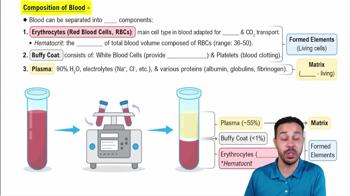
What are the main components of whole blood?
Puoi toccare per girare la carta.
👆
What are the main components of whole blood?
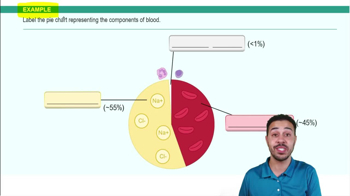
Plasma
(46–63%) and
formed elements
(37–54%), which include red blood cells, white blood cells, and platelets.
Avanzamenti del tracciato
I pulsanti di controllo sono stati cambiati in modalità "navigazione".
1/20
Video consigliati
VideoThumbView.guidedCourse
2:36
Introduction to Blood Example 1
11387
views
334
rank
VideoThumbView.guidedCourse
7:49
Composition of Blood
11929
views
337
rank
VideoThumbView.guidedCourse
1:55
Introduction to Blood Example 2
9397
views
225
rank
Termini in questo insieme (20)
Nascondere definizioni
What are the main components of whole blood?
Plasma
(46–63%) and
formed elements
(37–54%), which include red blood cells, white blood cells, and platelets.
What is the composition of plasma?
Plasma is about 92% water, 7% plasma proteins, and 1% other solutes.
What percentage of whole blood do red blood cells (RBCs) make up?
Red blood cells make up approximately 99.9% of the formed elements in blood.
Describe the shape and size of a mature red blood cell.
RBCs are biconcave discs about 7.2–8.4 µm in diameter, 2.31–2.85 µm wide, and 0.45–1.16 µm thick.
Why do RBCs appear two-dimensional in a blood smear?
Because they are flattened against the surface of the slide, making them appear as thin, two-dimensional objects.
Name the five types of white blood cells (WBCs).
Neutrophils, eosinophils, basophils, monocytes, and lymphocytes.
Which WBCs are classified as granular leukocytes?
Neutrophils, eosinophils, and basophils.
Which WBCs are classified as agranular leukocytes?
Monocytes and lymphocytes.
What is the typical percentage range of neutrophils in blood?
Neutrophils typically make up 50–70% of white blood cells.
What is the function of platelets in blood?
Platelets are involved in blood clotting and help prevent bleeding.
What determines a person's blood type?
The presence or absence of surface antigens (agglutinogens) A and B on red blood cells.
What antibodies are present in the plasma of Type A blood?
Anti-B antibodies, which attack Type B surface antigens.
What antibodies are present in the plasma of Type B blood?
Anti-A antibodies, which attack Type A surface antigens.
What antibodies are present in the plasma of Type AB blood?
Neither anti-A nor anti-B antibodies are present.
What antibodies are present in the plasma of Type O blood?
Both anti-A and anti-B antibodies are present.
What is the Rh factor in blood typing?
A surface antigen (D antigen) that can be either present (+) or absent (–), affecting blood compatibility.
How is hemoglobin concentration in blood measured?
Using a hemoglobinometer, which compares color density of a hemolyzed blood sample to a standard scale.
What is the significance of blood typing and cross-reactions?
To ensure compatibility for blood transfusions and prevent immune reactions against foreign antigens.
What is the typical size range of platelets?
Platelets are less than 0.1% of formed elements and are much smaller than red blood cells, typically 2–4 µm in diameter.
What is the role of white blood cells in blood?
White blood cells defend the body against infection and remove debris.
 IndietroIndietro
 2:36