Skip to main content
Anatomy & Physiology
Il mio corso
Impara
Preparazione agli esami
AI Tutor
Guide di studio
Soluzioni per libri di testo
Flashcard
Esplora
Prova l'app
Il mio corso
Impara
Preparazione agli esami
AI Tutor
Guide di studio
Soluzioni per libri di testo
Flashcard
Esplora
Prova l'app
Indietro
Blood Vessels and Cardiovascular System Anatomy
Puoi toccare per girare la carta.
Name the three tunics of a blood vessel wall.
Puoi toccare per girare la carta.
👆
Name the three tunics of a blood vessel wall.
Tunica interna (intima)
,
tunica media
, and
tunica externa
.
Avanzamenti del tracciato
I pulsanti di controllo sono stati cambiati in modalità "navigazione".
1/25
Video consigliati
VideoThumbView.guidedCourse
3:38
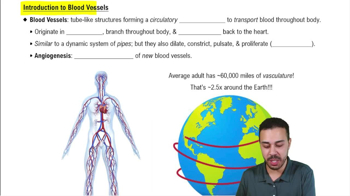
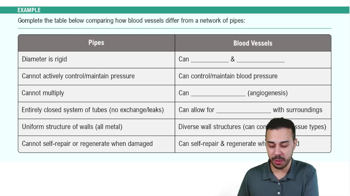
Introduction to Blood Vessels Example 1
6833
views
137
rank
VideoThumbView.guidedCourse
4:59
Blood Vessels
9809
views
219
rank
2
comments
VideoThumbView.guidedCourse
2:04
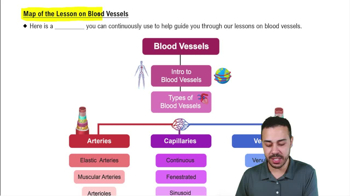
Map of the Lesson on Blood Vessels
7015
views
219
rank
1
comments
Termini in questo insieme (25)
Nascondere definizioni
Name the three tunics of a blood vessel wall.
Tunica interna (intima)
,
tunica media
, and
tunica externa
.
What are the main components of the tunica interna in arteries?
Endothelial cells, basal lamina, and internal elastic lamina.
What distinguishes the tunica media in arteries?
Contains smooth muscle and an external elastic lamina.
What is the function of the vasa vasorum in blood vessels?
Vasa vasorum
are small blood vessels in the tunica externa that supply the walls of large blood vessels.
How do veins differ from arteries in their tunica media?
Veins have a thinner tunica media with less smooth muscle compared to arteries.
What structural feature is unique to veins but not arteries?
Veins have valves to prevent backflow of blood.
What is a varicose vein?
A vein with damaged valves causing blood pooling and vein enlargement.
List three major arteries branching from the aortic arch in humans.
Brachiocephalic artery, left common carotid artery, and left subclavian artery.
Name two arteries that supply blood to the brain as part of the Circle of Willis.
Anterior cerebral artery and middle cerebral artery.
What is the difference between systolic and diastolic blood pressure?
Systolic is pressure during heart contraction; diastolic is pressure during heart relaxation.
What instrument is used to measure blood pressure?
A
sphygmomanometer
.
What are the sounds of Korotkoff?
Sounds heard through a stethoscope when measuring blood pressure indicating blood flow changes.
How do you calculate pulse pressure?
Pulse pressure = systolic pressure minus diastolic pressure.
Name two common pulse palpation sites on the upper limb.
Radial artery and brachial artery.
What is the main difference in branching of the aortic arch between humans and cats?
Cats have only two branches: brachiocephalic and left subclavian; humans have three.
Name the three main branches of the cat's aortic arch.
Brachiocephalic artery and left subclavian artery only (no common carotid branch).
Which veins drain blood into the superior vena cava?
Right and left brachiocephalic veins, subclavian veins, and internal jugular veins.
What is the function of the internal elastic lamina in arteries?
Provides elasticity and separates the tunica interna from the tunica media.
Identify the layers visible in a capillary wall.
Only the tunica interna (endothelium and basal lamina).
Name two arteries supplying the upper limb.
Axillary artery and brachial artery.
What is the role of the pulmonary trunk?
Carries deoxygenated blood from the right ventricle to the lungs.
Which artery supplies blood to the stomach?
The left gastric artery.
What is the significance of the hepatic portal vein?
It carries nutrient-rich blood from the digestive organs to the liver.
Name the three main veins draining the lower limb.
Femoral vein, great saphenous vein, and popliteal vein.
What is the normal range for adult human blood pressure?
Approximately 120/80 mmHg (systolic/diastolic).
 IndietroIndietro
 3:38