 Indietro
Bone Tissue & Bone Structure - Anatomy & Physiology
 3:56

Termini in questo insieme (61)
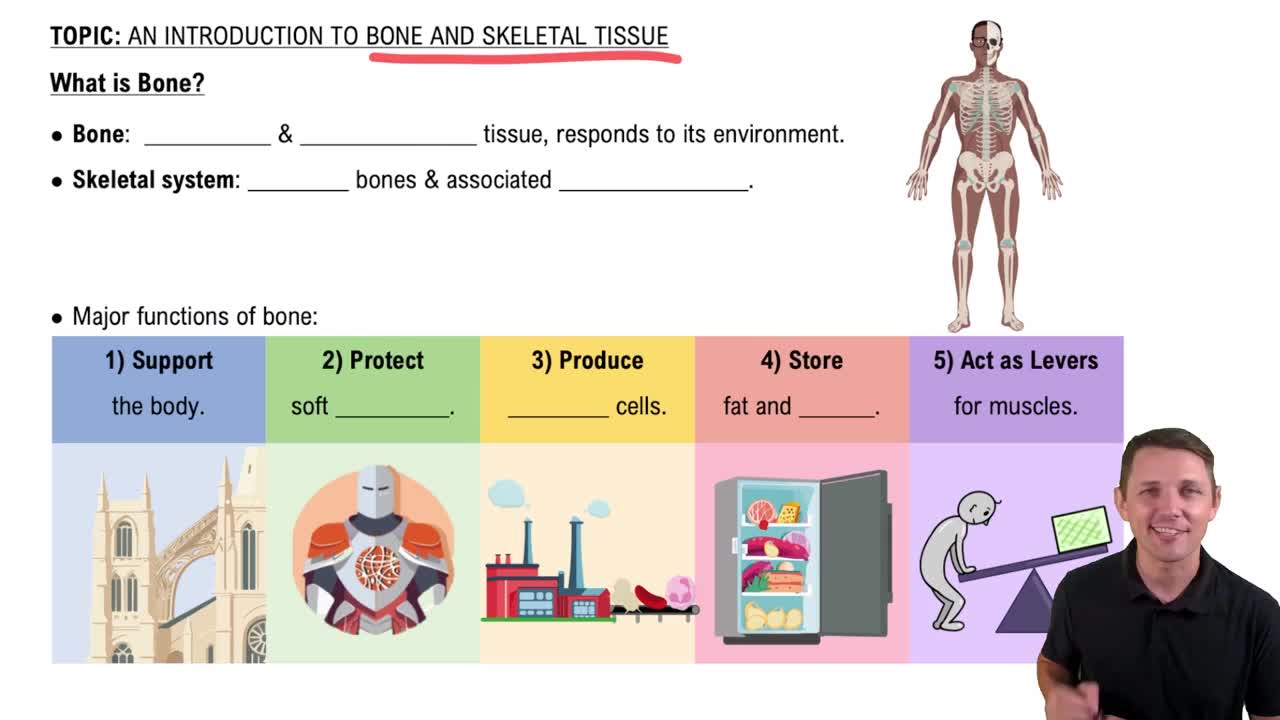
Support, protection, movement, mineral storage, blood cell production, and energy storage.
Collagen fibers for flexibility
Calcium phosphate for strength.
Bone forms directly from mesenchymal tissue, mainly in flat bones like the skull.
Bone develops by replacing hyaline cartilage, typical in long bones.
Epiphyseal plate
Growing (Children)
Epiphyseal line
End of growth
Increases blood calcium
Stimulating osteoclasts to break down bone
Lowers blood calcium
Inhibiting osteoclast activity
Open fracture
Breaks the skin.
Closed fracture
Does not break the skin
Hematoma formation, fibrocartilaginous callus formation, bony callus formation, and bone remodeling.
A condition of reduced bone mass (pre-osteoporosis)
Severe bone loss leading to fragile bones and increased fracture risk.
BLAST
Builds bone → Osteoblast.
CYTE
Mature/Maintains bone → Osteocyte.
CLAST
Breaks down bone → Osteoclast.
Epi-
Ends
Dia-
Shaft
Peri-
Around
Endo-
Inside, within
Epithelial Line
Finished growing
Epithelial Plate
Growing - Hyaline Cartilage until adulthood
Compact bone
Compact bone is dense and forms the outer layer.
Spongy bone
Spongy bone is porous, found inside bones, and contains red marrow.
Includes the epiphysis (ends), diaphysis (shaft), periosteum (outer covering), medullary cavity (inside shaft), and articular cartilage (covers ends).
Epiphysis
Ends of long bone
Diaphysis
Shaft of long bone
Periosteum
Covers outer surface of bone
Periosteum - Osteogenic layer
Cells for bone formation or bone break down
Periosteum - Fibrous layer
DENSE IRREGULAR Connective Tissue, for the attachment of muscle tendons to bone
Endosteum
Inner marrow lining
Articular Cartilage
Cartilage on the outer surface of the epiphysis, where the bone forms a joint with another bone
Osteon
Basic unit of compact bone
Scattered cells
Osteocyte in lacunae
Matrix
Calcium salt & Collagen fibers
Ground Substance
Calcium phosphate and Calcium carbonate
Without calcium, bones would be
Rubbery
Without collagen, bones would be
Brittle
Calcium makes the bones
Strong
Collagen makes the bone
Flexible
Osteoprogenitor Cells are found where
Endosteum and periosteum
Mesenchymal stem cells -> osteoprogenitor cells -> osteoblasts
Osteoblasts
Build bone
Osteocytes
Maintain bone, mature bone cells
Osteoclasts
Break down bone
Osteoblasts trapped in lacuna become what
Osteocytes
Osteogenesis
Bone formation
Ossification
The process of replacing other tissues with bone
Calcification
The process of depositing calcium salts
Forms of ossification
Intramembranous ossification
Endochondral ossification
Intramembranous Ossification
Mesenchymal or fibrouse connective tissue
Endochondral Ossification
Ossifies bones that originate as hyaline cartilage
Calcium homeostasis is maintained with
the Calcitonin and Parathyroid hormone
Parathyroid Hormone (PTH)
Increases blood calcium
Stimulating osteoclasts activity
Calcitonin
Decreases calcium ion levels in blood by
Inhibiting osteoclasts activity
Greenstick fracture
One side of shaft breaks the other side bends
Common in children
Hematoma formation
Torn blood vessels
hemorrhage
A mass of clotted blood
(hematoma) forms at the
fracture site
Site becomes swollen,
painful, and inflamed
Cartilage callus forms (soft callus)
Fibrocartilage(soft callus)
Osteoblasts and fibroblasts
migrate to the fracture
Fibroblasts secrete collagen
fibers that connect broken
bone ends
Osteoblasts begin forming
spongy bone
Spongy Bone callus formation
New bone trabeculae appear in the soft callus
Soft callus converts into a bony (hard callus)
Remodeling: Compact Bone formation
Compact bone is laid down to reconstruct shaft walls
Skin layers acronym (deep to superficial)
Bad (deep)
Sex
Gets
Less
Calls (superficial)
Skin layers (deep to superficial)
Stratum basale
Stratum spinosm
Stratum grandulosum
Stratum lucidum (thick skin)
Stratum corneum