Skip to main content
Anatomy & Physiology
Il mio corso
Impara
Preparazione agli esami
AI Tutor
Guide di studio
Soluzioni per libri di testo
Flashcard
Esplora
Prova l'app
Il mio corso
Impara
Preparazione agli esami
AI Tutor
Guide di studio
Soluzioni per libri di testo
Flashcard
Esplora
Prova l'app
Indietro
Bones of the External Skull and Face
Puoi toccare per girare la carta.
Frontal bone
Puoi toccare per girare la carta.
👆
Frontal bone
The bone forming the forehead and the upper part of the eye sockets.
Avanzamenti del tracciato
I pulsanti di controllo sono stati cambiati in modalità "navigazione".
1/26
Video consigliati
2:12
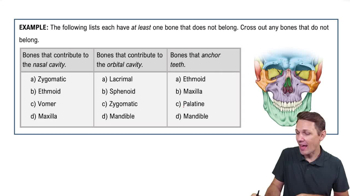
The Skull Example 1
12204
views
282
rank
4:42
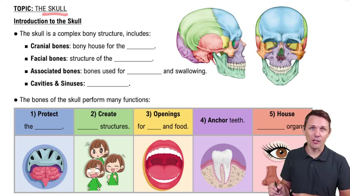
Introduction to the Skull
21690
views
513
rank
3:40
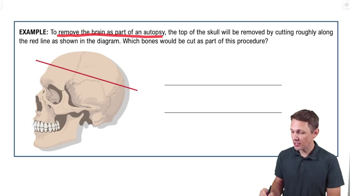
The Skull Example 3
8858
views
172
rank
Termini in questo insieme (26)
Nascondere definizioni
Frontal bone
The bone forming the forehead and the upper part of the eye sockets.
Parietal bone
Paired bones forming the sides and roof of the cranial cavity.
Occipital bone
Bone forming the back and base of the skull, containing the foramen magnum.
Temporal bone
Bone located at the sides and base of the skull, housing structures of the ear.
Nasal bone
Small paired bones forming the bridge of the nose.
Maxilla
Upper jaw bone that holds the upper teeth and forms part of the nose and eye sockets.
Lacrimal bone
Small bone forming part of the medial wall of the orbit, near the tear ducts.
Zygomatic bone
Cheekbone that forms the prominence of the cheeks and part of the orbit.
Zygomatic arch
Arch formed by the zygomatic bone and temporal bone, creating the cheek prominence.
Palatine bone & process
Bones forming the posterior part of the hard palate and part of the nasal cavity.
Vomer
Thin, flat bone forming the inferior part of the nasal septum.
Inferior nasal concha
Curved bone inside the nasal cavity that helps filter and humidify air.
Mandible
Lower jaw bone that holds the lower teeth and forms the chin.
Supraorbital foramen
Opening above the orbit allowing passage of nerves and blood vessels.
Infraorbital foramen
Opening below the orbit for nerves and vessels to the face.
Optic foramen (canal)
Opening in the sphenoid bone allowing the optic nerve to pass to the eye.
Superior orbital fissure
Slit-like opening in the orbit transmitting nerves and vessels to the eye.
Mental foramen
Opening on the anterior surface of the mandible for nerves and vessels.
Occipital condyle
Rounded projections on the occipital bone that articulate with the first cervical vertebra.
Mastoid process
Prominent bony projection of the temporal bone behind the ear for muscle attachment.
Foramen magnum
Large opening in the occipital bone allowing passage of the spinal cord.
Styloid process
Slender pointed projection of the temporal bone serving as an attachment for muscles and ligaments.
Coronal suture
Suture between the frontal and parietal bones.
Sagittal suture
Suture between the two parietal bones along the midline of the skull.
Squamous suture
Suture between the temporal and parietal bones on the side of the skull.
Lambdoidal suture
Suture between the occipital and parietal bones at the back of the skull.
 IndietroIndietro
 2:12