Indietro

Brain Anatomy and Functions - Anatomy & Physiology

I pulsanti di controllo sono stati cambiati in modalità "navigazione".
1/29
  • Cerebrum

    The largest brain part responsible for higher mental functions like conscious thought, intellect, and memory. It has left and right hemispheres.
  • Cerebellum

    Coordinates repetitive body movements and maintains balance and posture.
  • Diencephalon

    Contains the thalamus and hypothalamus; involved in sensory relay, emotions, autonomic functions, and hormone production.
  • Brainstem

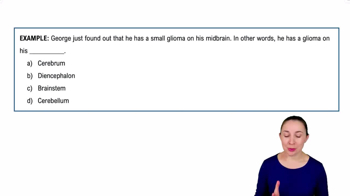
    Relays information between spinal cord and brain; includes midbrain, pons, and medulla oblongata.
  • Gyri

    Rounded elevations on the cerebrum that increase surface area.
  • Sulci

    Shallow depressions separating gyri on the cerebrum.
  • Fissures

    Deep grooves dividing major brain regions.
  • Primary brain vesicles during embryonic development

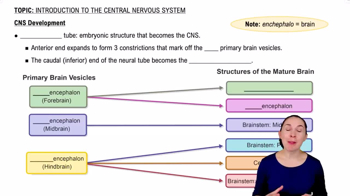
    Prosencephalon (forebrain), Mesencephalon (midbrain), Rhombencephalon (hindbrain).
  • Lateral ventricles

    One in each cerebral hemisphere, separated by the septum pellucidum, part of the brain's ventricular system.
  • Third ventricle

    Located in the diencephalon, connected to lateral ventricles via the interventricular foramen.
  • Fourth ventricle

    Extends into the medulla oblongata, connected to the third ventricle by the cerebral aqueduct.
  • Cranial meninges

    Three connective tissue layers protecting the brain: dura mater, arachnoid mater, and pia mater.
  • Dura mater

    Tough, outermost meningeal layer with periosteal and meningeal components.
  • Arachnoid mater

    Middle meningeal layer separated from dura mater by subdural space; subarachnoid space beneath contains CSF.
  • Pia mater

    Delicate, innermost meningeal layer attached directly to the brain surface by astrocytes.
  • Falx cerebri

    A dural fold that separates the two cerebral hemispheres.
  • Tentorium cerebelli

    Dural fold that separates the cerebrum from the cerebellum.
  • Falx cerebelli

    Dural fold dividing the two cerebellar hemispheres.
  • Cerebrospinal fluid (CSF)

    Fluid produced by the choroid plexus that cushions the CNS, supports, and transports nutrients and wastes.
  • Medulla oblongata functions

    Regulates autonomic functions like heart rate, blood pressure, digestion; relays sensory and motor info; coordinates reflexes.
  • Pons functions

    Contains sensory and motor nuclei for cranial nerves, respiratory nuclei, and relays info to/from cerebellum.
  • Midbrain functions

    Processes visual and auditory info, generates reflexive motor responses, and maintains consciousness.
  • Cerebellum anatomy

    Consists of two hemispheres, vermis, anterior/posterior lobes, flocculonodular lobe, cortex, and arbor vitae (white matter).
  • Thalamus role

    Relay and processing center for sensory info, filtering and transmitting signals to the cerebral cortex.
  • Hypothalamus functions

    Controls autonomic functions, emotions, hormone production; regulates temperature, circadian rhythms, hunger, thirst.
  • Thalamic anterior nuclei

    Part of the limbic system involved in emotion and memory.
  • Thalamic ventral nuclei

    Project sensory info to primary sensory cortex and relay motor info from cerebellum and basal nuclei.
  • Lateral geniculate body

    Projects visual info to the visual cortex and influences emotional states.
  • Medial geniculate body

    Projects auditory info to the auditory cortex and influences emotional states.