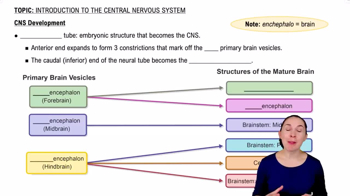
Origin of the brain during embryological development
The ectoderm folds to form the neural tube; the anterior portion becomes the brain, and the posterior portion becomes the spinal cord.
Primary brain vesicles and their derivatives
Diencephalon forms thalamus, hypothalamus, epithalamus; telencephalon forms cerebrum; mesencephalon forms midbrain; metencephalon forms pons and cerebellum; myelencephalon forms medulla.
Three main protective coverings of the brain
Cranial bones, meninges (dura mater, arachnoid, pia mater), and cerebrospinal fluid (CSF).
Functions of cerebrospinal fluid (CSF)
Provides mechanical protection, chemical protection, and circulation of nutrients and waste products.
Blood-brain barrier (BBB) components
Tight junctions of endothelial cells, continuous basement membrane, and astrocyte processes form the BBB to protect brain cells.
Medulla oblongata functions
Regulates vital reflexes like heart rate, respiratory rate, vasoconstriction, and non-vital reflexes such as swallowing and coughing.
Pons role in the brain
Connects spinal cord with brain, relays voluntary movement impulses to cerebellum, contains nuclei for cranial nerves V-VII, and helps control respiration.
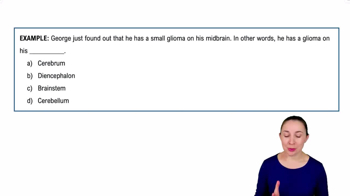
Midbrain key features
Connects pons and diencephalon, contains visual and auditory reflex nuclei (corpora quadrigemina), and nuclei for cranial nerves III and IV.
Reticular formation functions
Regulates muscle tone, alerts cortex to sensory signals (RAS), and maintains consciousness and awakening from sleep.
Cerebellum functions
Coordinates skeletal muscle contractions, maintains muscle tone, posture, and balance by comparing motor output to sensory feedback.
Thalamus function
Acts as a relay station for all sensory impulses except smell, and registers conscious recognition of pain and temperature.
Hypothalamus major roles
Controls autonomic nervous system, links nervous and endocrine systems, regulates emotions, body temperature, hunger, thirst, and sleep-wake cycles.
Cerebrum structure
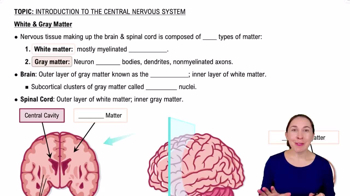
Largest brain part with gray matter cortex containing gyri and sulci, and underlying white matter connecting brain regions.
Cerebral lobes
Frontal, parietal, occipital, temporal lobes, and the insula (deep to other lobes).
Types of cerebral white matter fibers
Association fibers connect gyri in the same hemisphere; commissural fibers connect hemispheres; projection fibers connect cerebrum with other brain parts and spinal cord.
Basal nuclei function
Paired gray matter masses that help control muscular movements.
Limbic system functions
Involved in emotions, behavior, memory, and modifying emotional responses.
Primary sensory areas of cerebral cortex
Receive impulses from sense organs for touch, pain, temperature, vision, hearing, taste, and smell.
Primary motor area location and function
Located in precentral gyrus; controls voluntary skeletal muscle movements.
Electroencephalogram (EEG) uses
Records brain waves to diagnose epilepsy, tumors, trauma, metabolic abnormalities, and confirm brain death.
Brain lateralization: left hemisphere functions
Controls right-handed movements, spoken and written language, and numerical/scientific skills.
Short-term memory lasts seconds to hours and involves electrical/chemical events; long-term memory lasts days to years and involves anatomical and biochemical synaptic changes.
Acetylcholine (ACh) in the brain
Neurotransmitter that can stimulate or inhibit depending on receptor; principal neurotransmitter at neuromuscular junction.
Gamma aminobutyric acid (GABA) role
An amino acid neurotransmitter involved in brain neuron inhibition.
Parkinson's disease cause and symptoms
Degeneration of dopamine-producing neurons causes dopamine-ACh imbalance, leading to involuntary muscle contractions and movement difficulties.
Multiple sclerosis (MS) pathology
Progressive destruction of CNS myelin sheaths disrupting nerve impulse transmission.
Cranial nerves count and naming mnemonic
12 pairs named by distribution and order of brain attachment; mnemonic: Oh, Oh, Oh, The, Texture, And, Flavor, Of, Very, Good, Vegetables, AH.
Cerebrovascular accident (CVA)
Common brain disorder known as stroke caused by interrupted blood flow to the brain.
 Indietro
 0:50