The heart pumps blood throughout the body, delivering oxygen and nutrients and removing waste products.
Name the four chambers of the heart.
The heart has two atria (right and left) and two ventricles (right and left).
What separates the right and left sides of the heart?
The septum separates the right and left sides of the heart, preventing mixing of oxygenated and deoxygenated blood.
What is the role of the atria in the heart?
The atria receive blood returning to the heart and pump it into the ventricles.
What is the role of the ventricles in the heart?
The ventricles pump blood out of the heart to the lungs (right ventricle) and the rest of the body (left ventricle).
Name the valves that control blood flow from the atria to the ventricles.
The tricuspid valve is on the right side, and the mitral (bicuspid) valve is on the left side.
What valves prevent backflow from the ventricles to the arteries?
The pulmonary valve prevents backflow into the right ventricle, and the aortic valve prevents backflow into the left ventricle.
Describe the flow of blood through the heart starting from the body.
Blood enters the right atrium, moves to the right ventricle, is pumped to the lungs, returns to the left atrium, moves to the left ventricle, and is pumped to the body.
What type of blood vessels carry blood away from the heart?
Arteries carry blood away from the heart.
What type of blood vessels carry blood toward the heart?
Veins carry blood toward the heart.
What are capillaries and their function?
Capillaries are tiny blood vessels where exchange of oxygen, nutrients, and waste occurs between blood and tissues.
What is the difference between systemic and pulmonary circulation?
Systemic circulation carries oxygenated blood from the left heart to the body; pulmonary circulation carries deoxygenated blood from the right heart to the lungs.
What is the significance of the coronary arteries?
Coronary arteries supply oxygen-rich blood to the heart muscle itself.
What is the function of the sinoatrial (SA) node?
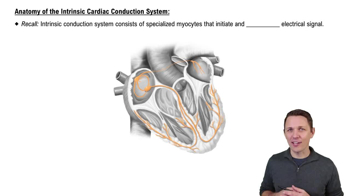
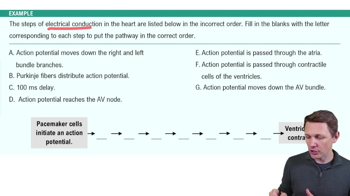
The SA node acts as the heart's natural pacemaker, initiating electrical impulses that cause heartbeats.
What is the role of the atrioventricular (AV) node?
The AV node delays the electrical impulse before it passes to the ventricles, allowing the atria to contract first.
Define systole and diastole.
Systole is the phase when the heart contracts and pumps blood; diastole is when the heart relaxes and fills with blood.
What is blood pressure?
Blood pressure is the force exerted by circulating blood on the walls of blood vessels.
What causes the 'lub-dub' sounds of the heartbeat?
The 'lub' is caused by closing of atrioventricular valves; the 'dub' is caused by closing of semilunar valves.
What is the function of veins' valves?
Valves in veins prevent backflow of blood, ensuring it moves toward the heart.
How does the structure of arteries differ from veins?
Arteries have thicker, more muscular walls to withstand high pressure; veins have thinner walls and valves.
 Indietro
 6:13