Skip to main content
Anatomy & Physiology
Il mio corso
Impara
Preparazione agli esami
AI Tutor
Guide di studio
Soluzioni per libri di testo
Flashcard
Esplora
Prova l'app
Il mio corso
Impara
Preparazione agli esami
AI Tutor
Guide di studio
Soluzioni per libri di testo
Flashcard
Esplora
Prova l'app
Indietro
Cell Division and Early Development - Anatomy & Physiology
Puoi toccare per girare la carta.
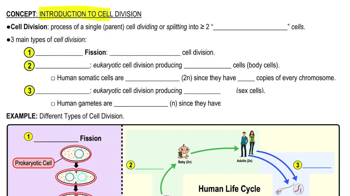
What are somatic cells?
Puoi toccare per girare la carta.
👆
What are somatic cells?
Somatic cells
are all body cells except sex cells (sperm and egg). Humans have 23 chromosome pairs in somatic cells, totaling 46 chromosomes.
Avanzamenti del tracciato
I pulsanti di controllo sono stati cambiati in modalità "navigazione".
1/26
Video consigliati
VideoThumbView.guidedCourse
04:44
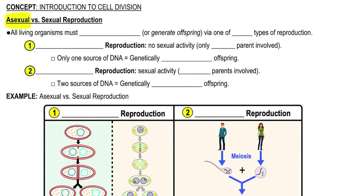
Asexual vs. Sexual Reproduction
18593
views
391
rank
VideoThumbView.guidedCourse
09:40
Introduction to Cell Division
28238
views
637
rank
1
comments
VideoThumbView.guidedCourse
03:18
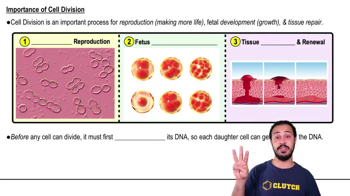
Importance of Cell Division
17801
views
574
rank
Termini in questo insieme (26)
Nascondere definizioni
What are somatic cells?
Somatic cells
are all body cells except sex cells (sperm and egg). Humans have 23 chromosome pairs in somatic cells, totaling 46 chromosomes.
What is the difference between homologous chromosomes and sex chromosomes?
22 pairs are
homologous
(same genes, possibly different alleles). The 23rd pair are
sex chromosomes
: XX in females, XY in males.
Define haploid and diploid numbers in humans.
Haploid (n)
is 23 chromosomes (one set).
Diploid (2n)
is 46 chromosomes (two sets, one from each parent).
What are the two main stages of the cell cycle?
1.
Interphase
: cell growth and DNA replication. 2.
Mitotic phase (M phase)
: mitosis (nuclear division) and cytokinesis (cytoplasmic division).
What happens during the G1 phase of interphase?
G1 lasts 8-10 hours with intense growth and metabolism. Centrosomes replicate. Cells not dividing remain in G0 phase.
What occurs during the S phase of interphase?
DNA is replicated, producing identical sister chromatids attached at the centromere. Kinetochore proteins form at centromeres.
Describe the G2 phase of interphase.
Lasts 4-6 hours. Final growth and metabolism phase before mitosis. Enzymes and proteins for cell division are produced.
What are the four phases of mitosis?
1. Prophase 2. Metaphase 3. Anaphase 4. Telophase
What key events occur during prophase?
Chromatin condenses into chromosomes, nuclear membrane and nucleoli disappear, centrosomes move to poles, spindle apparatus forms.
What happens during metaphase?
Chromosomes line up at the cell equator (metaphase plate) with sister chromatids attached to spindle microtubules.
Describe anaphase in mitosis.
Sister chromatids separate at kinetochores and move to opposite poles. Cytokinesis begins.
What occurs during telophase?
Spindle disassembles, chromosomes uncoil, nuclear membrane and nucleoli reappear, cytokinesis completes, forming two identical daughter cells.
What is meiosis and where does it occur?
Meiosis
is a reduction division producing haploid gametes (sperm and egg) from diploid cells. It occurs only in sex cells.
What are the two divisions of meiosis?
Meiosis I separates homologous pairs (diploid to haploid). Meiosis II separates sister chromatids, producing 4 haploid gametes.
What is synapsis and crossing over in meiosis I prophase?
Synapsis is pairing of homologous chromosomes forming tetrads. Crossing over is exchange of genetic material between sister chromatids.
What happens during metaphase I of meiosis?
Tetrads line up at the metaphase plate. Sister chromatids remain attached at centromeres.
Describe anaphase I of meiosis.
Homologous chromosomes separate and move to opposite poles. Sister chromatids remain attached.
What is the outcome of telophase I and cytokinesis?
Two haploid daughter cells form, each with sister chromatids still attached.
How does meiosis II differ from mitosis?
Meiosis II occurs in haploid cells and separates sister chromatids, producing 4 haploid gametes.
What is fertilization?
Fusion of haploid sperm and egg to form a diploid zygote, restoring the diploid chromosome number.
What is cleavage in early embryonic development?
Rapid mitotic divisions of the zygote producing smaller cells called blastomeres, forming a solid morula.
What is a blastocyst?
A fluid-filled structure formed about 5 days post-fertilization, containing trophoblast cells and an embryoblast.
What is implantation?
Attachment of the blastocyst to the uterine endometrium, occurring 5-7 days after fertilization.
What are the three germ layers formed from the epiblast?
Ectoderm (nervous system, skin epidermis), mesoderm (muscle, bone, blood vessels, dermis), endoderm (epithelial linings of tracts and glands).
What are the embryonic membranes and their origins?
Amnion (from epiblast), yolk sac (from hypoblast), chorion (from trophoblast), allantois (from yolk sac).
What is the fetal period?
From week 9 to 40, characterized by growth and maturation of organs.
 IndietroIndietro
 04:44