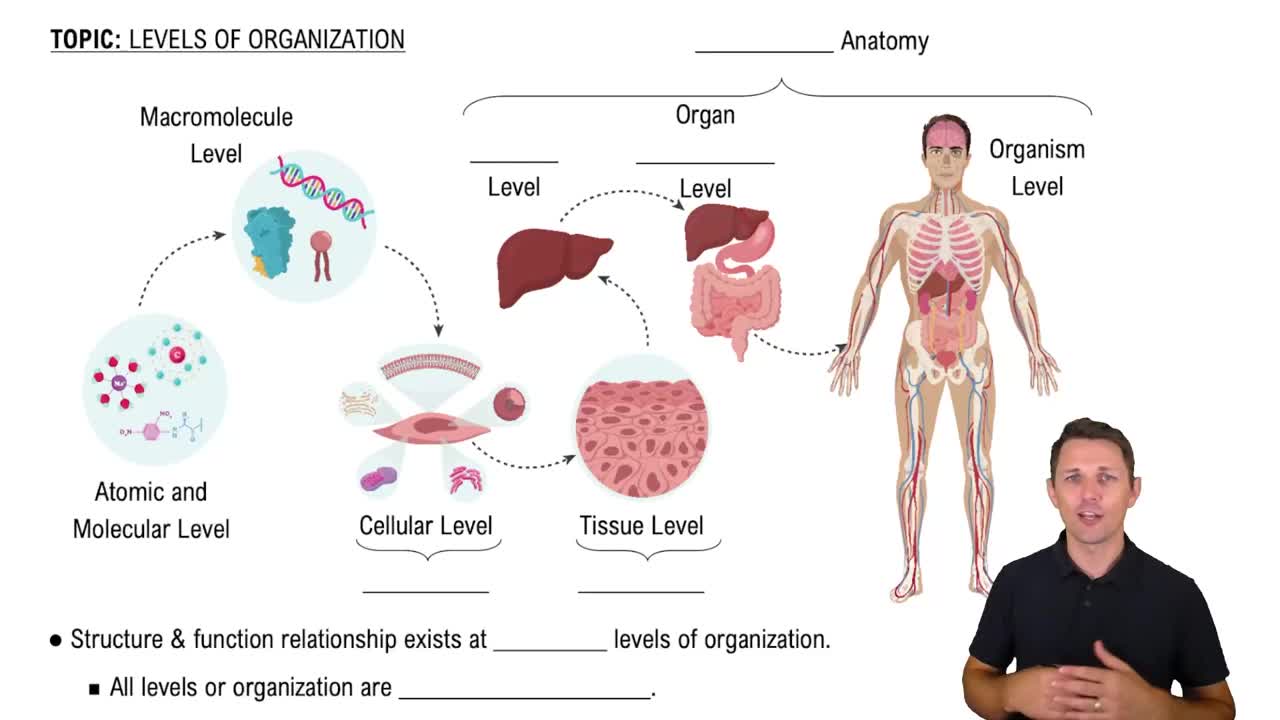
Cell is the smallest living unit in the human body; cells are building blocks of all organisms, come from division of preexisting cells, and maintain homeostasis at the cellular level.
What are the main functions of the plasma membrane?
Physical isolation, regulation of exchange, sensitivity to environment, and structural support.
Describe the structure of the plasma membrane lipids.
Phospholipid bilayer with hydrophilic heads facing outward and hydrophobic tails forming the core; contains cholesterol and glycolipids.
What are integral and peripheral membrane proteins?
Integral proteins span the membrane; peripheral proteins are bound to inner or outer membrane surfaces.
List the functional types of membrane proteins.
Anchoring, recognition, enzymes, receptor, carrier, and channel proteins.
What is the glycocalyx and its functions?
A sticky sugar coat of proteoglycans, glycoproteins, and glycolipids; functions in lubrication, protection, anchoring, specificity, and immune recognition.
What are organelles and how are they classified?
Internal cell structures with specific functions; classified as membranous (e.g., ER, Golgi) or nonmembranous (e.g., cytoskeleton, ribosomes).
What is the cytoskeleton and its components?
Protein framework providing shape, strength, and flexibility; includes microfilaments, intermediate filaments, and microtubules.
Functions of microfilaments in the cytoskeleton?
Provide mechanical strength, attach plasma membrane to cytoplasm, interact with myosin for muscle contraction, and form terminal web.
Role of microtubules in the cell?
Strengthen cell, anchor organelles, assist movement, form spindle apparatus, and compose centrioles and cilia.
What are centrioles and their function?
Cylindrical structures in the centrosome that form the spindle apparatus during cell division.
Difference between primary and motile cilia?
Primary cilia are nonmotile and sense stimuli; motile cilia beat to move fluids across cell surfaces.
What is the function of ribosomes?
Synthesize proteins; free ribosomes produce cytosolic proteins, fixed ribosomes produce proteins for export or membranes.
Functions of the rough and smooth endoplasmic reticulum?
Rough ER synthesizes and modifies proteins; smooth ER synthesizes lipids, steroids, glycogen, and detoxifies drugs.
What are the main functions of the Golgi apparatus?
Modify, package, and store secretions; renew plasma membrane; package enzymes into lysosomes.
Describe lysosome function and activation.
Digest damaged organelles, bacteria, and debris; activated by fusion with organelles, endosomes, or membrane breakdown during autolysis.
What are peroxisomes and their role?
Vesicles containing enzymes that break down fatty acids and organic compounds; neutralize hydrogen peroxide with catalase.
Describe mitochondria structure and function.
Double membrane organelle with cristae; produces ATP by metabolizing nutrients; contains own DNA and ribosomes.
What is the nucleus and its main functions?
Largest organelle controlling metabolism, storing genetic info, and directing protein synthesis.
What is transcription in protein synthesis?
Synthesis of mRNA from DNA template; mRNA carries genetic code to cytoplasm for translation.
What occurs during translation?
mRNA codons are decoded by ribosomes; tRNA delivers amino acids; polypeptides are formed until stop codon.
Define diffusion and factors affecting its rate.
Passive movement from high to low concentration; influenced by distance, molecule size, temperature, gradient steepness, and electrical forces.
What is osmosis and osmotic pressure?
Net diffusion of water across a membrane toward higher solute concentration; osmotic pressure is the force driving water movement.
Explain isotonic, hypotonic, and hypertonic solutions.
Isotonic: equal solute concentration, no net water movement; hypotonic: lower solute, water enters cell; hypertonic: higher solute, water leaves cell.
What is carrier-mediated transport?
Transport via specific membrane proteins; can be passive (facilitated diffusion) or active (energy-dependent).
Describe primary and secondary active transport.
Primary uses ATP to pump solutes against gradient; secondary uses gradient established by primary transport to move other solutes.
What is vesicular transport?
Active transport moving materials in vesicles via endocytosis, exocytosis, or transcytosis.
What is membrane potential?
Electrical potential difference across plasma membrane due to unequal charge distribution; resting potential ranges from −10 mV to −100 mV.
What is the cell life cycle and its phases?
Sequence of growth and division: interphase (G0, G1, S, G2) and M phase (mitosis and cytokinesis).
What is apoptosis?
Genetically controlled programmed cell death.
What causes cancer at the cellular level?
Mutations in genes regulating growth and division (oncogenes); caused by mutagens and carcinogens.
 Indietro
 05:04