Skip to main content
Anatomy & Physiology
Il mio corso
Impara
Preparazione agli esami
AI Tutor
Guide di studio
Soluzioni per libri di testo
Flashcard
Esplora
Prova l'app
Il mio corso
Impara
Preparazione agli esami
AI Tutor
Guide di studio
Soluzioni per libri di testo
Flashcard
Esplora
Prova l'app
Indietro
Central Nervous System Anatomy & Physiology
Puoi toccare per girare la carta.
Ependymal cells
Puoi toccare per girare la carta.
👆
Ependymal cells
Cells that line the ventricles of the brain and produce cerebrospinal fluid (CSF).
Avanzamenti del tracciato
I pulsanti di controllo sono stati cambiati in modalità "navigazione".
1/35
Video consigliati
0:50
Introduction to the Central Nervous System Example 1
13309
views
249
rank
2
comments
2:41
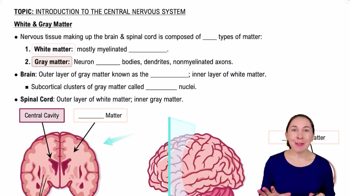
White & Gray Matter
13391
views
245
rank
3:34
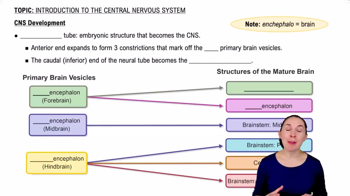
CNS Development
14042
views
280
rank
2
comments
Termini in questo insieme (35)
Nascondere definizioni
Ependymal cells
Cells that line the ventricles of the brain and produce cerebrospinal fluid (CSF).
Cerebrospinal fluid (CSF)
A clear fluid that cushions the brain and spinal cord, providing protection and nutrient transport.
Gyri, sulci, and fissures
Gyri
are ridges,
sulci
are shallow grooves, and
fissures
are deep grooves on the cerebral hemispheres.
Primary motor cortex
Region of the cerebral cortex that controls voluntary skeletal muscle movements via pyramidal tracts.
Pyramidal tracts
Motor pathways originating in the primary motor cortex that control voluntary movement; damage causes loss of skilled movement.
Premotor cortex
Area that stores programs for learned motor skills and coordinates complex movements.
Broca's area
Region that stores muscular movement programs for speech and directs the primary motor cortex.
Primary somatosensory cortex
Cortical area that receives and processes sensory information from the body.
Somatosensory association area
Area that integrates sensory input to produce understanding of object size, texture, and relationship.
Primary visual cortex
Region that receives visual information from the retina.
Visual association area
Area that interprets visual stimuli and recognizes objects.
Primary auditory cortex
Cortical area that processes auditory information.
Auditory association area
Region that interprets sounds and stores memories of sounds.
Olfactory cortex
Area responsible for processing smell information.
Gustatory cortex
Region that processes taste sensations.
Prefrontal cortex
Area involved in complex cognitive behavior, personality expression, and decision making.
Commissural tracts
White matter fibers that connect corresponding areas of the two cerebral hemispheres.
Association tracts
White matter fibers that connect different parts of the same hemisphere.
Projection tracts
Fibers that connect the cerebral cortex with lower brain or spinal cord centers.
Basal nuclei
Clusters of neurons involved in regulating voluntary motor control and procedural learning.
Thalamus
Relay station for sensory information; includes lateral and medial geniculate bodies for vision and hearing.
Hypothalamus
Brain region controlling autonomic functions, hormone release, and homeostasis.
Mammillary bodies
Part of the hypothalamus involved in memory processing.
Pineal gland
Endocrine gland that secretes melatonin to regulate sleep-wake cycles.
Corpora quadrigemina
Midbrain structures including superior colliculi (visual reflexes) and inferior colliculi (auditory reflexes).
Medulla oblongata centers
Includes cardiac, vasomotor, and respiratory centers controlling heart rate, blood pressure, and breathing.
Limbic system
Brain system involved in emotion, memory, and motivation.
Reticular activating system (RAS)
Network that regulates wakefulness and attention.
Meninges
Protective membranes around the brain and spinal cord: dura mater, arachnoid, and pia mater.
Blood-brain barrier
Selective barrier that protects the brain from harmful substances in the blood.
Spinal cord gray matter
Contains posterior horns (sensory), anterior horns (motor), and lateral horns (autonomic neurons).
Ventral roots
Spinal nerve roots carrying motor information from the spinal cord to muscles.
Dorsal roots
Spinal nerve roots carrying sensory information to the spinal cord.
Lateral spinothalamic tract
Sensory pathway transmitting pain and temperature to the brain.
Anterior corticospinal tract
Motor pathway controlling voluntary movement of axial muscles.
 IndietroIndietro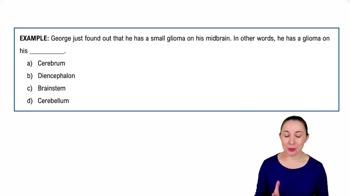
 0:50
0:50