Skip to main content
Anatomy & Physiology
Il mio corso
Impara
Preparazione agli esami
AI Tutor
Guide di studio
Soluzioni per libri di testo
Flashcard
Esplora
Prova l'app
Il mio corso
Impara
Preparazione agli esami
AI Tutor
Guide di studio
Soluzioni per libri di testo
Flashcard
Esplora
Prova l'app
Indietro
ch 2
Puoi toccare per girare la carta.
What are the three main subatomic particles of an atom?
Puoi toccare per girare la carta.
👆
What are the three main subatomic particles of an atom?
Protons
(positive charge),
Neutrons
(neutral), and
Electrons
(negative charge).
Avanzamenti del tracciato
I pulsanti di controllo sono stati cambiati in modalità "navigazione".
1/23
Video consigliati
VideoThumbView.guidedCourse
02:13
Atoms- Smallest Unit of Matter Example 1
30871
views
796
rank
VideoThumbView.guidedCourse
03:51
Atoms- Smallest Unit of Matter Example 3
20093
views
427
rank
VideoThumbView.guidedCourse
09:44
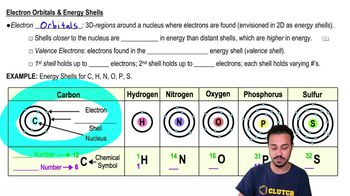
Electron Orbitals & Energy Shells
27925
views
591
rank
5
comments
Termini in questo insieme (23)
Nascondere definizioni
What are the three main subatomic particles of an atom?
Protons
(positive charge),
Neutrons
(neutral), and
Electrons
(negative charge).
Where is most of an atom's mass located?
In the
nucleus
, which contains protons and neutrons.
What is the electron cloud in an atom?
The region around the nucleus where
electrons whirl
and occupy energy levels.
Define atomic number and mass number.
Atomic number
is the number of protons;
mass number
is the total of protons and neutrons.
What are isotopes?
Atoms with the same number of protons but different numbers of neutrons, having identical chemical properties but different mass numbers.
What determines the chemical properties of an element?
The number of electrons in the
outermost electron shell
(valence shell).
What makes an atom reactive or inert?
Atoms with
unfilled outer shells
are reactive; atoms with
full outer shells
(noble gases) are inert.
What is an ion?
An atom that has gained or lost electrons and thus has a net electrical charge.
What is a cation and an anion?
A
cation
is a positively charged ion (lost electrons); an
anion
is a negatively charged ion (gained electrons).
How are ionic bonds formed?
By electrical attraction between
cations and anions
after transfer of electrons.
What is a covalent bond?
A chemical bond formed by
sharing electrons
between atoms.
Difference between nonpolar and polar covalent bonds?
Nonpolar bonds share electrons
equally
; polar bonds share electrons
unequally
, creating partial charges.
What is metabolism?
All chemical reactions in the body that provide energy, maintain, repair, grow, and perform special functions.
Define kinetic and potential energy in biological context.
Kinetic energy
is energy of motion;
potential energy
is stored energy with capacity to do work.
What are reactants and products in a chemical reaction?
Reactants are substances at the start; products are substances formed at the end of the reaction.
Describe decomposition and synthesis reactions.
Decomposition breaks molecules into smaller parts; synthesis assembles smaller molecules into larger ones.
What is hydrolysis and dehydration synthesis?
Hydrolysis breaks bonds by adding water; dehydration synthesis forms bonds by removing water.
What role do enzymes play in chemical reactions?
Enzymes lower the
activation energy
required, speeding up reactions without being consumed.
What is activation energy?
The minimum energy needed to start a chemical reaction.
List four important properties of water in the body.
Lubrication
,
chemical reactant
,
high heat capacity
, and
solvent
.
Why is water a good solvent?
Because its polar molecules form hydration spheres that dissolve many inorganic and organic substances.
What are electrolytes?
Soluble inorganic substances whose ions conduct electrical current in body fluids.
Define hydrophilic and hydrophobic molecules.
Hydrophilic
molecules interact readily with water;
hydrophobic
molecules do not.
 IndietroIndietro
 02:13