 Indietro
Chapter 11 Sensory Physiology - Anatomy & Physiology
 2:47

Termini in questo insieme (23)
Transduce means to convert one form of energy into another, such as converting a sensory stimulus into an electrical signal in a neuron.
A sensory stimulus initiates a change in membrane potential by activating receptor proteins that open ion channels.
A modality is the type or form of a stimulus, such as touch, temperature, or pain.
The two types are myelinated and unmyelinated receptors; myelinated receptors conduct signals faster.
Nonneural receptors receive chemical or physical stimuli and generate receptor potentials without generating action potentials themselves.
The adequate stimulus is the specific type of stimulus a receptor is most sensitive to and can detect effectively.
Threshold is the minimum stimulus intensity required to generate a receptor potential that triggers an action potential.
A receptor potential is a graded change in membrane potential in a sensory receptor in response to a stimulus.
The receptive field is the specific area or region where a sensory neuron detects stimuli.
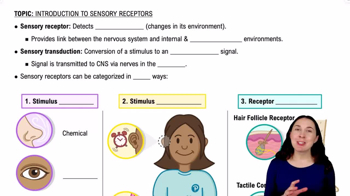
They are mechanoreceptors, thermoreceptors, nociceptors, and chemoreceptors.
Smaller receptive fields allow for greater sensitivity and better spatial resolution of stimuli.
Via ascending pathways in the spinal cord or through cranial nerves directly to the brain.
Perceptual threshold is the minimum stimulus intensity perceived consciously; habituation is decreased perception after repeated stimuli.
Neurons determine modality by the type of receptor activated and the specific brain region where they terminate.
Lateral inhibition enhances contrast by inhibiting neighboring neurons, sharpening stimulus location via primary, secondary, and tertiary neurons.
Intensity is coded by the number of receptors activated and the frequency of action potentials generated.
Stronger or longer stimuli increase action potential frequency and neurotransmitter release amplitude.
Tonic receptors adapt slowly and respond continuously; phasic receptors adapt quickly and respond mainly to changes.
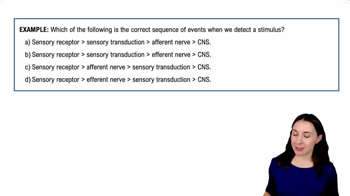
Signals travel from receptor → primary neuron → secondary neuron in spinal cord/brainstem → tertiary neuron in thalamus → somatosensory cortex.
Nociceptors detect pain stimuli and are located in skin, muscles, joints, and some internal organs.
Fast pain is sharp and carried by myelinated fibers; slow pain is dull and carried by unmyelinated fibers.
Mechanical: pressure or stretch; Thermal: temperature changes; Chemical: pH or irritants.
Referred pain is pain perceived at a location different from the stimulus origin, often due to shared neural pathways.