Skip to main content
Anatomy & Physiology
Il mio corso
Impara
Preparazione agli esami
AI Tutor
Guide di studio
Soluzioni per libri di testo
Flashcard
Esplora
Prova l'app
Il mio corso
Impara
Preparazione agli esami
AI Tutor
Guide di studio
Soluzioni per libri di testo
Flashcard
Esplora
Prova l'app
Indietro
Chapter 24-3
Puoi toccare per girare la carta.
Pharynx
Puoi toccare per girare la carta.
👆
Pharynx
An anatomical space serving as a common passageway for solid food, liquid, and air.
Avanzamenti del tracciato
I pulsanti di controllo sono stati cambiati in modalità "navigazione".
1/28
Video consigliati
VideoThumbView.guidedCourse
4:06
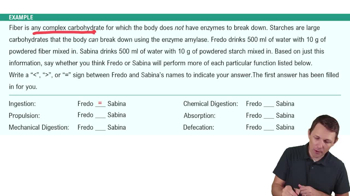
Introduction to the Digestive System Example 2
6677
views
116
rank
VideoThumbView.guidedCourse
5:08
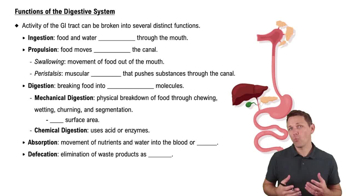
Functions of the Digestive System
7554
views
157
rank
VideoThumbView.guidedCourse
6:28
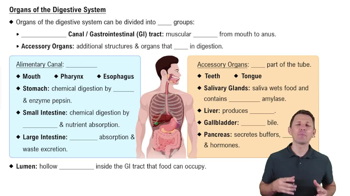
Organs of the Digestive System
11037
views
332
rank
2
comments
Termini in questo insieme (28)
Nascondere definizioni
Pharynx
An anatomical space serving as a common passageway for solid food, liquid, and air.
Three parts of the pharynx
Nasopharynx, oropharynx, and laryngopharynx.
Epithelium type lining the pharynx
Stratified squamous epithelium.
Role of pharyngeal muscles in swallowing
Work with oral cavity muscles to start swallowing and push the bolus into the esophagus.
Esophagus function
A hollow muscular tube that actively propels ingested food to the stomach.
Length and width of the esophagus
Approximately 25 cm long and 2 cm wide at its widest point.
Starting point of the esophagus
Posterior to the cricoid cartilage at vertebra C6.
Histology of esophageal mucosa
Nonkeratinized stratified squamous epithelium with a muscularis mucosae layer of smooth muscle.
Function of esophageal submucosa folds
Allow expansion to accommodate a large bolus during swallowing.
Muscle layers of the esophagus
Inner circular and outer longitudinal layers; superior third is skeletal muscle, middle third mixed, inferior third smooth muscle.
Adventitia of the esophagus
Connective tissue layer anchoring the esophagus to the posterior body wall.
Esophageal innervation
Parasympathetic and sympathetic fibers from the esophageal plexus.
Function of muscle tone in the superior esophagus
Prevents air from entering the esophagus.
Role of the lower esophageal sphincter
Prevents reflux of stomach contents into the esophagus by remaining contracted.
Phases of deglutition (swallowing)
Buccal phase, pharyngeal phase, and esophageal phase.
Key action in the buccal phase
Compression of the bolus against the hard palate and tongue retraction to push it into the oropharynx.
Pharyngeal phase main events
Bolus contacts palatal arches, larynx elevates, epiglottis folds to protect airway, and nasopharynx is sealed.
Duration of the esophageal phase
Less than a second; bolus is pushed by peristaltic waves into the stomach.
Muscles that elevate the larynx during swallowing
Palatopharyngeus and stylopharyngeus muscles.
Function of pharyngeal constrictor muscles
Push the bolus toward and into the esophagus.
Swallowing reflex initiation
Triggered by tactile receptors on the palatal arches and uvula stimulated by the bolus.
Swallowing center location and nerve involvement
Located in the medulla oblongata; receives input via trigeminal (V) and glossopharyngeal (IX) nerves.
Primary peristaltic waves control
Coordinated by afferent and efferent fibers in glossopharyngeal (IX) and vagus (X) nerves.
Typical time for a bolus to travel the esophagus
About 9 seconds; liquids move faster, dry boluses slower.
Secondary peristaltic waves
Local reflexes triggered by sensory receptors in the esophageal walls to clear remaining bolus.
How the glottis is protected during swallowing
Epiglottis bends over the glottis, and the glottis closes to prevent food entry.
Effect of swallowing on respiration
Respiratory centers are inhibited and breathing stops briefly during swallowing.
Frequency of swallowing in a day
Approximately 2400 times daily.
 IndietroIndietro
 4:06