Skip to main content
Anatomy & Physiology
Il mio corso
Impara
Preparazione agli esami
AI Tutor
Guide di studio
Soluzioni per libri di testo
Flashcard
Esplora
Prova l'app
Il mio corso
Impara
Preparazione agli esami
AI Tutor
Guide di studio
Soluzioni per libri di testo
Flashcard
Esplora
Prova l'app
Indietro
(CHAPTER 4 PART 2) Connective Tissue Types and Characteristics - Anatomy & Physiology
Puoi toccare per girare la carta.
What are the major functions of connective tissue?
Puoi toccare per girare la carta.
👆
What are the major functions of connective tissue?
Binding and support
, protecting, insulating, storing reserve fuel, and transporting substances within the body (e.g., blood).
Avanzamenti del tracciato
I pulsanti di controllo sono stati cambiati in modalità "navigazione".
1/25
Video consigliati
06:37
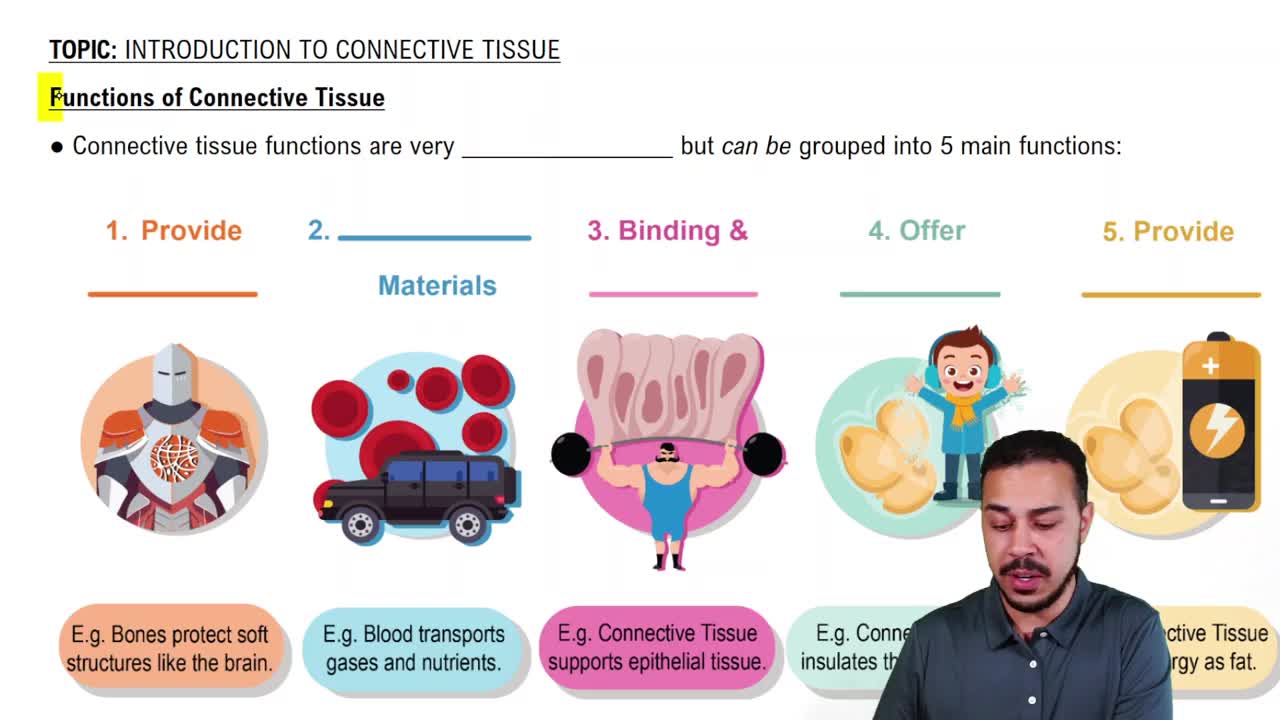
Functions of Connective Tissue
8072
views
137
rank
08:54
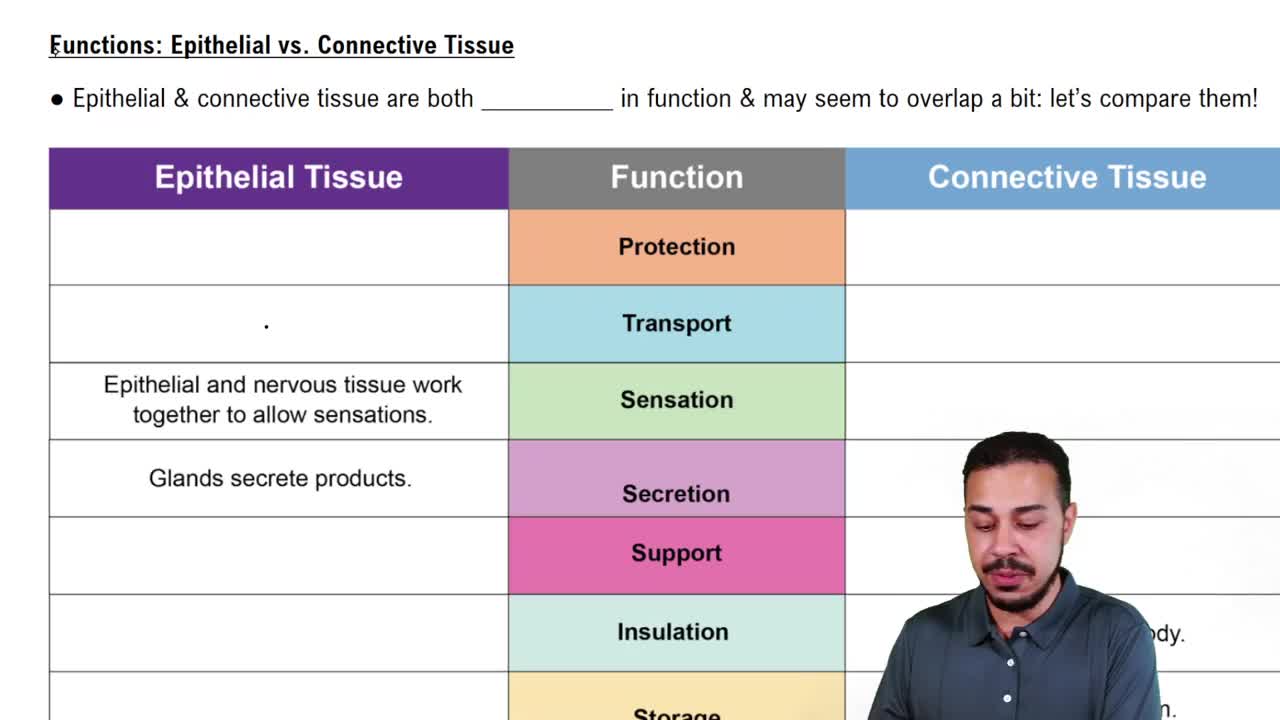
Functions: Epithelial vs. Connective Tissue
7621
views
120
rank
3
comments
01:32
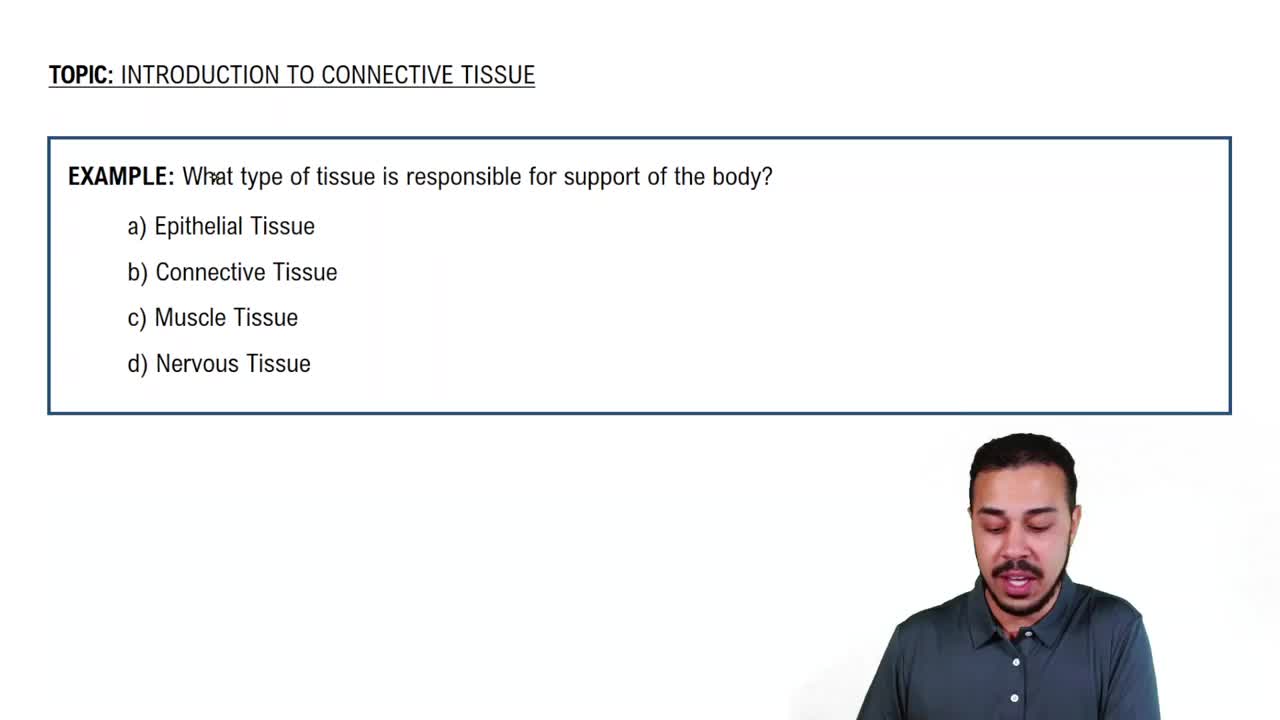
Introduction to Connective Tissue Example 1
6382
views
65
rank
1
comments
Termini in questo insieme (25)
Nascondere definizioni
What are the major functions of connective tissue?
Binding and support
, protecting, insulating, storing reserve fuel, and transporting substances within the body (e.g., blood).
What are the three main components of connective tissue?
Fibers
,
ground substance
, and
cells
.
What are the four main classes of connective tissue?
Connective tissue proper, cartilage, bone, and blood.
What are the two subclasses of connective tissue proper?
Loose connective tissue and dense connective tissue.
Name the three types of loose connective tissue.
Areolar, adipose, and reticular connective tissue.
What are the three types of dense connective tissue?
Dense regular, dense irregular, and elastic connective tissue.
What is the primary cell type in connective tissue proper that produces fibers?
Fibroblasts
.
What are the three types of fibers found in connective tissue?
Collagen fibers, elastic fibers, and reticular fibers.
What is the function of collagen fibers?
Provide
high tensile strength
and are the strongest and most abundant fibers.
What is the role of elastic fibers in connective tissue?
Allow tissues to
stretch and recoil
.
What is the function of reticular fibers?
Form a
mesh-like network
that supports soft organs and cells.
What distinguishes immature '-blast' cells from mature '-cyte' cells in connective tissue?
'-blast' cells actively secrete matrix and fibers; '-cyte' cells maintain the matrix and can revert to '-blast' for repair.
What are the main functions of areolar connective tissue?
Supports and binds other tissues, wraps and cushions organs, and holds tissue fluid.
What is the primary function of adipose tissue?
Stores energy as fat, provides insulation, and cushions organs.
Where is reticular connective tissue primarily found and what is its function?
Found in lymphoid organs; forms a soft internal skeleton (stroma) supporting blood cells.
What is the key characteristic of dense regular connective tissue?
Parallel collagen fibers providing great tensile strength in one direction; found in tendons and ligaments.
How does dense irregular connective tissue differ from dense regular?
Collagen fibers are thicker and arranged irregularly to resist tension from multiple directions.
What is the function of elastic connective tissue?
Allows tissues to stretch and recoil, found in walls of large arteries and certain ligaments.
What are the main features of cartilage tissue?
Tough, flexible, avascular tissue with chondrocytes in lacunae; matrix rich in water and collagen.
Name the three types of cartilage and a key feature of each.
Hyaline (most abundant, glassy), elastic (more elastic fibers, flexible), fibrocartilage (strong, shock-absorbing).
What distinguishes bone tissue from cartilage?
Bone is hard and calcified with inorganic salts, richly vascularized, and supports and protects body structures.
What are osteoblasts and osteocytes?
Osteoblasts produce bone matrix; osteocytes maintain the matrix and reside in lacunae.
What makes blood a connective tissue?
It has cells (erythrocytes, leukocytes, platelets) suspended in a fluid matrix (plasma) and transports substances.
What is the function of mast cells in connective tissue?
Detect foreign microorganisms and initiate inflammation by releasing histamine and heparin.
What role do macrophages play in connective tissue?
Phagocytize foreign materials and dead cells; can be fixed or mobile.
 IndietroIndietro
 06:37