A homogeneous mixture with particles evenly distributed; solvent is the substance in greatest amount, solutes are dissolved substances.
What characterizes a colloid?
A heterogeneous mixture with larger particles than solutions that scatter light but do not settle out; can undergo sol-gel transformations.
Describe a suspension.
A heterogeneous mixture with very large particles that settle out over time, such as blood cells settling in plasma.
List three main differences between mixtures and compounds.
Mixtures do not involve chemical bonding, can be separated physically, and can be heterogeneous or homogeneous; compounds involve chemical bonds, separated chemically, and are homogeneous.
What is the role of electrons in chemical bonding?
Electrons in the outermost shell (valence shell) determine chemical reactions and bond formation by gaining, losing, or sharing electrons.
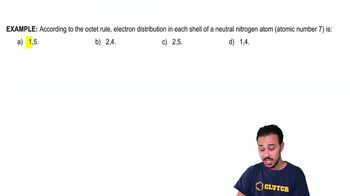
What is the octet rule?
Atoms tend to have 8 electrons in their valence shell to achieve stability, except hydrogen and helium which are stable with 2 electrons.
What makes an element chemically inert?
Having a full valence shell of electrons, making it stable and nonreactive, like noble gases.
Define ionic bonds.
Chemical bonds formed by the transfer of valence electrons from one atom to another, creating oppositely charged ions that attract.
What happens when sodium and chlorine form an ionic bond?
Sodium transfers its valence electron to chlorine, forming a Na+ cation and a Cl- anion, which attract to form sodium chloride.
How are covalent bonds formed?
By sharing pairs of valence electrons between atoms; can be single, double, or triple bonds depending on the number of shared electron pairs.
What distinguishes polar covalent bonds from nonpolar covalent bonds?
Polar covalent bonds have unequal sharing of electrons causing partial charges; nonpolar covalent bonds share electrons equally.
Give an example of a polar molecule and explain why it is polar.
Water (H2O) is polar because oxygen is more electronegative, pulling electrons closer and creating partial negative and positive charges.
What is a hydrogen bond?
A weak attraction between a partially positive hydrogen atom of one molecule and a partially negative electronegative atom of another.
Compare the relative strengths of covalent, ionic, and hydrogen bonds.
Covalent bonds are strongest, ionic bonds are intermediate, and hydrogen bonds are weakest.
What is the significance of hydrogen bonding in water?
Hydrogen bonds give water its polarity, high surface tension, and ability to form cohesive interactions important for biological functions.
What are van der Waals interactions?
Weak attractions due to asymmetrical electron distribution creating temporary positive and negative regions that allow molecules to stick together.
What is the valence shell and why is it important?
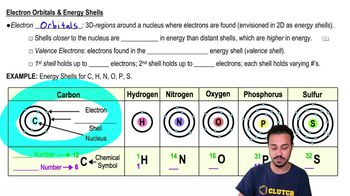
The outermost electron shell of an atom; electrons here have the most potential energy and participate in chemical bonding.
How many electrons can the first three electron shells hold?
Shell 1 holds up to 2 electrons, shell 2 up to 8, and shell 3 up to 18 electrons.
Why do atoms form chemical bonds?
To achieve a full valence shell of electrons, usually 8, which provides chemical stability.
 Indietro
 02:13