 Indietro
Chemical Bonds and Reactions in Anatomy & Physiology
 1:59

Termini in questo insieme (23)
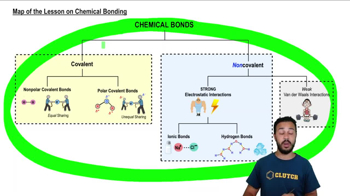
A nonpolar covalent bond involves equal sharing of electrons between atoms, resulting in electrically balanced, nonpolar molecules like CO2.
A polar covalent bond involves unequal sharing of electrons between atoms with different electronegativities, creating electrically polar molecules with partial charges.
Oxygen is very electronegative and hydrogen is electropositive; bonds between O and H are assumed to be polar.
Electronegativity is an atom's ability to attract electrons; atoms with higher electronegativity pull electrons more strongly.
Oxygen is more electronegative than hydrogen, pulling shared electrons closer and creating a dipole with partial negative (O) and partial positive (H) charges.
A dipole is a molecule with two different charges at opposite ends, such as the partial positive and negative charges in water.
Ionic bonds involve complete electron transfer forming charged ions; polar covalent bonds have unequal sharing; nonpolar covalent bonds have equal sharing of electrons.
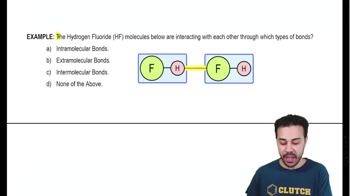
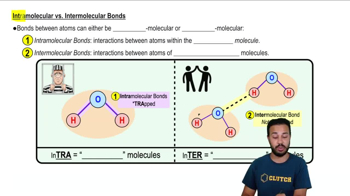
Hydrogen bonds are weak attractions between the electropositive hydrogen of one molecule and an electronegative atom of another, important in water and protein structure.
Synthesis reactions combine atoms or molecules to form larger, more complex molecules, used in anabolic processes (A + B → AB).
Decomposition reactions break down molecules into smaller parts, involved in catabolic processes (AB → A + B).
Exchange reactions involve both synthesis and decomposition, where bonds are made and broken simultaneously (AB + C → AC + B).
Exergonic reactions release energy (catabolic), while endergonic reactions absorb energy (anabolic).
Increased temperature, higher reactant concentration, smaller particle size, and catalysts (like enzymes) increase reaction rates.
Biochemistry studies the chemical composition and reactions of living matter, including organic and inorganic compounds.
Water, salts, acids, and bases are inorganic compounds essential for life and do not contain carbon.
Water has high heat capacity, acts as a polar solvent, participates in reactions, cushions organs, and is the body's main transport medium.
Salts are ionic compounds that dissociate into electrolytes, essential for electrical currents and homeostasis (e.g., NaCl, KCl).
Acids donate H+ ions; bases accept H+ ions or release OH– ions in solution.
The pH scale measures hydrogen ion concentration from 0 (acidic) to 14 (basic), with 7 being neutral; it is logarithmic.
A neutralization reaction occurs when acids and bases mix, forming water and a salt, balancing pH and charge.
Buffers resist large pH changes by releasing or binding H+ ions, converting strong acids/bases into weak ones, maintaining homeostasis.
Carbon forms four covalent bonds, is electroneutral, and is the backbone of major organic compounds like carbohydrates, lipids, proteins, and nucleic acids.
Polymers are synthesized by dehydration synthesis (removing water) and broken down by hydrolysis (adding water).