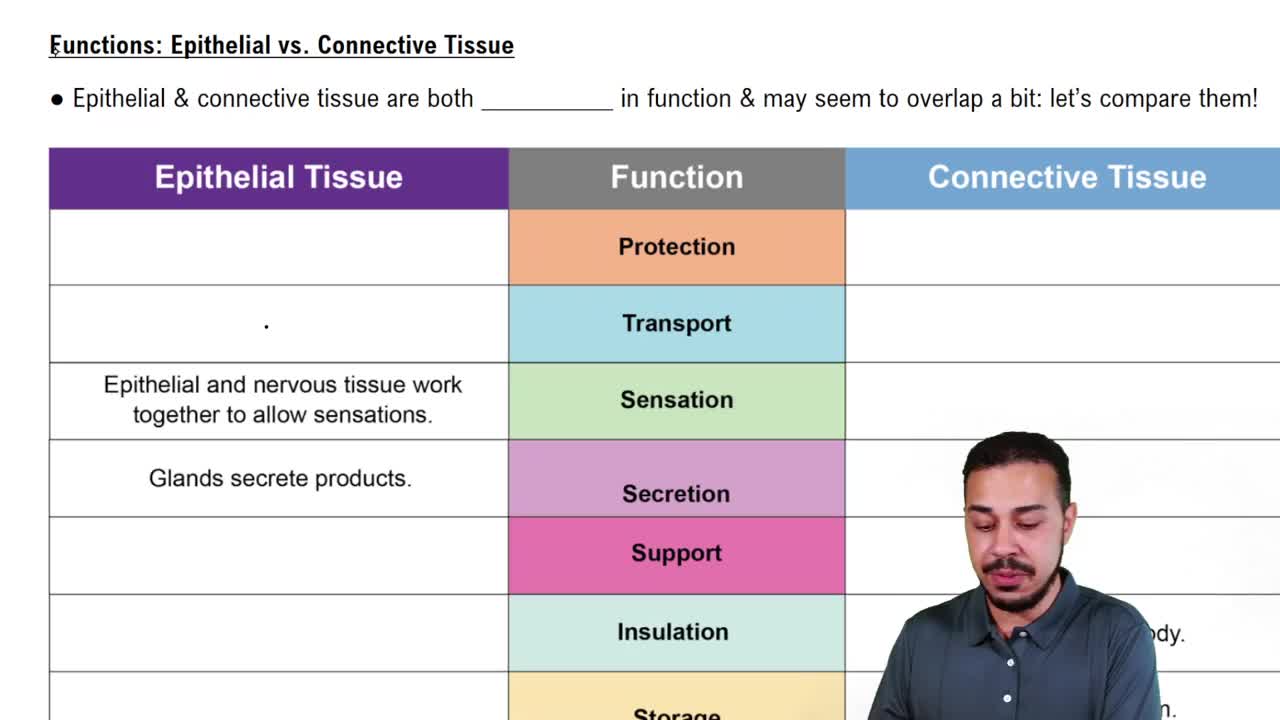
Where is areolar tissue found and what is its function?
Located deep in the dermis and between muscles; cushions organs and provides support with independent movement.
What are the two types of adipose tissue and their functions?
White fat stores energy and cushions; brown fat generates heat, especially in infants.
What is the function of reticular tissue and where is it found?
Provides a supporting framework; found in liver, spleen, lymph nodes, and bone marrow.
Describe dense regular connective tissue and its locations.
Collagen fibers aligned parallel to resist tension in one direction; found in tendons, ligaments, and aponeuroses.
How does dense irregular connective tissue differ from dense regular?
Collagen fibers arranged in multiple directions to resist stress from many angles; found in dermis and organ capsules.
What are the components and functions of blood as a fluid connective tissue?
Contains erythrocytes (oxygen transport), leukocytes (immune defense), platelets (clotting), and plasma as matrix.
What is the role of lymph in connective tissue?
Lymph contains lymphocytes and participates in immune responses within the lymphatic system.
What characterizes cartilage as a supporting connective tissue?
Cartilage has chondrocytes in lacunae, a gel matrix with chondroitin sulfates, is avascular, and covered by a fibrous perichondrium.
What are the three types of cartilage and their primary functions?
Hyaline cartilage: flexible support and reduces friction; elastic cartilage: flexible and returns to shape; fibrous cartilage: resists compression and absorbs shock.
What is the structure and function of bone as a supporting connective tissue?
Bone has a solid matrix called lamellae, is covered by periosteum, and provides support and strength.
What are osteons and their components?
Osteons are structural units of compact bone, consisting of central canal, osteocytes in lacunae, canaliculi, and lamellae matrix.
What are the four types of membranes formed by epithelia and connective tissue?
Mucous, serous, cutaneous, and synovial membranes.
What is the function of mucous membranes and where are they found?
Line digestive, respiratory, reproductive, and urinary tracts; keep surfaces moist and resist pathogen entry.
What are serous membranes and their three types?
Line body cavities; include pleura (lungs), peritoneum (abdominal cavity), and pericardium (heart); produce transudate fluid.
 Indietro
 06:37