Skip to main content
Anatomy & Physiology
Il mio corso
Impara
Preparazione agli esami
AI Tutor
Guide di studio
Soluzioni per libri di testo
Flashcard
Esplora
Prova l'app
Il mio corso
Impara
Preparazione agli esami
AI Tutor
Guide di studio
Soluzioni per libri di testo
Flashcard
Esplora
Prova l'app
Indietro
Digestive System Anatomy & Physiology
Puoi toccare per girare la carta.
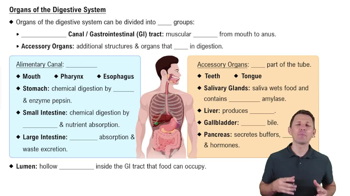
What are the two main groups of organs in the digestive system?
Puoi toccare per girare la carta.
👆
What are the two main groups of organs in the digestive system?
Alimentary canal
(mouth to anus) and
accessory digestive organs
(teeth, tongue, gallbladder, digestive glands).
Avanzamenti del tracciato
I pulsanti di controllo sono stati cambiati in modalità "navigazione".
1/31
Video consigliati
VideoThumbView.guidedCourse
4:06
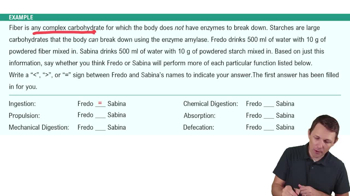
Introduction to the Digestive System Example 2
6673
views
116
rank
VideoThumbView.guidedCourse
5:08
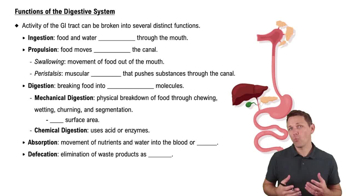
Functions of the Digestive System
7550
views
156
rank
VideoThumbView.guidedCourse
6:28
Organs of the Digestive System
11032
views
332
rank
2
comments
Termini in questo insieme (31)
Nascondere definizioni
What are the two main groups of organs in the digestive system?
Alimentary canal
(mouth to anus) and
accessory digestive organs
(teeth, tongue, gallbladder, digestive glands).
Name the six main activities of the gastrointestinal tract.
Ingestion, mechanical breakdown, digestion, propulsion, absorption, defecation.
What is peristalsis in the digestive system?
Adjacent segments of alimentary tract organs alternately contract and relax, moving food distally along the tract.
What is segmentation in the digestive system?
Nonadjacent segments alternately contract and relax, moving food forward then backward to mix and slowly propel it.
What is the peritoneum and its function?
A serous membrane of the abdominal cavity with visceral and parietal layers; lubricates and supports mobile digestive organs.
What is the mesentery and its roles?
A double layer of peritoneum that routes blood vessels, lymphatics, nerves, holds organs in place, and stores fat.
What is the greater omentum and its functions?
A visceral mesentery hanging from the stomach; involved in fat deposition, immune function, and isolating infections.
What causes peritonitis and why is it dangerous?
Inflammation of the peritoneum caused by wounds or ruptures; can be lethal if infection spreads widely.
What arteries supply blood to the digestive organs?
Branches of the aorta: hepatic, splenic, left gastric, inferior and superior mesenteric arteries.
What is the hepatic portal circulation?
Drains nutrient-rich blood from digestive organs and delivers it to the liver for processing.
List the four basic layers (tunics) of the alimentary canal.
Mucosa, submucosa, muscularis externa, serosa.
What type of epithelium lines the oral cavity?
Stratified squamous epithelium.
What are the functions of the tongue in digestion?
Repositions and mixes food, forms bolus, initiates swallowing, speech, and taste.
Name the four types of papillae on the tongue and their functions.
Filiform (friction), fungiform (taste buds), circumvallate (taste buds), foliate (taste buds in infants).
What are the three major extrinsic salivary glands?
Parotid, submandibular, and sublingual glands.
What are the main functions of saliva?
Cleanses mouth, dissolves food chemicals for taste, moistens food, begins starch digestion.
What are the classes of teeth and their functions?
Incisors (cut), canines (tear), premolars (grind), molars (best grinders).
Describe the phases of deglutition (swallowing).
Buccal phase (voluntary tongue contraction) and pharyngeal-esophageal phase (involuntary, vagus nerve controlled).
What are the regions of the stomach?
Cardia, fundus, body, pyloric part (antrum, pyloric canal, pylorus).
What are the three layers of the stomach's muscularis externa?
Inner oblique, middle circular, and outer longitudinal layers.
What do parietal cells in the stomach secrete?
Hydrochloric acid (HCl) and intrinsic factor for vitamin B12 absorption.
What is the role of chief cells in the stomach?
Secrete pepsinogen (inactive enzyme) and lipases for digestion.
What protects the stomach lining from harsh digestive conditions?
A mucosal barrier of thick bicarbonate-rich mucus and tight epithelial junctions.
What are the three subdivisions of the small intestine?
Duodenum, jejunum, ileum.
What structural modifications increase the small intestine's surface area?
Circular folds (plicae circularis), villi, and microvilli.
What is the function of Peyer's patches in the small intestine?
Protect the distal ileum against bacteria as part of the immune system.
What is the main digestive function of the liver?
Production of bile, which emulsifies fats.
What is the function of the gallbladder?
Stores and concentrates bile, releasing it into the bile duct during digestion.
What are the endocrine and exocrine functions of the pancreas?
Endocrine: secretes insulin and glucagon; Exocrine: secretes pancreatic juice with digestive enzymes.
What are the unique features of the large intestine?
Teniae coli (longitudinal muscle bands), haustra (pouches), and epiploic appendages (fat-filled pouches).
What are the main regions of the large intestine?
Cecum, appendix, colon, rectum, anal canal.
 IndietroIndietro
 4:06