 Indietro
Efferent Division and Autonomic Nervous System - Anatomy & Physiology
 1:10

Termini in questo insieme (20)
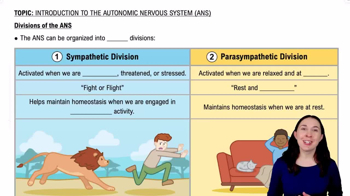
The sympathetic and parasympathetic divisions, distinguished anatomically by ganglia location and functionally by their activity during stress or rest.
Antagonistic control, where sympathetic and parasympathetic divisions have opposite effects on target organs to maintain balance.
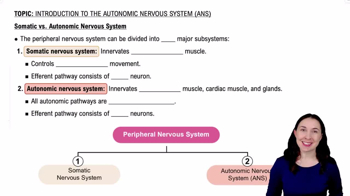
It consists of a preganglionic neuron (from CNS to ganglion) and a postganglionic neuron (from ganglion to target tissue).
Sympathetic ganglia are near the spinal cord (paravertebral or prevertebral), parasympathetic ganglia are near or within the target organs.
Acetylcholine (ACh) is released by both sympathetic and parasympathetic preganglionic neurons.
Sympathetic postganglionic neurons mostly release norepinephrine, parasympathetic postganglionic neurons release acetylcholine (ACh).
Synapses using acetylcholine as neurotransmitter; receptor subtypes are nicotinic and muscarinic receptors.
On target tissues of sympathetic postganglionic neurons; they bind norepinephrine and mediate varied responses depending on receptor subtype.
They allow neurotransmitter release along the length of postganglionic axons, enabling diffuse and widespread effects on target tissues.
By adjusting organ function automatically in response to internal changes, maintaining stable internal conditions.
The medulla oblongata directs many autonomic reflexes; the hypothalamus controls higher-level autonomic regulation.
Sympathetic increases heart rate; parasympathetic decreases it. Sympathetic dilates pupils; parasympathetic constricts pupils.
Responses depend on receptor subtype (alpha or beta); e.g., beta receptors increase heart rate, alpha receptors cause vasoconstriction.
Sympathetic ganglia are close to the spinal cord; parasympathetic ganglia are located near or inside the target organs.
Acetylcholine (ACh) is used at synapses between preganglionic and postganglionic neurons in both divisions.
It allows signal modulation at the ganglion and enables widespread or targeted control of organs.
Sympathetic prepares body for 'fight or flight'; parasympathetic promotes 'rest and digest' activities.
The hypothalamus integrates autonomic functions and coordinates responses to maintain homeostasis.
They act on muscarinic cholinergic receptors on target tissues.
They allow neurotransmitter release at multiple points along an axon, enabling broad influence over target tissues.