Indietro

Endocrine System Anatomy & Physiology

I pulsanti di controllo sono stati cambiati in modalità "navigazione".
1/29
  • Difference between endocrine and exocrine glands

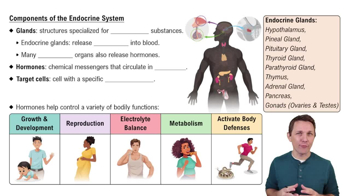
    Endocrine glands are ductless and release hormones into surrounding tissue; exocrine glands have ducts and secrete non-hormonal substances like sweat and saliva.

  • Major endocrine glands and organs

    Includes pituitary, thyroid, parathyroid, adrenal, pineal, thymus glands, hypothalamus, pancreas, and gonads (testes and ovaries).
  • Circulating vs local hormones

    Circulating hormones travel through blood to distant targets; local hormones act near the site of secretion as autocrines or paracrines.
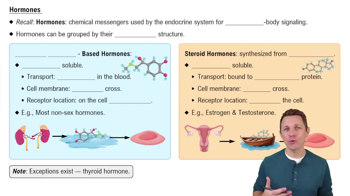
  • Chemical classification of hormones

    Hormones are either amino acid-based (amines, peptides, proteins) or steroids (derived from cholesterol).
  • Examples of eicosanoids and their roles

    Leukotrienes (inflammation, allergy) and prostaglandins (raise blood pressure, uterine contractions, blood clotting, pain). Act locally, not true hormones.
  • Five common cellular responses to hormone stimulus

    1) Alter membrane permeability, 2) Stimulate protein synthesis, 3) Activate/deactivate enzymes, 4) Induce secretion, 5) Stimulate mitosis.
  • Mechanism of action for water-soluble hormones

    Bind to plasma membrane receptors, activate G proteins, and use second messengers to mediate cellular response.
  • Mechanism of action for lipid-soluble hormones

    Diffuse through membrane, bind intracellular receptors, and directly activate gene transcription.
  • Three major stimuli regulating hormone release

    Humoral (blood ion/nutrient levels), neural (nerve fibers stimulate glands), and hormonal (hormones stimulate other glands).
  • Example of humoral stimulus

    Low blood calcium triggers parathyroid gland to release parathyroid hormone (PTH) to increase calcium levels.
  • Example of neural stimulus

    Sympathetic nervous system stimulates adrenal medulla to release epinephrine and norepinephrine during stress.
  • Example of hormonal stimulus

    Hypothalamus releases hormones that regulate anterior pituitary hormone secretion.
  • Factors influencing target cell activation

    Blood hormone levels, number of receptors on target cells, and receptor-hormone binding affinity.
  • Up-regulation vs down-regulation of hormone receptors

    Up-regulation increases receptor number in response to low hormone levels; down-regulation decreases receptors when hormone levels are high.
  • Types of hormone interactions at target cells

    Permissiveness, synergism, and antagonism describe how hormones influence each other's effects.
  • Anatomy of the pituitary gland

    Located in sella turcica; has anterior (glandular) and posterior (neural) lobes connected to hypothalamus.
  • Hormones released by posterior pituitary

    Oxytocin and antidiuretic hormone (ADH), synthesized in hypothalamus and stored in posterior pituitary.
  • Thyroid gland location and structure

    Butterfly-shaped gland anterior to trachea, inferior to larynx; largest pure endocrine gland.
  • Main thyroid hormones and their effects

    Thyroxine (T4) and triiodothyronine (T3) regulate basal metabolic rate, growth, nervous system development, and cardiovascular function.
  • Role of parathyroid hormone (PTH)

    Increases blood calcium by stimulating osteoclasts, enhancing kidney reabsorption, and promoting intestinal absorption via vitamin D activation.
  • Adrenal gland structure and zones

    Paired glands atop kidneys; cortex has zona glomerulosa (mineralocorticoids), zona fasciculata (glucocorticoids), zona reticularis (gonadocorticoids); medulla produces catecholamines.
  • Functions of adrenal cortex hormones

    Mineralocorticoids regulate sodium and potassium; glucocorticoids promote glucose production and stress resistance; gonadocorticoids influence sex characteristics.
  • Adrenal medulla hormones and effects

    Epinephrine and norepinephrine increase heart rate, blood pressure, and metabolic rate during fight-or-flight response.
  • Pancreas endocrine function

    Islets of Langerhans produce glucagon (raises blood glucose) and insulin (lowers blood glucose).
  • Glucagon's main action

    Stimulates liver to break down glycogen and produce glucose, raising blood glucose levels.
  • Insulin's main action

    Promotes glucose uptake by cells, glycogen formation, and lowers blood glucose levels.
  • Female gonadal hormones and roles

    Estrogens promote secondary sex characteristics and uterine cycle; progesterone maintains pregnancy and prepares mammary glands.
  • Male gonadal hormone and role

    Testosterone promotes reproductive system maturation, secondary sex characteristics, and libido.
  • Pineal gland function

    Secretes melatonin regulating circadian rhythms and may prevent early sexual maturation.