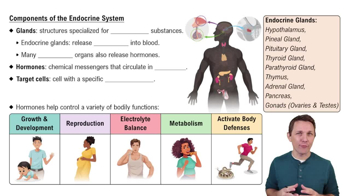
What is the primary function of the endocrine system?
The endocrine system regulates physiological processes by secreting hormones that maintain homeostasis alongside the nervous system.
Name the five mechanisms of intercellular communication.
Direct, paracrine, autocrine, endocrine, and synaptic communication.
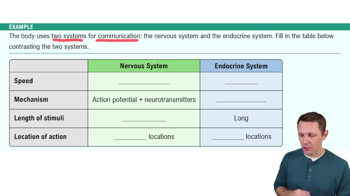
How does endocrine communication differ from nervous system communication?
Endocrine communication is slower and longer-lasting via hormones in the bloodstream; nervous system communication is fast and short-lived via neurotransmitters.
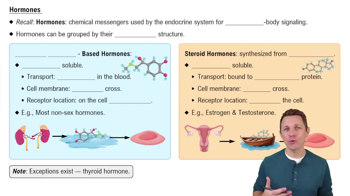
What are the main classes of hormones?
Amino acid derivatives, peptide hormones, and lipid derivatives.
How are hydrophilic and hydrophobic hormones transported in the blood?
Hydrophilic hormones circulate freely and are short-lived; hydrophobic hormones bind to transport proteins and have longer-lasting effects.
What are the two types of hormone receptors?
Extracellular receptors for non-lipid soluble hormones and intracellular receptors for lipid-soluble hormones.
Describe the role of second messenger systems in hormone action.
Hormone binds receptor (first messenger), activates G protein, which produces second messengers like cAMP to amplify the signal.
Where is the pituitary gland located and what are its two main lobes?
Located in the sella turcica; has anterior (adenohypophysis) and posterior (neurohypophysis) lobes.
Which hormones are released by the posterior pituitary?
Oxytocin (OXT) and antidiuretic hormone (ADH).
What is the function of oxytocin?
Stimulates uterine contractions, milk ejection, and sexual arousal.
What is the function of antidiuretic hormone (ADH)?
Promotes water retention by the kidneys; inhibited by alcohol.
Where is the thyroid gland located and what cells produce calcitonin?
Located inferior to the thyroid cartilage; C cells (parafollicular cells) produce calcitonin.
What are the main effects of thyroid hormones?
Increase metabolic rate, oxygen consumption, heart rate, and are essential for development of skeletal, muscular, and nervous systems.
How does calcitonin affect blood calcium levels?
Lowers blood calcium by increasing kidney excretion and decreasing intestinal absorption.
What hormone do the parathyroid glands secrete and what is its effect?
Parathyroid hormone (PTH); increases blood calcium by stimulating osteoclasts, kidney reabsorption, and intestinal absorption.
Name the three zones of the adrenal cortex and their hormone types.
Zona glomerulosa: mineralocorticoids; zona fasciculata: glucocorticoids; zona reticularis: androgens.
What hormones are produced by the adrenal medulla and their function?
Epinephrine and norepinephrine; mobilize energy, increase heart rate, and prepare for fight-or-flight.
What is the role of the pineal gland?
Produces melatonin, which regulates circadian rhythms and inhibits reproductive functions.
What are the main pancreatic hormones and their functions?
 Indietro
 7:06