Skip to main content
Anatomy & Physiology
Il mio corso
Impara
Preparazione agli esami
AI Tutor
Guide di studio
Soluzioni per libri di testo
Flashcard
Esplora
Prova l'app
Il mio corso
Impara
Preparazione agli esami
AI Tutor
Guide di studio
Soluzioni per libri di testo
Flashcard
Esplora
Prova l'app
Indietro
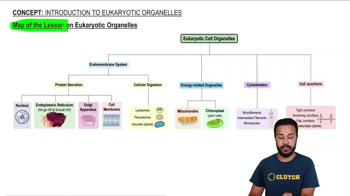
Eukaryotic Cell Organelles and Their Functions
Puoi toccare per girare la carta.
Nucleus
Puoi toccare per girare la carta.
👆
Nucleus
The
control center
of the cell that stores DNA and coordinates growth, metabolism, and reproduction.
Avanzamenti del tracciato
I pulsanti di controllo sono stati cambiati in modalità "navigazione".
1/15
Video consigliati
VideoThumbView.guidedCourse
03:45
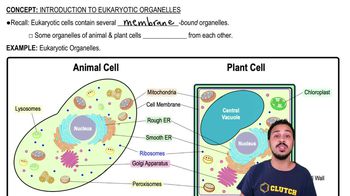
Introduction to Eukaryotic Organelles
30312
views
551
rank
VideoThumbView.guidedCourse
05:32
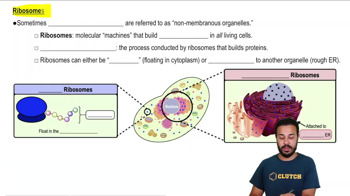
Ribosomes
25427
views
412
rank
VideoThumbView.guidedCourse
02:04
Map of the Lesson on Eukaryotic Organelles
22186
views
292
rank
Termini in questo insieme (15)
Nascondere definizioni
Nucleus
The
control center
of the cell that stores DNA and coordinates growth, metabolism, and reproduction.
Ribosomes
Tiny molecular machines that
build proteins
by linking amino acids; found free in cytoplasm or on rough ER.
Rough Endoplasmic Reticulum (Rough ER)
Studded with ribosomes; helps
synthesize and transport proteins
within the cell.
Smooth Endoplasmic Reticulum (Smooth ER)
Lacks ribosomes; involved in
lipid synthesis
and
detoxification
processes.
Golgi Apparatus
Modifies, sorts, and
packages proteins and lipids
for delivery inside or outside the cell.
Mitochondria
Known as the cell's
powerhouse
; generates ATP energy through cellular respiration.
Lysosomes
Contain digestive enzymes to
break down waste, old organelles, and foreign substances
; mainly in animal cells.
Peroxisomes
Organelles that
break down fatty acids
and
detoxify harmful substances
.
Vacuoles
Storage organelles; plant cells have a large central vacuole for water and nutrients, animal cells have smaller vacuoles.
Chloroplasts
Found in plant cells; sites of
photosynthesis
, converting sunlight into chemical energy.
Cell Wall
A rigid structure in plant cells made of cellulose that provides
structure and protection
.
Cell Membrane
A flexible barrier that
controls what enters and leaves
the cell.
Cytoskeleton
A network of protein fibers (microfilaments, intermediate filaments, microtubules) that provide
shape, support, and movement
inside the cell.
Difference between plant and animal cell organelles
Plant cells have
chloroplasts and cell walls
; animal cells have more
lysosomes
.
Are ribosomes membrane-bound?
No, ribosomes are
not surrounded by membranes
and are found in all cells.
 IndietroIndietro
 03:45