Skip to main content
Anatomy & Physiology
Il mio corso
Impara
Preparazione agli esami
AI Tutor
Guide di studio
Soluzioni per libri di testo
Flashcard
Esplora
Prova l'app
Il mio corso
Impara
Preparazione agli esami
AI Tutor
Guide di studio
Soluzioni per libri di testo
Flashcard
Esplora
Prova l'app
Indietro
Functional Anatomy of the Endocrine Glands - Anatomy & Physiology
Puoi toccare per girare la carta.
What is the primary function of the endocrine system?
Puoi toccare per girare la carta.
👆
What is the primary function of the endocrine system?
The endocrine system regulates body functions through the secretion of
hormones
into the bloodstream to maintain homeostasis.
Avanzamenti del tracciato
I pulsanti di controllo sono stati cambiati in modalità "navigazione".
1/20
Video consigliati
7:06
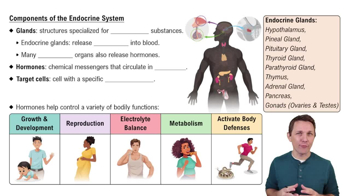
Components of the Endocrine System
15289
views
458
rank
6:20
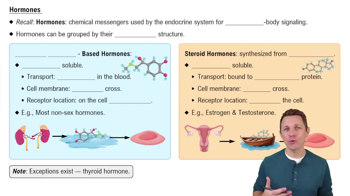
Hormones
11653
views
285
rank
3:33
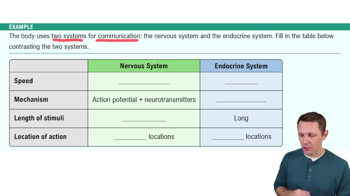
Introduction to the Endocrine System Example 1
16440
views
491
rank
1
comments
Termini in questo insieme (20)
Nascondere definizioni
What is the primary function of the endocrine system?
The endocrine system regulates body functions through the secretion of
hormones
into the bloodstream to maintain homeostasis.
Name the major endocrine organs shown in human anatomy.
Major endocrine organs include the
hypothalamus
,
pituitary gland
,
thyroid gland
,
parathyroid glands
,
adrenal glands
,
pancreas
, and
gonads
.
What hormone does the hypothalamus primarily produce to regulate the pituitary gland?
The hypothalamus produces
releasing and inhibiting hormones
that control the secretion of pituitary hormones.
List two hormones secreted by the anterior pituitary gland.
The anterior pituitary secretes
growth hormone (GH)
and
adrenocorticotropic hormone (ACTH)
among others.
What hormone is released by the posterior pituitary gland?
The posterior pituitary releases
oxytocin
and
antidiuretic hormone (ADH)
.
Describe the microscopic anatomy of the thyroid gland.
The thyroid gland contains
follicles
filled with colloid, which stores thyroid hormones, and
parafollicular cells
that secrete calcitonin.
What hormones are produced by the thyroid gland?
The thyroid gland produces
thyroxine (T4)
,
triiodothyronine (T3)
, and
calcitonin
.
What is the role of parathyroid hormone (PTH)?
Parathyroid hormone
increases blood calcium levels by stimulating bone resorption and calcium absorption in the intestines.
Name the three layers of the adrenal cortex and a hormone each produces.
The adrenal cortex layers are:
zona glomerulosa
(aldosterone),
zona fasciculata
(cortisol), and
zona reticularis
(androgens).
What hormones are secreted by the adrenal medulla?
The adrenal medulla secretes
epinephrine
and
norepinephrine
to mediate the fight-or-flight response.
Which cells in the pancreas produce insulin and glucagon?
Beta cells
produce insulin, and
alpha cells
produce glucagon in the pancreatic islets.
What is the primary effect of insulin?
Insulin lowers blood glucose by promoting cellular uptake and storage as glycogen.
What is the primary effect of glucagon?
Glucagon raises blood glucose by stimulating glycogen breakdown and glucose release from the liver.
Which hormones are produced by the gonads?
The gonads produce
estrogens
and
progesterone
in females, and
testosterone
in males.
What is the role of growth hormone (GH)?
Growth hormone stimulates
growth of bones and muscles
and promotes protein synthesis.
How does antidiuretic hormone (ADH) affect the kidneys?
ADH increases water reabsorption in the kidneys to concentrate urine and maintain body water balance.
What hormone stimulates milk ejection during breastfeeding?
Oxytocin
stimulates milk ejection by causing contraction of mammary gland myoepithelial cells.
What is the effect of aldosterone on the body?
Aldosterone promotes
sodium retention
and
potassium excretion
by the kidneys, regulating blood pressure and volume.
Name a homeostatic imbalance related to the thyroid gland.
Examples include
hypothyroidism
(low thyroid hormone) and
hyperthyroidism
(excess thyroid hormone).
What hormone imbalance causes diabetes mellitus?
Diabetes mellitus results from insufficient insulin production or cellular resistance to insulin.
 IndietroIndietro
 7:06