Skip to main content
Anatomy & Physiology
Il mio corso
Impara
Preparazione agli esami
AI Tutor
Guide di studio
Soluzioni per libri di testo
Flashcard
Esplora
Prova l'app
Il mio corso
Impara
Preparazione agli esami
AI Tutor
Guide di studio
Soluzioni per libri di testo
Flashcard
Esplora
Prova l'app
Indietro
Fundamentals of the Nervous System and Nervous Tissue - Anatomy & Physiology
Puoi toccare per girare la carta.
What are the two principal parts of the nervous system?
Puoi toccare per girare la carta.
👆
What are the two principal parts of the nervous system?
Central nervous system (CNS)
- integration and control center;
Peripheral nervous system (PNS)
- mainly nerves extending from brain and spinal cord.
Avanzamenti del tracciato
I pulsanti di controllo sono stati cambiati in modalità "navigazione".
1/29
Video consigliati
01:10
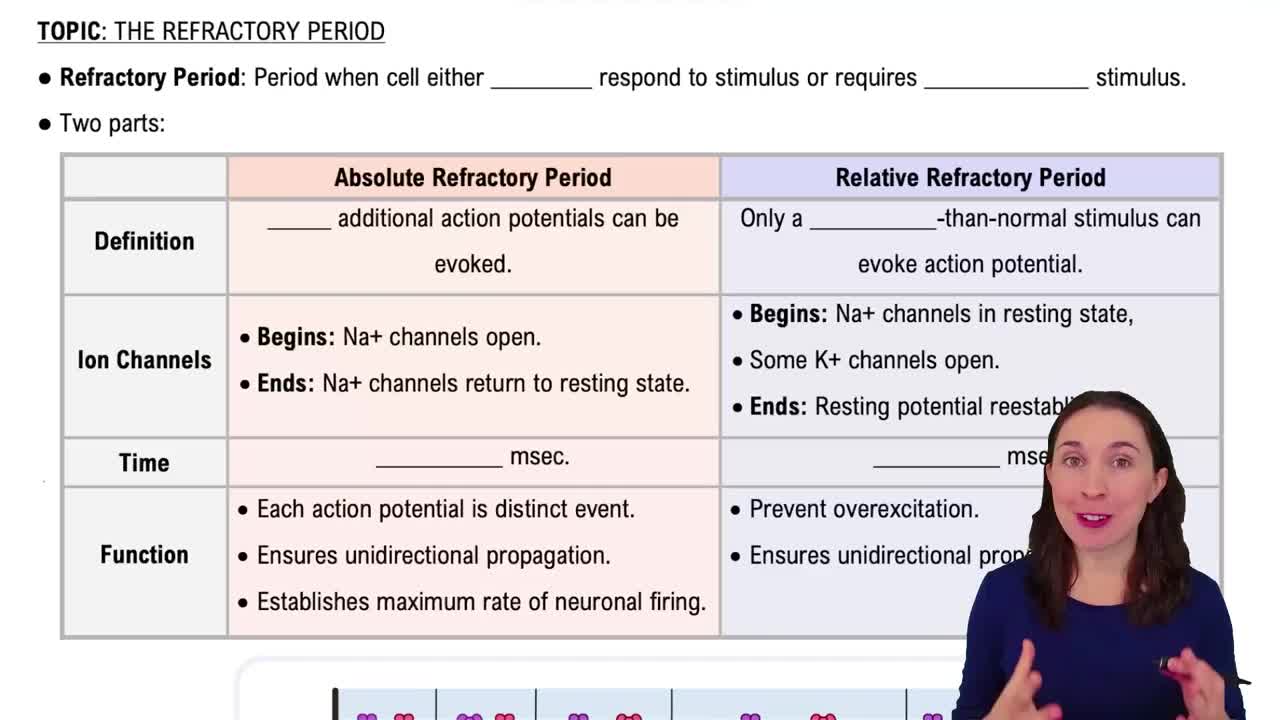
The Refractory Period Example 1
6808
views
95
rank
06:26
Refractory Period
9324
views
172
rank
2
comments
Termini in questo insieme (29)
Nascondere definizioni
What are the two principal parts of the nervous system?
Central nervous system (CNS)
- integration and control center;
Peripheral nervous system (PNS)
- mainly nerves extending from brain and spinal cord.
What are the main functions of the nervous system?
To receive sensory input, integrate information, and produce motor output to respond to stimuli.
What are neuroglia and neurons?
Neuroglia
are small cells that support and protect neurons;
Neurons
are excitable cells that transmit electrical signals.
Name the four main types of neuroglia in the CNS.
Astrocytes, Microglial cells, Ependymal cells, Oligodendrocytes.
What is the function of astrocytes?
Support neurons, regulate chemical environment, guide neuron migration, recycle neurotransmitters, and maintain blood-brain barrier.
What role do microglial cells play in the CNS?
Act as defensive cells by monitoring neurons and phagocytizing microorganisms and debris.
What are ependymal cells and their function?
Ciliated cells lining CNS cavities that circulate cerebrospinal fluid and form a permeable barrier.
What is the role of oligodendrocytes?
Wrap CNS nerve fibers with myelin sheath to insulate and speed up electrical impulses.
What are the two major neuroglia in the PNS?
Satellite cells (surround neuron cell bodies) and Schwann cells (form myelin sheaths around peripheral nerve fibers).
What are the special characteristics of neurons?
Extreme longevity, amitotic (mostly), high metabolic rate requiring oxygen and glucose.
What is the function of dendrites in neurons?
Receptive regions that receive signals and convey graded potentials toward the cell body.
Describe the structure and function of an axon.
Single long process that generates and transmits action potentials away from the cell body to axon terminals.
What is the myelin sheath and its function?
A white fatty insulating layer around axons that protects and increases speed of nerve impulse transmission.
How is myelin formed in the PNS and CNS?
In PNS by Schwann cells wrapping axons; in CNS by oligodendrocyte processes wrapping multiple axons.
What are the three structural classes of neurons?
Multipolar (many dendrites, one axon), Bipolar (one dendrite, one axon), Unipolar (single process dividing into two branches).
What are the three functional classes of neurons?
Sensory (afferent), Motor (efferent), and Interneurons (association neurons).
What is resting membrane potential in neurons?
The voltage difference across the membrane at rest, approximately -70 mV, with the inside negative relative to outside.
What ion plays the most important role in generating resting membrane potential?
Potassium (K+)
due to its higher permeability and concentration gradient.
What are graded potentials?
Short-lived, localized changes in membrane potential that can be depolarizing or hyperpolarizing.
What is an action potential?
A brief, large depolarization (~100 mV) that propagates along the axon to transmit signals over long distances.
Describe the four main phases of an action potential.
Resting state, Depolarization (Na+ channels open), Repolarization (Na+ channels inactivate, K+ channels open), Hyperpolarization (K+ channels remain open).
What is the all-or-none phenomenon in action potentials?
An action potential either occurs fully when threshold is reached or does not occur at all.
How does myelination affect action potential conduction?
Myelination enables saltatory conduction, where impulses jump between nodes of Ranvier, increasing speed about 30 times.
What are the two types of synapses?
Electrical synapses (gap junctions) and Chemical synapses (neurotransmitter release).
What are the six steps of chemical synaptic transmission?
1. AP arrives, 2. Ca2+ channels open, 3. Neurotransmitter released, 4. Neurotransmitter binds receptor, 5. Ion channels open, 6. Neurotransmitter effect terminated.
What are EPSPs and IPSPs?
Excitatory postsynaptic potentials depolarize membrane; inhibitory postsynaptic potentials hyperpolarize membrane.
What is neural integration?
The process by which neurons process and integrate multiple synaptic inputs to produce a response.
What are the four types of neural circuits?
Diverging, Converging, Reverberating, and Parallel after-discharge circuits.
What is synaptic potentiation?
Repeated use of a synapse increases its efficiency, contributing to learning and memory.
 IndietroIndietro
 01:10