Skip to main content
Anatomy & Physiology
Il mio corso
Impara
Preparazione agli esami
AI Tutor
Guide di studio
Soluzioni per libri di testo
Flashcard
Esplora
Prova l'app
Il mio corso
Impara
Preparazione agli esami
AI Tutor
Guide di studio
Soluzioni per libri di testo
Flashcard
Esplora
Prova l'app
Indietro
Heart
Puoi toccare per girare la carta.
What causes normal heart sounds?
Puoi toccare per girare la carta.
👆
What causes normal heart sounds?
Normal heart sounds are caused by the
closure of the heart valves
.
Avanzamenti del tracciato
I pulsanti di controllo sono stati cambiati in modalità "navigazione".
1/30
Video consigliati
6:13
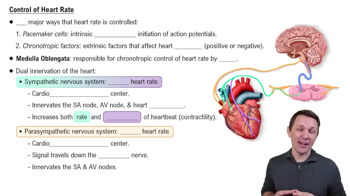
Control of Heart Rate
8172
views
170
rank
1
comments
8:41
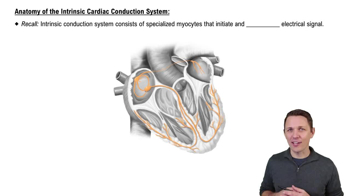
Anatomy of the Intrinsic Cardiac Conduction System
14004
views
340
rank
3
comments
3:42
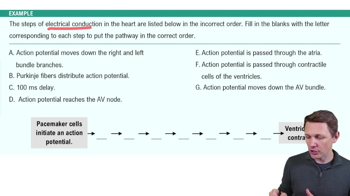
Electrical Conduction System of the Heart Example 2
7658
views
189
rank
Termini in questo insieme (30)
Nascondere definizioni
What causes normal heart sounds?
Normal heart sounds are caused by the
closure of the heart valves
.
What does not occur when semilunar valves are open?
When semilunar valves are open,
ventricles are not in diastole
.
Effect of large blood loss (hemorrhage) on blood pressure
Large blood loss causes
lowering of blood pressure due to decreased cardiac output
.
Why is the left ventricular wall thicker than the right?
The left ventricular wall is thicker to
pump blood with greater pressure
.
What is heart block damage associated with?
Heart block is damage to the
AV node
.
What does the P wave on an ECG represent?
The P wave indicates
atrial depolarization
.
Where does blood in the pulmonary veins return?
Blood in the pulmonary veins returns to the
left atrium
.
What is cardiac tamponade?
Cardiac tamponade is a condition where
fluid compresses the heart and limits its ability to contract
.
What is angina pectoris?
Angina pectoris is
pain from deficient blood delivery to the heart, often due to transient coronary artery spasm
.
Where to auscultate the aortic semilunar valve?
Place the stethoscope in the
second intercostal space to the right of the sternum
.
Source of blood to myocardium capillaries
Blood is supplied to myocardium capillaries by the
coronary arteries
.
What does the thickness of the left ventricle indicate?
The thicker left ventricle pumps blood against
greater resistance
.
Which factor does not influence heart rate?
Skin color
does not influence heart rate.
Which is not an age-related heart change?
Thinning of valve flaps
is not an age-related change.
Primary cause of damage when cardiac muscle is deprived of blood
Damage results primarily from
decreased oxygen delivery
.
Consequence if cardiac muscle absolute refractory period matched skeletal muscle
Tetanic contractions might occur,
stopping the heart's pumping action
.
How does norepinephrine affect the heart?
Norepinephrine causes
threshold to be reached more quickly
, increasing heart rate.
Effect of cutting vagal nerves to the heart
Heart rate would
increase by about 25 beats per minute
.
What is a foramen ovale?
A foramen ovale
connects the two atria in the fetal heart
.
Which vessel receives blood during right ventricular systole?
The
pulmonary trunk
receives blood during right ventricular systole.
Which vessels receive blood during ventricular systole?
Both the
aorta and pulmonary trunk
receive blood during ventricular systole.
Which is not part of the heart's conduction system?
The
AV valve
is not part of the conduction system.
When is the tricuspid valve closed?
The tricuspid valve is closed
when the ventricle is in systole
.
How to visually distinguish right and left ventricles?
By
noticing the thickness of the ventricle walls
.
Correct statement about heart valves
AV valves are supported by
chordae tendineae
to prevent blood regurgitation during ventricular contraction.
Function of myocardial cells
The entire heart contracts as a
unit or not at all
.
Which heart wall layer contracts?
The
myocardium
is the contracting layer of the heart wall.
How does cardiac muscle compare to skeletal muscle?
Cardiac muscle has
gap junctions
allowing it to act as a functional syncytium.
What happens during ventricular filling?
Blood flows mostly
passively through atria and open AV valves into ventricles
.
When is the second heart sound heard?
During
isovolumetric relaxation
phase of the cardiac cycle.
 IndietroIndietro
 6:13