What are the two main parts of the human skeleton?
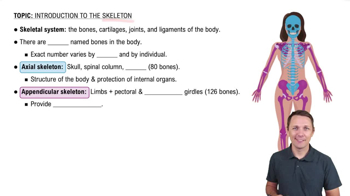
The axial skeleton (skull, vertebral column, rib cage) and the appendicular skeleton (pectoral girdle, upper limbs, pelvic girdle, lower limbs).
What bones form the skull?
The skull is formed by the cranium and facial bones, including the frontal, parietal, temporal, occipital, sphenoid, ethmoid, maxilla, mandible, nasal, zygomatic, and others.
What is the function of the hyoid bone?
The hyoid bone supports the tongue and is an attachment site for muscles of the neck and pharynx; it does not articulate with other bones.
Name the three regions of the vertebral column.
The vertebral column consists of the cervical, thoracic, and lumbar vertebrae, followed by the sacrum and coccyx.
What distinguishes cervical vertebrae from others?
Cervical vertebrae have transverse foramina for vertebral arteries and smaller bodies; the first two are the atlas (C1) and axis (C2) with unique structures like the dens.
What is the function of the thoracic cage?
The thoracic cage protects vital organs like the heart and lungs and supports the shoulder girdle and upper limbs.
What bones make up the thoracic cage?
The thoracic cage consists of the sternum, ribs, and costal cartilages.
What are the three parts of the sternum?
The sternum is composed of the manubrium, body, and xiphoid process.
What bones form the pectoral girdle?
The pectoral girdle consists of the clavicle and scapula.
What bones form the pelvic girdle?
The pelvic girdle is formed by the paired coxal bones (ilium, ischium, pubis) and the sacrum.
Name the major bones of the upper limb.
The upper limb includes the humerus, radius, ulna, carpals, metacarpals, and phalanges.
Name the major bones of the lower limb.
The lower limb includes the femur, patella, tibia, fibula, tarsals, metatarsals, and phalanges.
What is the anatomical significance of the mandibular condyle?
The mandibular condyle articulates with the temporal bone to form the temporomandibular joint (TMJ), allowing jaw movement.
What is the function of the vertebral foramen?
The vertebral foramen is the opening through which the spinal cord passes.
What is the dens (odontoid process) and its function?
The dens is a projection of the axis (C2) that acts as a pivot for rotation of the atlas (C1) and the skull.
What are the sacral foramina?
The sacral foramina are openings in the sacrum that allow passage of nerves and blood vessels.
What is the difference between true ribs, false ribs, and floating ribs?
True ribs attach directly to the sternum, false ribs attach indirectly via cartilage, and floating ribs do not attach to the sternum.
What is the role of the clavicle in the skeleton?
The clavicle acts as a strut to hold the scapula and arm away from the thorax, allowing greater range of motion.
What is the anatomical position of the scapula?
The scapula is a flat, triangular bone located on the posterior thoracic wall, connecting the humerus with the clavicle.
What bones form the orbit of the eye?
The orbit is formed by the frontal, sphenoid, zygomatic, maxilla, palatine, lacrimal, and ethmoid bones.
 Indietro
 4:50
