Skip to main content
Anatomy & Physiology
Il mio corso
Impara
Preparazione agli esami
AI Tutor
Guide di studio
Soluzioni per libri di testo
Flashcard
Esplora
Prova l'app
Il mio corso
Impara
Preparazione agli esami
AI Tutor
Guide di studio
Soluzioni per libri di testo
Flashcard
Esplora
Prova l'app
Indietro
Immune Memory and Vaccination in Anatomy & Physiology
Puoi toccare per girare la carta.
What is the primary immune response?
Puoi toccare per girare la carta.
👆
What is the primary immune response?
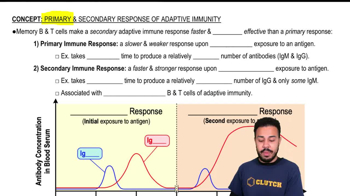
The primary immune response is the body's first reaction to a new antigen, involving activation of naive B and T cells and production of antibodies.
Avanzamenti del tracciato
I pulsanti di controllo sono stati cambiati in modalità "navigazione".
1/20
Video consigliati
VideoThumbView.guidedCourse
6:59
Primary and Secondary Response of Adaptive Immunity
1213
views
12
rank
Termini in questo insieme (20)
Nascondere definizioni
What is the primary immune response?
The primary immune response is the body's first reaction to a new antigen, involving activation of naive B and T cells and production of antibodies.
What is the Lag Phase in the primary immune response?
The Lag Phase is the initial delay after antigen exposure when no antibodies are detected as immune cells activate and proliferate.
How long do memory B cells live?
Memory B cells can live for years to decades, providing long-term immunity by quickly responding to previously encountered antigens.
What is the secondary immune response?
The secondary immune response is a faster and stronger reaction upon re-exposure to an antigen due to memory B and T cells.
Compare primary vs secondary immune responses.
Primary response is slower with lower antibody levels; secondary response is faster, stronger, and produces more antibodies due to memory cells.
What are vaccinations?
Vaccinations introduce antigens or weakened pathogens to stimulate the immune system to develop immunity without causing disease.
What are the different types of vaccinations?
Types include live attenuated, inactivated, subunit, toxoid, and mRNA vaccines, each using different methods to trigger immunity.
What are mutations in the context of immunity?
Mutations are changes in pathogen DNA or RNA that can alter antigens, potentially reducing vaccine effectiveness.
Compare active vs passive immunity.
Active immunity
involves the body producing its own antibodies after exposure;
passive immunity
is receiving antibodies from another source.
Examples of active immunity.
Natural infection and vaccination both stimulate the body to produce its own antibodies and memory cells.
Examples of passive immunity.
Receiving maternal antibodies through breast milk or antibody injections provides immediate but temporary protection.
Why is the secondary immune response faster?
Memory cells recognize the antigen quickly and activate rapidly, bypassing the lag phase seen in the primary response.
What role do memory B cells play in immunity?
Memory B cells remember specific antigens and enable a rapid and strong antibody response upon re-exposure.
What is the significance of the lag phase?
The lag phase represents the time needed for immune cells to recognize the antigen and begin producing antibodies.
How do vaccines contribute to herd immunity?
Vaccines reduce disease spread by increasing the number of immune individuals, protecting those who cannot be vaccinated.
What is a live attenuated vaccine?
A vaccine using a weakened form of the pathogen that can replicate but does not cause disease in healthy individuals.
What is an inactivated vaccine?
A vaccine containing killed pathogens that cannot replicate but still trigger an immune response.
What is a subunit vaccine?
A vaccine using only parts of the pathogen, such as proteins or sugars, to stimulate immunity.
What is a toxoid vaccine?
A vaccine made from inactivated toxins produced by bacteria to protect against toxin-mediated diseases.
How do mRNA vaccines work?
mRNA vaccines deliver genetic instructions for cells to produce a pathogen protein, triggering an immune response.
 IndietroIndietro
 6:59
