The immune system has innate (nonspecific) defenses and adaptive (specific) defenses that work together to protect the body.
What constitutes the first line of defense in innate immunity?
Physical and chemical barriers such as skin, sebum, stomach acid, mucus in respiratory tract, and acidic urine prevent pathogen entry.
What role do phagocytic cells play in innate immunity?
Phagocytic cells like neutrophils and macrophages ingest and destroy pathogens in tissues and blood.
What is the function of endogenous pyrogens?
Endogenous pyrogens induce fever, which slows bacterial growth and enhances immune responses.
Name key internal defenses of innate immunity.
Phagocytosis, natural killer (NK) cells, inflammatory response, and antimicrobial proteins like complement and interferons.
What is the complement system?
A group of proteins that enhance inflammation, opsonize pathogens, and form the Membrane Attack Complex (MAC) to lyse bacteria.
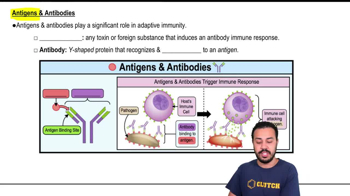
What are antigens?
Large, complex proteins that trigger antibody production or specific immune responses; can be foreign or self-antigens like MHC proteins.
What is the difference between Class I and Class II MHC molecules?
Class I MHC is on all nucleated cells and presents endogenous antigens to cytotoxic T cells. Class II MHC is on antigen-presenting cells and presents exogenous antigens to helper T cells.
Describe the structure of an antibody.
Y-shaped protein with two heavy chains and two light chains, each antibody has two antigen-binding sites.
What cells produce antibodies?
B lymphocytes (B cells) produce antibodies as part of the humoral immune response.
What is the primary immune response?
The initial production of antibodies by B cells upon first exposure to an antigen; slower and less intense.
What is the secondary immune response?
A faster and stronger antibody response upon subsequent exposure to the same antigen due to memory B cells.
Differentiate active and passive immunity.
Active immunity involves the body producing its own antibodies; passive immunity involves receiving antibodies from another source.
List functions of antibodies.
Antibodies fix complement, neutralize pathogens, and cause agglutination to enhance pathogen removal.
Name the five main classes of immunoglobulins.
IgA, IgD, IgE, IgG, and IgM, each with distinct functions and body locations.
What is the role of cytotoxic T cells (CD8+)?
They recognize antigens on Class I MHC and destroy infected or abnormal cells by releasing perforin and cytotoxins.
What is the role of helper T cells (CD4+)?
Helper T cells activate B cells and cytotoxic T cells by releasing cytokines like interleukin-2 (IL-2) and recognize antigens on Class II MHC.
How do helper T cells coordinate the immune response?
They provide costimulatory signals necessary for activation and proliferation of B cells and cytotoxic T cells.
What causes immunodeficiencies?
Primary immunodeficiencies are genetic (e.g., SCID), while acquired immunodeficiencies like AIDS result from infections that destroy immune cells.
What are Type I and Type IV hypersensitivities?
Type I is an immediate IgE-mediated allergic reaction; Type IV is a delayed reaction mediated by cytotoxic T cells.
 Indietro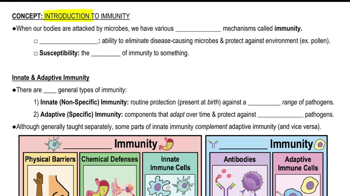
 5:52
5:52