Skip to main content
Anatomy & Physiology
Il mio corso
Impara
Preparazione agli esami
AI Tutor
Guide di studio
Soluzioni per libri di testo
Flashcard
Esplora
Prova l'app
Il mio corso
Impara
Preparazione agli esami
AI Tutor
Guide di studio
Soluzioni per libri di testo
Flashcard
Esplora
Prova l'app
Indietro
Integumentary System - Anatomy & Physiology
Puoi toccare per girare la carta.
What are the two major parts of the integumentary system?
Puoi toccare per girare la carta.
👆
What are the two major parts of the integumentary system?
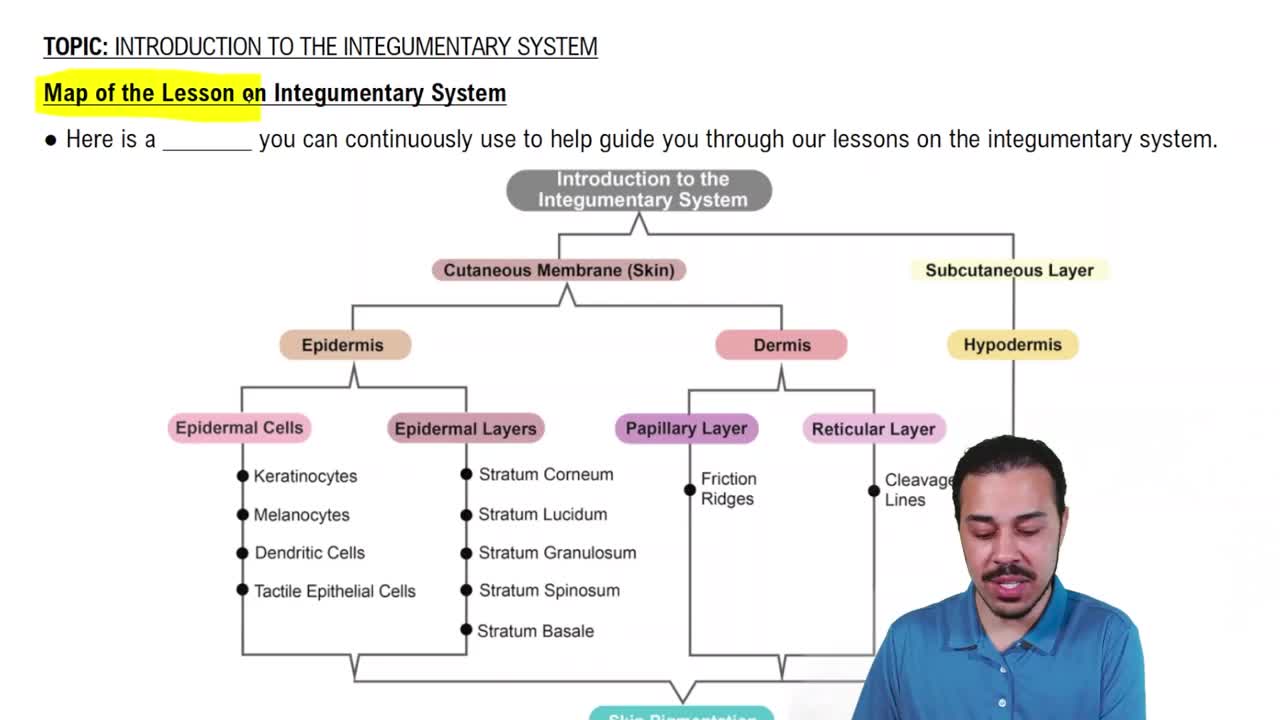
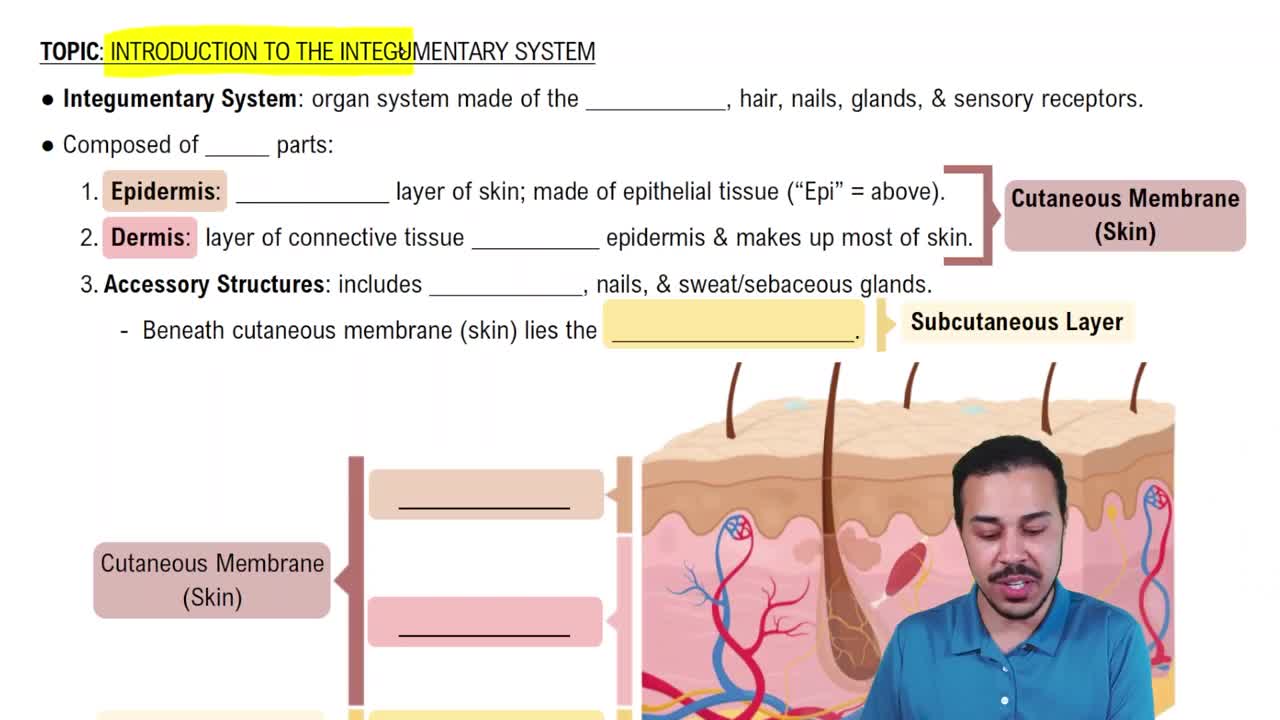
1) Cutaneous membrane (epidermis and dermis) 2) Accessory structures (hair, nails, sweat glands, sebaceous glands)
Avanzamenti del tracciato
I pulsanti di controllo sono stati cambiati in modalità "navigazione".
1/27
Video consigliati
VideoThumbView.guidedCourse
06:54
Introduction to the Integumentary System
24034
views
819
rank
3
comments
VideoThumbView.guidedCourse
03:40
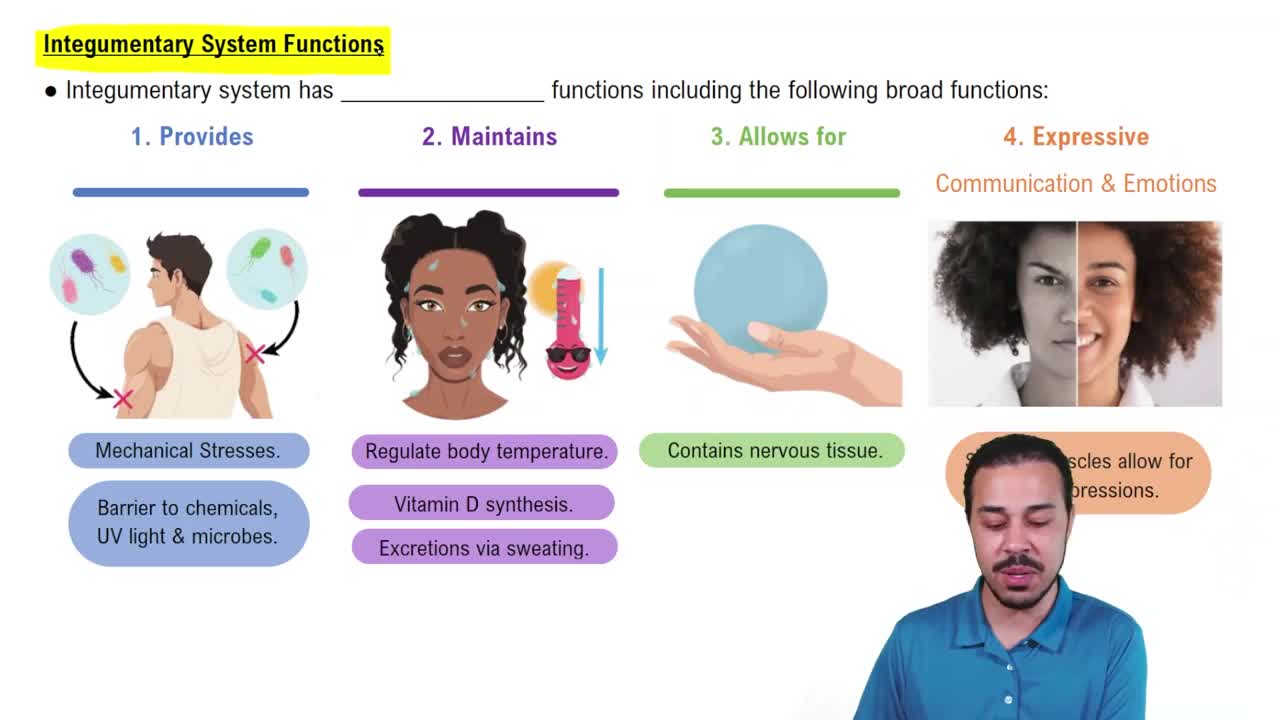
Integumentary System Functions
15618
views
393
rank
1
comments
VideoThumbView.guidedCourse
02:47
Map of the Lesson on Integumentary System
13760
views
648
rank
6
comments
Termini in questo insieme (27)
Nascondere definizioni
What are the two major parts of the integumentary system?
1) Cutaneous membrane (epidermis and dermis) 2) Accessory structures (hair, nails, sweat glands, sebaceous glands)
What are the primary functions of the skin?
Physical protection, immune response coordination, sensory information, excretion, thermoregulation, and storage of lipids.
What type of epithelium composes the epidermis?
Keratinized stratified squamous epithelium.
Name the four main cell types found in the epidermis.
Keratinocytes, melanocytes, Langerhans (dendritic) cells, and Merkel (tactile) cells.
What is the function of keratinocytes?
Produce fibrous keratin, providing protective properties to the skin.
What pigment do melanocytes produce and what is its function?
Melanin; it protects skin from UV radiation by absorbing it and forming sun shields around nuclei.
What are the layers of the epidermis in thin skin?
Stratum basale, stratum spinosum, stratum granulosum, and stratum corneum.
What additional layer is found in thick skin epidermis?
Stratum lucidum, located between the stratum granulosum and stratum corneum.
Describe the stratum basale.
Deepest epidermal layer; single layer of stem cells that actively divide and replace superficial keratinocytes.
What is the stratum spinosum characterized by?
8-10 layers of keratinocytes with a spiny appearance; contains Langerhans cells.
What occurs in the stratum granulosum?
Keratinocytes flatten, organelles disintegrate, and keratinization begins; cells above this layer die.
What is the role of the stratum corneum?
Superficial layer of dead, keratinized cells that protect deeper layers and prevent water loss.
What pigments influence skin color?
Carotene (yellow-orange) and melanin (red/yellow or brown/black).
How does blood flow affect skin color?
Oxygenated hemoglobin gives a pinkish hue; low oxygen causes cyanosis, a bluish tint.
What is albinism?
Inherited inability to produce melanin, resulting in lack of pigment in hair, eyes, and skin.
What is vitiligo?
Partial or complete loss of melanocytes due to immune system malfunction, causing depigmented skin patches.
What are the two layers of the dermis?
Papillary layer (areolar tissue with dermal papillae) and reticular layer (dense irregular connective tissue).
What are friction ridges and their function?
Epidermal ridges over dermal ridges that create fingerprints and contain sweat pores.
What is the hypodermis composed of and its function?
Adipose and areolar connective tissue; stabilizes skin and stores ~80% of body fat.
What are the main functions of hair?
Protects and insulates the scalp, guards openings against debris, and acts as a sensory receptor.
What are the three layers of the hair shaft?
Medulla (core), cortex (intermediate), and cuticle (surface layer).
What is the arrector pili muscle?
Smooth muscle attached to hair follicles; contraction causes hair to stand up (goosebumps).
What are the two types of sweat glands?
Apocrine glands (secrete into hair follicles, produce odorous sweat) and eccrine glands (secrete onto skin surface, regulate temperature).
What is the function of sebaceous glands?
Secrete sebum to lubricate skin and hair, inhibit bacterial growth, and protect hair shafts.
What are the main parts of a nail?
Nail body (visible plate), free edge (extends beyond finger), and nail root (production site).
How are burns classified by depth?
First-degree: epidermis only; second-degree: epidermis and dermis; third-degree: epidermis, dermis, and hypodermis.
What is the ABCD rule for melanoma detection?
A: asymmetry, B: border irregularity, C: color variation, D: diameter larger than 6 mm.
 IndietroIndietro
 06:54