What is a body system and its relationship to the whole body?
A body system is a group of organs that work together to perform major functions for the body, contributing to overall homeostasis and health.
Which organs are found in the integumentary system?
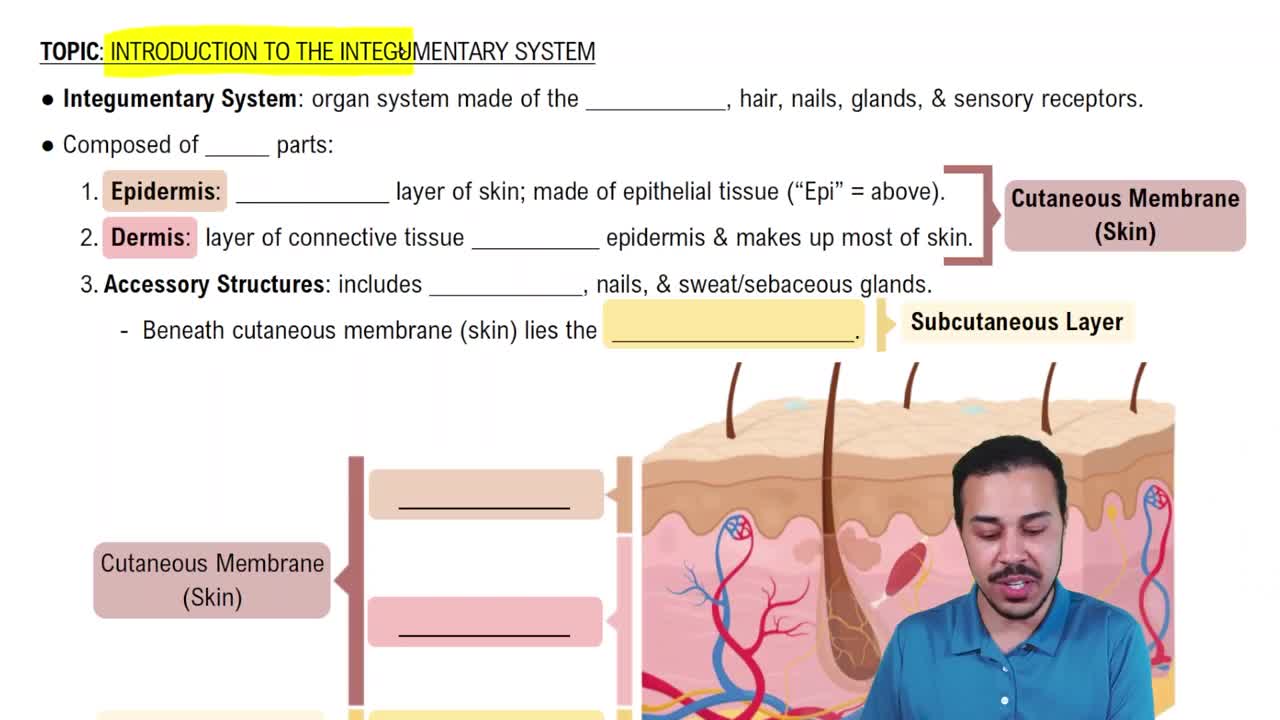
The integumentary system includes the skin, hair, nails, sebaceous glands, and sudoriferous (sweat) glands.
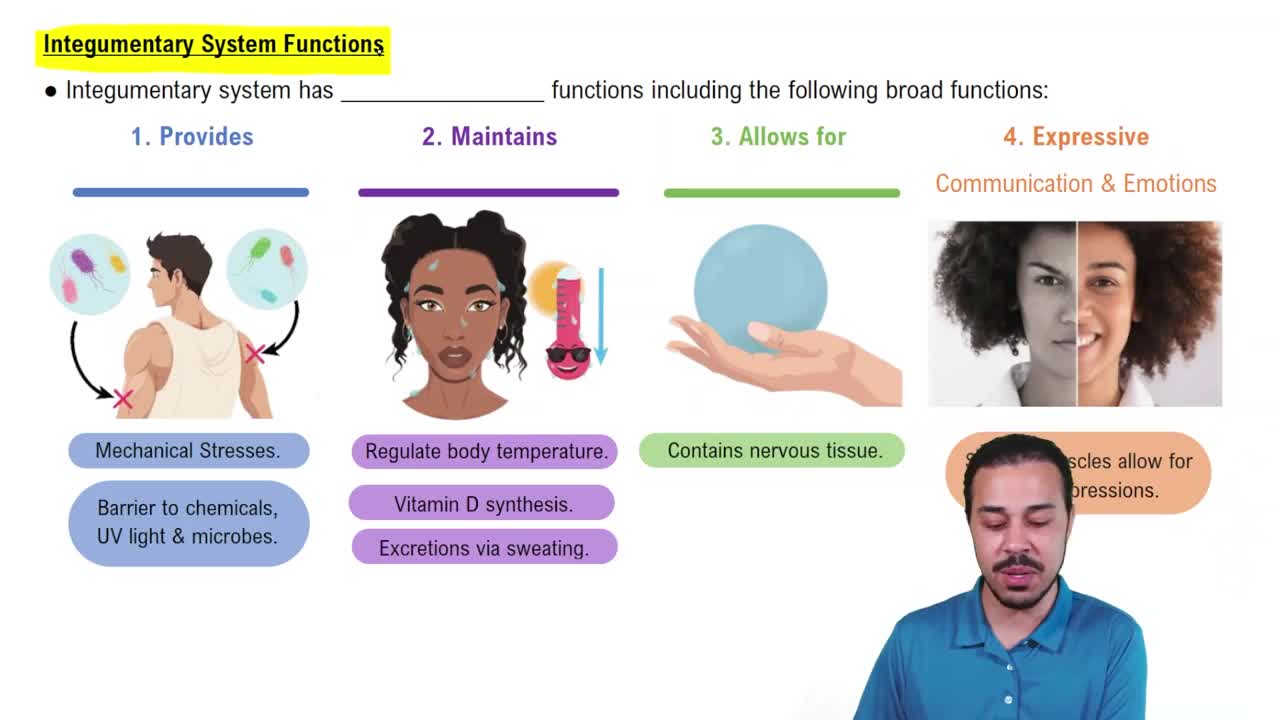
What are the basic functions of the integumentary system?
Functions include protection, temperature regulation, sensation, excretion, and vitamin D synthesis. Skin layers and glands play key roles in these.
Name the major layers of the integument and their tissue types.
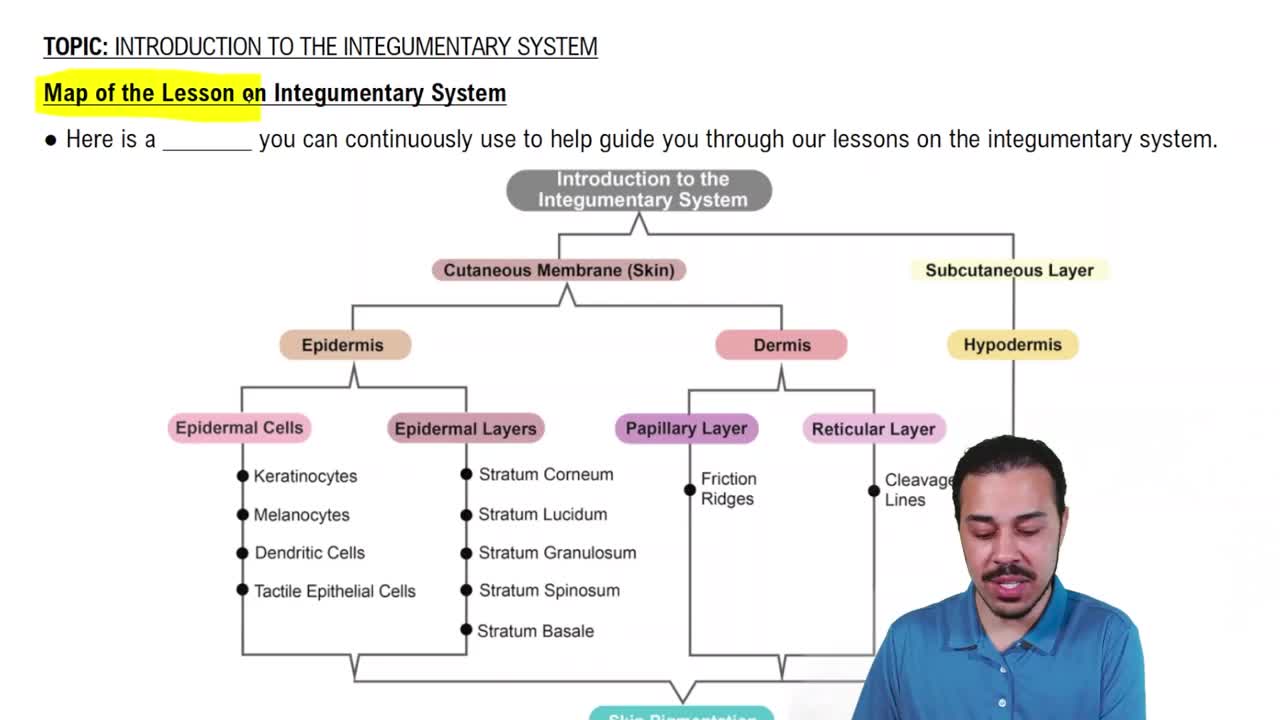
The integument has three major layers: epidermis (stratified squamous epithelial tissue), dermis (dense irregular connective tissue), and hypodermis (areolar and adipose connective tissue).
What are the major cell types in the epidermis and their roles?
Keratocytes produce keratin; melanocytes produce melanin pigment; Langerhans cells provide immune defense; Merkel cells function in touch sensation.
Describe the stratum basale of the epidermis.
The stratum basale is the deepest epidermal layer with a single layer of basal cells that divide to form new keratinocytes; contains melanocytes and Merkel cells.
What characterizes the stratum spinosum?
The stratum spinosum has several layers of keratinocytes connected by desmosomes, providing strength; Langerhans cells are also present.
Describe the stratum granulosum.
The stratum granulosum contains 3-5 layers of keratinocytes with granules that promote keratinization and waterproofing.
What is the stratum lucidum and where is it found?
The stratum lucidum is a thin, clear layer of dead keratinocytes found only in thick skin areas like palms and soles.
Describe the stratum corneum.
The stratum corneum is the outermost layer with many layers of dead, flattened keratinocytes that form a tough, protective barrier.
What are the two regions of the dermis and their differences?
The papillary region is thin, superficial, with loose connective tissue and dermal papillae; the reticular region is thicker, deeper, with dense irregular connective tissue providing strength.
What is the function of dermal papillae?
Dermal papillae increase surface area between dermis and epidermis, enhancing nutrient exchange and strengthening their connection.
What is the function of the hypodermis?
The hypodermis anchors skin to underlying tissues, provides insulation, cushioning, and stores energy in adipose tissue.
What pigments influence skin color and their sources?
Skin color is influenced by melanin (from melanocytes), carotene (from diet), and hemoglobin (in blood).
How are melanocytes stimulated to produce melanin?
Melanocytes produce melanin when stimulated by UV radiation, which increases melanin synthesis and dispersal to protect skin cells.
Describe the basic anatomy of a hair.
Hair consists of a shaft above the skin, a root below, surrounded by the hair follicle embedded in the dermis.
What is the hair life cycle and its relation to alopecia?
Hair cycles through growth (anagen), regression (catagen), and rest (telogen) phases; disruption can cause alopecia (hair loss).
Describe the basic anatomy of a nail.
Nails are made of keratinized epithelial cells, with a visible nail plate, nail bed underneath, and a nail matrix where growth occurs.
Differentiate between sebaceous and sudoriferous glands.
Sebaceous glands secrete oily sebum into hair follicles; sudoriferous glands produce sweat and open onto skin surface or hair follicles.
What are the types of sudoriferous glands and their characteristics?
Eccrine glands produce watery sweat for cooling; apocrine glands produce thicker sweat in armpits and groin; both release sweat onto skin surface.
What are common types of skin cancer and why are they dangerous?
Common skin cancers include basal cell carcinoma, squamous cell carcinoma, and melanoma. Melanoma is most dangerous due to rapid metastasis.
How are burns classified by depth?
Burns are classified as first-degree (epidermis), second-degree (epidermis and dermis), and third-degree (full thickness including hypodermis).
What major health complications arise from burns?
Burn victims risk fluid loss, infection, and impaired temperature regulation due to loss of skin barrier functions.
What is the Rule of Nines in burn assessment?
The Rule of Nines estimates burn surface area by dividing the body into sections of 9% or multiples, guiding fluid replacement and treatment.
 Indietro
 06:54