Skip to main content
Anatomy & Physiology
Il mio corso
Impara
Preparazione agli esami
AI Tutor
Guide di studio
Soluzioni per libri di testo
Flashcard
Esplora
Prova l'app
Il mio corso
Impara
Preparazione agli esami
AI Tutor
Guide di studio
Soluzioni per libri di testo
Flashcard
Esplora
Prova l'app
Indietro
Integumentary System - Anatomy & Physiology
Puoi toccare per girare la carta.
What components make up the integumentary system?
Puoi toccare per girare la carta.
👆
What components make up the integumentary system?
The integumentary system is composed of
skin, hair, nails, sweat glands, oil glands, and mammary glands
.
Avanzamenti del tracciato
I pulsanti di controllo sono stati cambiati in modalità "navigazione".
1/22
Video consigliati
VideoThumbView.guidedCourse
06:54
Introduction to the Integumentary System
24100
views
820
rank
3
comments
VideoThumbView.guidedCourse
03:40
Integumentary System Functions
15648
views
395
rank
1
comments
VideoThumbView.guidedCourse
02:47
Map of the Lesson on Integumentary System
13791
views
649
rank
6
comments
Termini in questo insieme (22)
Nascondere definizioni
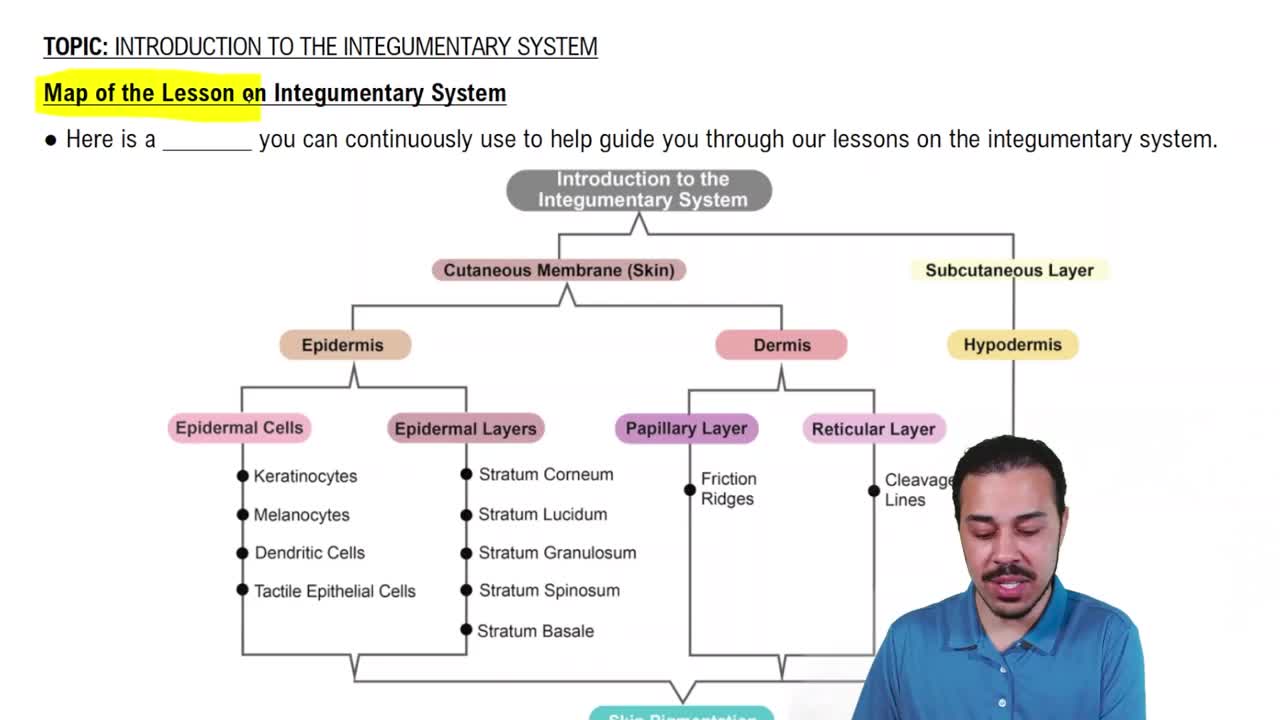
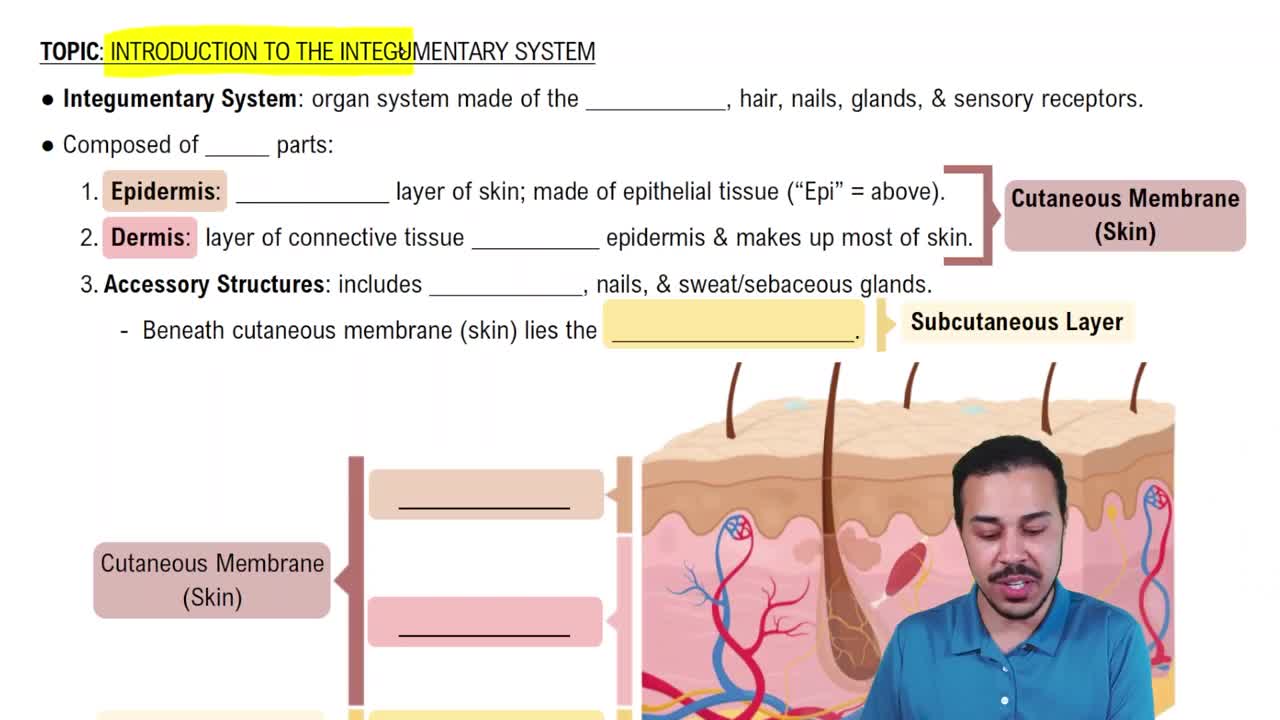
What components make up the integumentary system?
The integumentary system is composed of
skin, hair, nails, sweat glands, oil glands, and mammary glands
.
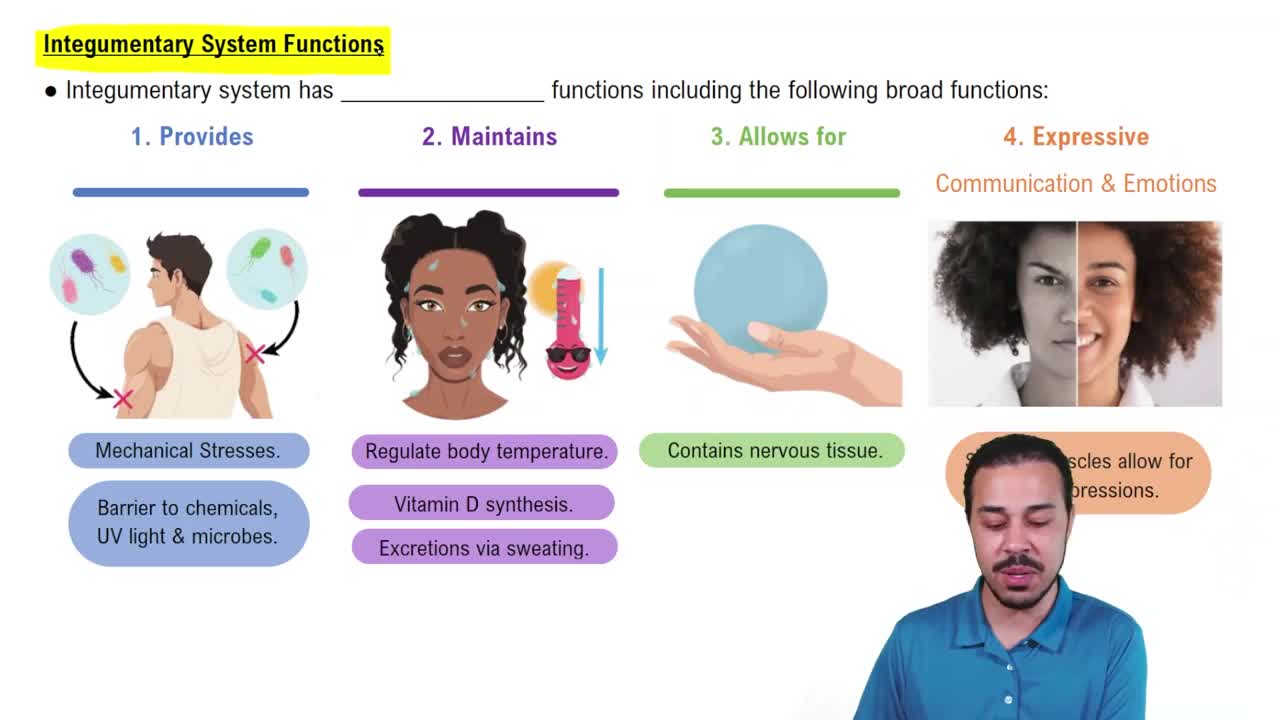
What are the main functions of the integumentary system?
Physical protection, regulation of body temperature, excretion, nutrition synthesis, sensation, and immune defense
.
What are the two main subdivisions of the skin?
Epidermis
(stratified squamous epithelium) and
dermis
(underlying loose connective tissue).
What lies deep to the dermis?
The
subcutaneous layer
, which is beneath the dermis.
What are the accessory structures of the integumentary system?
Accessory structures include
hair, nails, and many multicellular exocrine glands
.
What is the most abundant cell type in the epidermis?
Keratinocytes
are the most abundant cells in the epidermis.
Name the four main cell types found in the epidermis.
Keratinocytes, melanocytes, Merkel cells, and Langerhans cells
.
What is the function of melanocytes?
Melanocytes
produce pigment and are found deep in the epidermis.
What role do Merkel cells play?
Merkel cells
function as sensory cells in the epidermis.
What are Langerhans cells?
Langerhans cells
are fixed macrophages involved in immune defense.
What is hair composed of and where does it originate?
Hair is a
nonliving keratinized structure
that extends beyond the skin surface and originates from hair follicles.
What percentage of body hair is not on the head?
Approximately
98%
of the 5 million hairs on the body are not on the head.
How does the integument respond to mechanical stress?
Mechanical stress triggers
stem cell divisions
resulting in callus formation.
What happens when the integument is severely damaged?
Severe damage may result in
acellular scar tissue
due to incomplete healing.
What are the layers of the epidermis from deepest to most superficial?
Stratum germinativum (basale), stratum spinosum, stratum granulosum, stratum lucidum (only in thick skin), and stratum corneum
.
What is the function of the stratum germinativum?
It is the
innermost basal layer
attached to the basal lamina and contains epidermal stem cells, melanocytes, and Merkel cells.
What characterizes the stratum spinosum?
Keratinocytes are bound by
macula adherens (desmosomes)
to provide strength.
What occurs in the stratum granulosum?
Keratinocytes produce
keratohyalin and keratin
, forming fibers and cells that become water-resistant.
Where is the stratum lucidum found and what is its appearance?
Found only in
thick skin
, it appears as a
glassy layer
.
What is the role of the stratum corneum?
It is the
outermost layer
with multiple layers of dead, waterproof keratinized cells that are lost by desquamation.
What are the two layers of the dermis?
The
papillary layer
(loose connective tissue) and the
reticular layer
(dense irregular connective tissue).
What functions does the dermis provide?
The dermis
nourishes and supports the epidermis
, provides strength, elasticity, and contains blood vessels, nerves, and glands.
 IndietroIndietro
 06:54