What are the two major parts of the integumentary system?
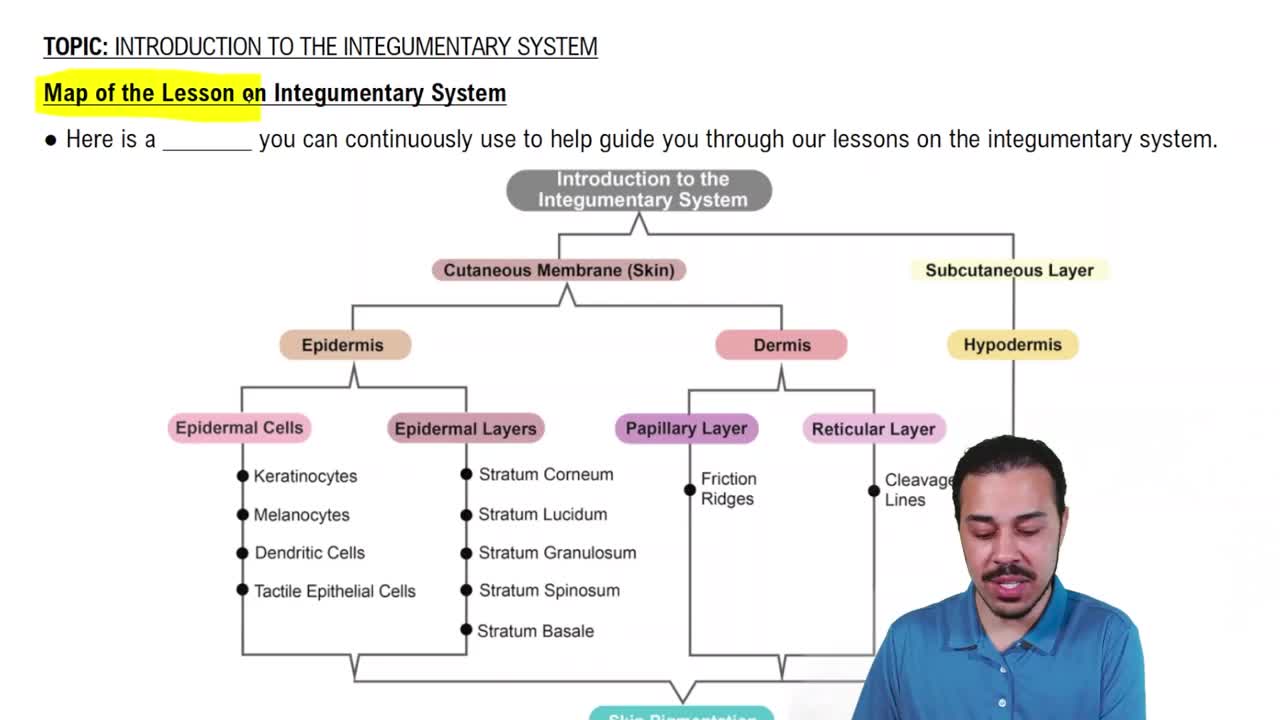
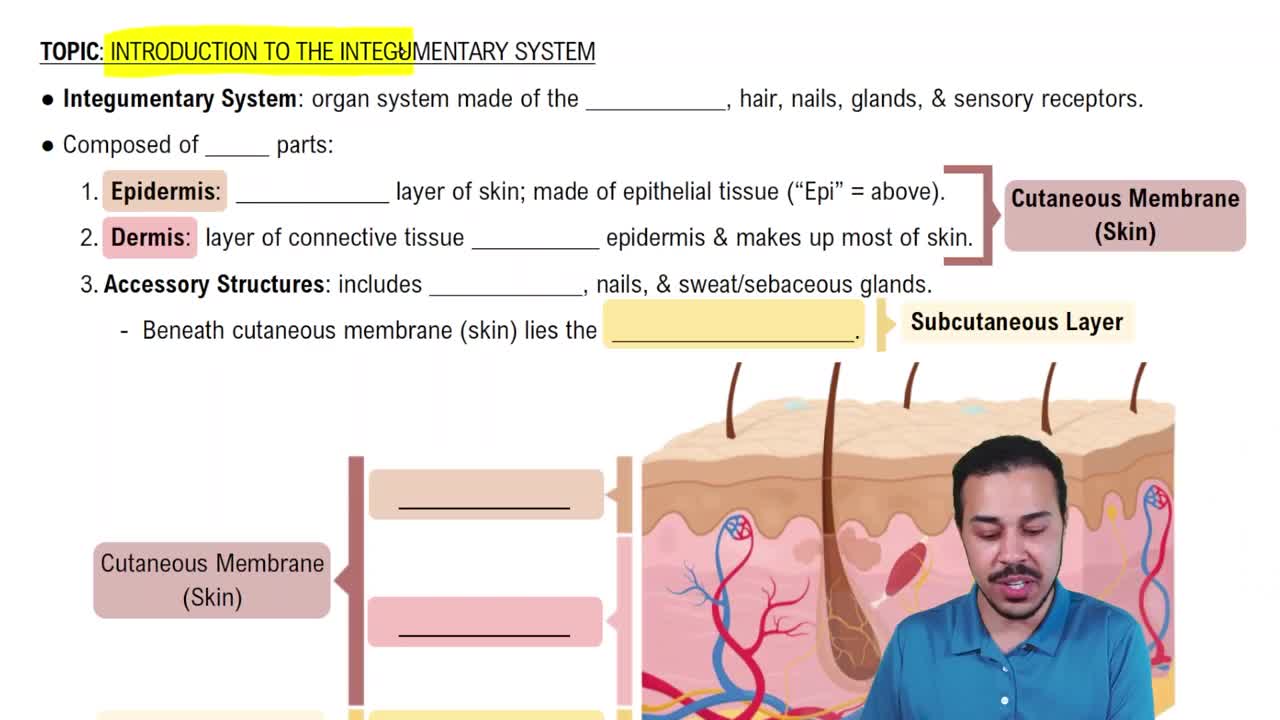
The integumentary system consists of the cutaneous membrane (skin) and accessory structures such as hair, exocrine glands, and nails.
What layers make up the cutaneous membrane?
The cutaneous membrane consists of the epidermis (superficial epithelium) and the dermis (underlying connective tissue).
What is the subcutaneous layer and its function?
The subcutaneous layer or hypodermis is loose connective tissue beneath the dermis that separates the integument from deeper tissues and stabilizes skin position.
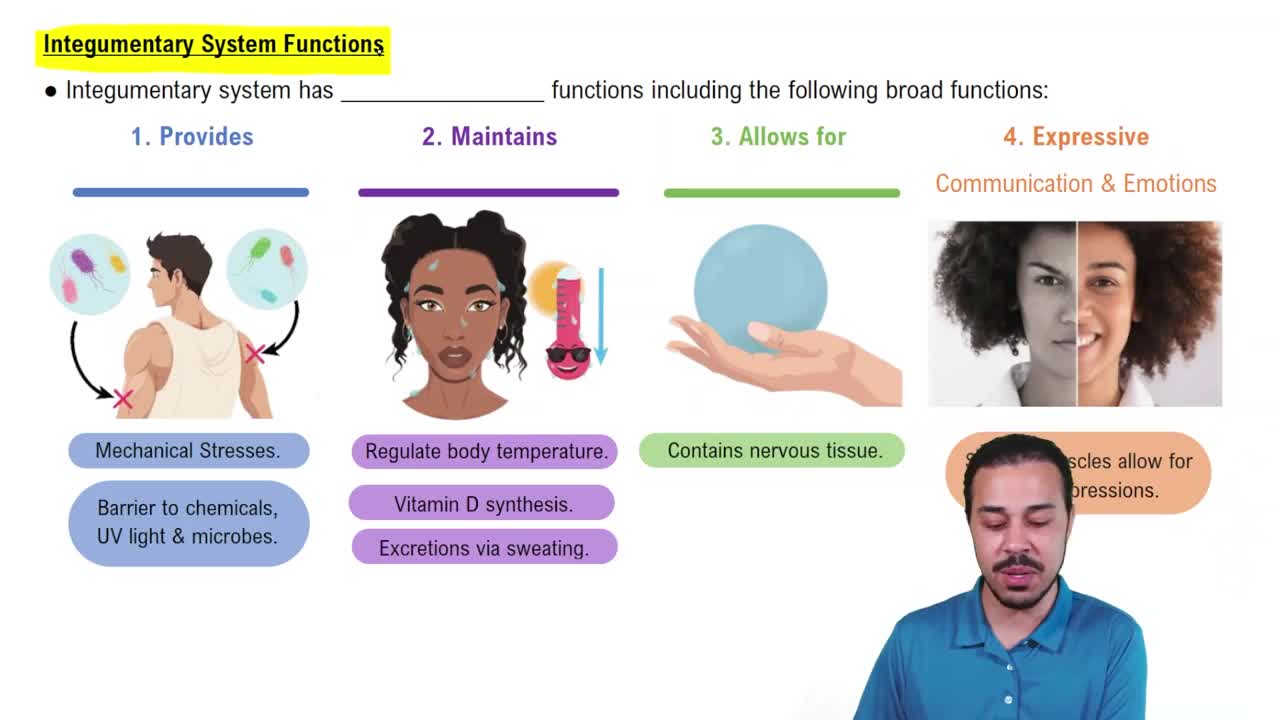
List five general functions of the integumentary system.
Protection, temperature maintenance, synthesis and storage of nutrients, sensory reception, and excretion and secretion.
What type of cells primarily compose the epidermis?
The epidermis is mostly composed of keratinocytes, which produce keratin, along with melanocytes, Merkel cells, and dendritic cells.
Difference between thick and thin skin?
Thick skin has five layers of epidermal cells and is found on palms and soles; thin skin has four layers and covers the rest of the body.
Name the five strata of the epidermis from deep to superficial.
Stratum basale, stratum spinosum, stratum granulosum, stratum lucidum (only in thick skin), and stratum corneum.
What is the function of the stratum basale?
The stratum basale contains stem cells that divide to replace lost epidermal cells and includes melanocytes and Merkel cells.
What are epidermal ridges and their significance?
Epidermal ridges are downward projections of the stratum basale that interlock with dermal papillae, increasing surface area and forming fingerprints.
What is the role of melanocytes in the skin?
Melanocytes produce melanin, a pigment that absorbs UV radiation to protect DNA in skin cells from damage.
What is the role of vitamin D3 synthesized in the skin?
Vitamin D3 is converted to calcitriol, a hormone essential for calcium and phosphorus absorption, supporting bone health.
Name the two major layers of the dermis.
The dermis has a superficial papillary layer and a deeper reticular layer.
What type of connective tissue is found in the papillary layer of the dermis?
The papillary layer consists of areolar connective tissue containing capillaries, lymphatic vessels, and sensory neurons.
What is the main cell type in the reticular layer of the dermis?
The dominant cell type in the reticular layer is the fibroblast, which produces collagen and elastic fibers.
What are sebaceous glands and their function?
Sebaceous glands secrete sebum, an oily substance that lubricates hair and skin and inhibits bacterial growth.
What causes acne related to sebaceous glands?
Acne results from blocked sebaceous ducts causing inflammation and formation of pimples.
Differentiate between apocrine and eccrine sweat glands.
Apocrine glands secrete into hair follicles and produce odorous sweat after puberty; eccrine glands secrete watery sweat directly onto skin for cooling.
What is the main function of eccrine sweat glands?
Eccrine sweat glands regulate body temperature through evaporation of watery sweat.
Describe the four phases of skin regeneration after injury.
Inflammation, migration (clot formation and cell migration), proliferation (collagen meshwork formation), and scarring (scar tissue formation).
What are the classifications of burns by depth?
First-degree (epidermis only), second-degree (epidermis and part of dermis), and third-degree (full thickness, epidermis and dermis destroyed).
What is the Rule of Nines used for?
The Rule of Nines estimates the percentage of body surface area affected by burns for treatment assessment.
 Indietro
 06:54