Indietro

Introduction to the Endocrine System - Anatomy & Physiology

I pulsanti di controllo sono stati cambiati in modalità "navigazione".
1/20
  • What are the two parts of any chemical signal in the endocrine system?

    Chemical messenger and receptor. The chemical messenger initiates a response, and the receptor binds to the messenger to trigger that response.
  • What are the three types of chemical messengers described in the endocrine system?

    Autocrine (acts on the same cell), paracrine (acts on nearby cells), and endocrine (acts on distant cells via the bloodstream).
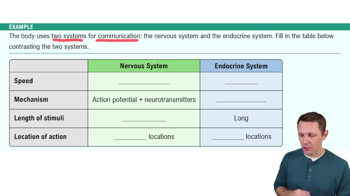
  • How does the nervous system differ from the endocrine system in terms of speed and duration of action?

    The nervous system acts quickly with short duration (milliseconds), while the endocrine system acts slowly with long-lasting effects.
  • What is the main difference in the location of action between the nervous and endocrine systems?

    Nervous system signals act at specific locations via neurotransmitters, whereas endocrine signals act at distant locations through hormones in the bloodstream.
  • What is a synapse in the context of nervous system signaling?

    A synapse is the junction where a nerve impulse is transmitted from one neuron to another or to an effector cell.
  • What type of chemical messenger is epinephrine and where is it produced?

    Epinephrine is an adrenaline hormone produced by the adrenal medulla during stressful situations.
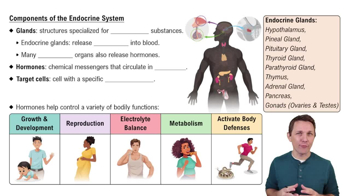
  • What are the main components of the endocrine system?

    Glands (which secrete substances), endocrine glands (release hormones), many organs (some release hormones), and hormones (chemical messengers).
  • Name five endocrine glands in the human body.

    Hypothalamus, Pituitary gland, Thyroid gland, Adrenal gland, Pancreas.
  • What are the five body functions controlled by hormones?

    Growth & development, reproduction, electrolyte balance, metabolism, and active body defenses.
  • What hormone lowers blood glucose levels?

    Insulin lowers blood glucose levels.
  • Which hormone increases blood glucose levels and promotes gluconeogenesis?

    Glucagon increases blood glucose and promotes gluconeogenesis.
  • What hormone is involved in the development of secondary sexual characteristics in males?

    Testosterone is responsible for male secondary sexual characteristics.
  • What hormone is secreted by the thyroid gland to regulate metabolism?

    Thyroid hormone regulates metabolism.
  • What is the role of growth hormone?

    Growth hormone stimulates growth and protein synthesis.
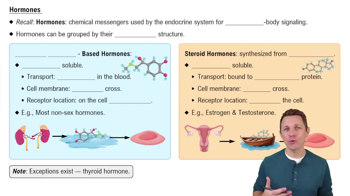
  • What is the difference between steroid hormones and amino acid-based hormones?

    Steroid hormones are lipid-based and can cross cell membranes easily; amino acid-based hormones are water-soluble and cannot cross membranes easily.
  • Why do steroid hormones use transport proteins in the blood?

    Steroid hormones are lipid-soluble and not water-soluble, so transport proteins help them travel through the watery bloodstream.
  • How do amino acid-based hormones typically interact with target cells?

    They bind to receptors on the cell membrane because they cannot cross the lipid membrane.
  • What is the function of transport proteins for steroid hormones?

    Transport proteins allow steroid hormones to cross the cell membrane and temporarily make them water-soluble.
  • Which system uses electrical signals and neurotransmitters for communication?

    The nervous system uses electrical signals and neurotransmitters.
  • Which system uses chemical messengers called hormones for communication?

    The endocrine system uses hormones as chemical messengers.