 Indietro
Lipids - Anatomy & Physiology
 03:31

Termini in questo insieme (20)
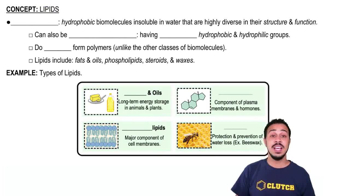
Lipids are hydrophobic biomolecules insoluble in water, diverse in structure and function, including fats, oils, phospholipids, steroids, and waxes.
No, lipids do not form polymers, unlike carbohydrates, proteins, and nucleic acids.
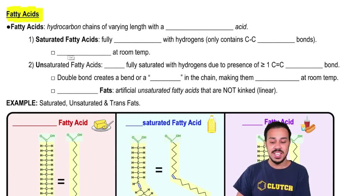
Hydrocarbon chains of varying length with a carboxylic acid group at one end.
Fatty acids fully saturated with hydrogens, containing only C-C single bonds, and are solid at room temperature.
Fatty acids with one or more C=C double bonds, causing bends or kinks, making them liquid at room temperature.
Artificial unsaturated fatty acids that are not kinked and have a linear shape.
A lipid composed of three fatty acid chains covalently linked to a single glycerol molecule via dehydration synthesis.
Phospholipids contain a phosphate group and are the major component of all cell membranes.
They are amphipathic molecules with a hydrophilic (polar) head and two hydrophobic (nonpolar) fatty acid tails.
The polar heads interact with water, while the nonpolar tails avoid water, forming bilayers in membranes.
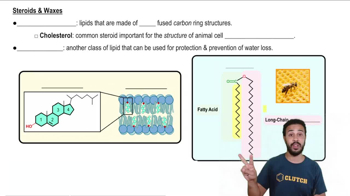
Lipids made of four fused carbon ring structures, important for plasma membrane structure and hormones.
Cholesterol is a common steroid important for the structure of animal cell membranes.
Waxes are lipids composed of fatty acids bound to long-chain alcohols, used for protection and prevention of water loss.
Waxes are hydrophobic, providing a protective barrier against water loss.
Only carbon-carbon single bonds (C-C).
It creates a kink or bend in the chain, affecting the fatty acid's physical state.
A chemical reaction where fatty acids link to glycerol by removing water molecules to form ester bonds.
Fats are typically saturated and solid at room temperature, while oils are unsaturated and liquid.
Because their amphipathic nature allows them to form bilayers that create a selective barrier for cells.
Four fused carbon rings forming a rigid backbone.