Skip to main content
Anatomy & Physiology
Il mio corso
Impara
Preparazione agli esami
AI Tutor
Guide di studio
Soluzioni per libri di testo
Flashcard
Esplora
Prova l'app
Il mio corso
Impara
Preparazione agli esami
AI Tutor
Guide di studio
Soluzioni per libri di testo
Flashcard
Esplora
Prova l'app
Indietro
Meiosis and Gamete Formation in Anatomy & Physiology
Puoi toccare per girare la carta.
What is meiosis?
Puoi toccare per girare la carta.
👆
What is meiosis?
Meiosis
is a cell division process where the DNA amount is reduced from diploid to haploid, producing gametes with half the adult DNA.
Avanzamenti del tracciato
I pulsanti di controllo sono stati cambiati in modalità "navigazione".
1/20
Video consigliati
VideoThumbView.guidedCourse
1:06
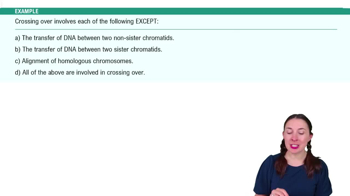
Meiosis Example 5
1938
views
30
rank
VideoThumbView.guidedCourse
4:49
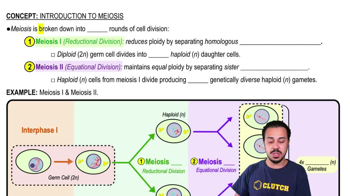
Meiosis I & Meiosis II
2843
views
45
rank
VideoThumbView.guidedCourse
5:19
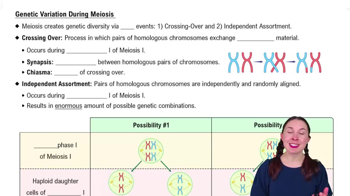
Genetic Variation During Meiosis
2195
views
34
rank
Termini in questo insieme (20)
Nascondere definizioni
What is meiosis?
Meiosis
is a cell division process where the DNA amount is reduced from diploid to haploid, producing gametes with half the adult DNA.
What is the main purpose of meiosis?
To create gametes (sperm and egg) with half the chromosome number and to increase genetic variation through shuffling and crossing over.
How many rounds of cell division occur in meiosis?
Two rounds: Meiosis I separates homologous chromosomes, and Meiosis II separates sister chromatids.
What happens during Prophase I of meiosis?
Chromosomes condense, become X-shaped, and the nucleus begins to disappear. Homologous chromosomes pair up.
How do homologous chromosomes line up during Metaphase I?
Homologous pairs line up at the cell's midline, unlike mitosis where individual chromosomes line up.
What separates during Anaphase I?
Homologous chromosomes are pulled to opposite poles, but sister chromatids remain attached.
What is the chromosome state after Telophase I?
Cells separate with one set of chromosomes each, still in X-shaped (duplicated) form.
What occurs during Meiosis II?
Sister chromatids separate, similar to mitosis, resulting in haploid cells.
What is crossing over?
A process where pieces of DNA are exchanged between homologous chromosomes, increasing genetic variation.
What is the chromosome number in gametes?
Gametes are haploid, containing half the chromosome number of adult diploid cells.
What are the characteristics of sperm cells?
Motile cells with a plasma membrane, flagella, nucleus, and many mitochondria; they carry mostly DNA and little cytoplasm.
How does the egg differ from sperm after meiosis?
Only one of four cells survives as the egg, which is larger and contains most organelles and cytoplasm.
Why is mitochondrial DNA important in eggs?
Mitochondria have their own DNA, which is inherited maternally and can trace maternal lineage.
What is apoptosis?
Apoptosis
is programmed cell death, a controlled process to remove cells.
How does meiosis contribute to genetic diversity?
By randomly separating homologous chromosomes and allowing crossing over, meiosis shuffles genetic material.
What is the difference between meiosis and mitosis in chromosome separation?
Meiosis I separates homologous chromosomes; mitosis separates sister chromatids.
What happens during Metaphase II?
Chromosomes line up individually at the cell midline, similar to mitosis.
What is the final product of meiosis?
Four haploid gamete cells, each genetically unique.
What is the significance of unequal cytoplasm division in eggs?
It ensures the egg has enough organelles and nutrients to support early development after fertilization.
How does meiosis ensure each gamete gets one copy of each chromosome?
Through controlled separation of homologous pairs and sister chromatids during two division rounds.
 IndietroIndietro
 1:06