 Indietro
Membrane Specializations, Transport, and Protein Synthesis in Anatomy & Physiology
 02:26

Termini in questo insieme (20)
Microvilli are finger-like projections that increase the surface area of the plasma membrane to enhance absorption.
Cilia are hair-like structures that move fluid, mucus, or cells over the surface of the tissue.
Flagella are long, whip-like structures that propel cells, such as sperm, through fluid.
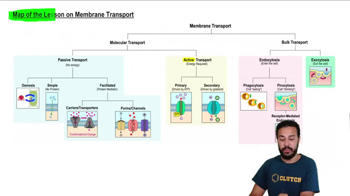
Secondary active transport uses the energy from an ion gradient created by primary active transport to move other substances against their gradient.
Vesicular transport moves large molecules or particles across the membrane via vesicles, including endocytosis and exocytosis.
Protein synthesis includes transcription in the nucleus and translation in the cytoplasm at ribosomes.
Transcription occurs in the nucleus where DNA is copied into mRNA.
Translation occurs at ribosomes in the cytoplasm where mRNA is decoded to form a polypeptide chain.
Ribosomes read mRNA sequences and assemble amino acids into proteins during translation.
The rough ER synthesizes and folds proteins destined for secretion or membrane insertion.
The smooth ER is involved in lipid synthesis and detoxification, not directly in protein synthesis.
The Golgi apparatus modifies, sorts, and packages proteins for transport to their destinations.
Endocytosis is the process of engulfing substances into the cell via vesicles.
Exocytosis is the process of vesicles fusing with the plasma membrane to release contents outside the cell.
Primary active transport uses ATP directly to move ions or molecules against their concentration gradient.
The sodium-glucose cotransporter uses the sodium gradient to transport glucose into cells.
Cilia are short and numerous, moving substances over cell surfaces; flagella are longer and usually singular, propelling the entire cell.
Membrane specializations like microvilli, cilia, and flagella enhance cell function by increasing surface area or enabling movement.
mRNA carries the genetic code from DNA to ribosomes for protein assembly.
tRNA brings specific amino acids to the ribosome matching the mRNA codon during translation.