 Indietro
Membrane Specializations, Transport Mechanisms, and Protein Synthesis Phases
 02:26

Termini in questo insieme (20)
Microvilli are finger-like projections that increase the surface area of the plasma membrane to enhance absorption.
Cilia are hair-like structures that move fluid, mucus, or cells over the surface of the tissue.
Flagella are long, whip-like structures that enable cell motility, such as sperm movement.
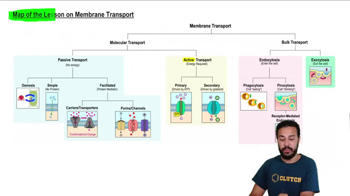
Secondary active transport uses the energy from an ion gradient created by primary active transport to move substances against their concentration gradient.
Vesicular transport involves the movement of large molecules or particles across the membrane via vesicles, including endocytosis and exocytosis.
Protein synthesis occurs in three main phases: transcription (in the nucleus), RNA processing (in the nucleus), and translation (in the cytoplasm).
Transcription is the process where DNA is copied into messenger RNA (mRNA) inside the nucleus.
RNA processing modifies the primary mRNA transcript by splicing out introns and adding a 5' cap and poly-A tail in the nucleus.
Translation is the process where ribosomes in the cytoplasm read mRNA to assemble amino acids into a polypeptide chain.
Ribosomes facilitate the decoding of mRNA and the formation of peptide bonds during translation.
Endocytosis is a vesicular transport process where the cell engulfs extracellular material by forming vesicles from the plasma membrane.
Exocytosis is the process where vesicles fuse with the plasma membrane to release contents outside the cell.
Primary active transport uses ATP directly to move molecules against their concentration gradient via transport proteins like pumps.
Microvilli increase surface area for absorption, while cilia move substances across the cell surface.
Transcription and RNA processing occur in the nucleus; translation occurs in the cytoplasm.
The 5' cap and poly-A tail protect mRNA from degradation and assist in its export from the nucleus and translation.
Transfer RNA (tRNA) brings specific amino acids to the ribosome matching the mRNA codon during translation.
Secondary active transport uses ion gradients created by primary active transport instead of ATP directly.
Major types include endocytosis (phagocytosis, pinocytosis) and exocytosis.
Flagella provide motility to sperm cells, enabling them to swim.