Skip to main content
Anatomy & Physiology
Il mio corso
Impara
Preparazione agli esami
AI Tutor
Guide di studio
Soluzioni per libri di testo
Flashcard
Esplora
Prova l'app
Il mio corso
Impara
Preparazione agli esami
AI Tutor
Guide di studio
Soluzioni per libri di testo
Flashcard
Esplora
Prova l'app
Indietro
Muscle Classification and Major Muscle Actions in Anatomy & Physiology
Puoi toccare per girare la carta.
How are muscles named based on fiber orientation?
Puoi toccare per girare la carta.
👆
How are muscles named based on fiber orientation?
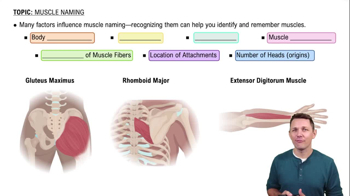
Rectus
means parallel/straight,
Transverse
means perpendicular,
Oblique
means at a 45-degree angle, and
Orbicularis
means circular.
Avanzamenti del tracciato
I pulsanti di controllo sono stati cambiati in modalità "navigazione".
1/24
Video consigliati
VideoThumbView.guidedCourse
4:43
Muscle Naming
10117
views
187
rank
VideoThumbView.guidedCourse
4:32
Muscle Naming Example 1
7507
views
146
rank
2
comments
Termini in questo insieme (24)
Nascondere definizioni
How are muscles named based on fiber orientation?
Rectus
means parallel/straight,
Transverse
means perpendicular,
Oblique
means at a 45-degree angle, and
Orbicularis
means circular.
What does the muscle name 'Gluteus maximus' indicate?
Maximus
means the largest muscle in that group or region.
What is the origin and insertion of the frontalis muscle?
Origin: epicranial aponeurosis; Insertion: skin of eyebrows. Action: elevates eyebrows and wrinkles forehead horizontally.
Which muscle closes the eye and where does it originate and insert?
Orbicularis oculi closes the eye. Origin: frontal bone and maxilla; Insertion: skin of orbital area.
What are the main actions of the masseter muscle?
Elevates the mandible. Origin: zygomatic arch; Insertion: mandible.
What is the primary action of the sternocleidomastoid muscle?
Flexes the neck and causes contralateral rotation of the neck. Origin: sternum and clavicle; Insertion: mastoid process.
Which muscles extend the trunk and laterally flex the trunk?
The erector spinae group: Iliocostalis, Longissimus, and Spinalis muscles.
What is the action of the diaphragm in respiration?
Flattens and lowers the floor of the thoracic cavity to aid in inhalation.
Name the four abdominal muscles and their common action.
Rectus abdominis, External oblique, Internal oblique, and Transverse abdominis all compress the abdominal cavity.
What muscle elevates the scapula and originates from the cervical spine?
Levator scapulae.
Which muscle group stabilizes the glenohumeral joint?
The rotator cuff muscles: Supraspinatus, Infraspinatus, Teres minor, and Subscapularis.
What are the actions of the deltoid muscle?
Abducts the shoulder; anterior fibers flex the shoulder; posterior fibers extend the shoulder.
Which muscles flex the elbow?
Biceps brachii, Brachialis, and Brachioradialis.
What is the action of the triceps brachii?
Extends the elbow.
Which muscles flex the wrist?
Flexor carpi radialis, Flexor carpi ulnaris, and Palmaris longus.
What muscle flexes the thumb and where does it originate?
Flexor pollicis longus; origin: radius; insertion: distal phalanx of digit #1.
What muscles make up the iliopsoas and what is their main action?
Iliacus and Psoas major; they flex the thigh and trunk.
Which muscle flexes the hip, flexes the knee, abducts the hip, and laterally rotates the hip?
Sartorius.
What are the main actions of the gluteus maximus?
Extends the hip, laterally rotates the hip, and abducts the hip.
Which muscles extend the knee in the quadriceps femoris group?
Rectus femoris, Vastus lateralis, Vastus intermedius, and Vastus medialis.
What are the actions of the hamstring muscle group?
Extend the hip and flex the knee.
Which muscle dorsiflexes the ankle and inverts the foot?
Tibialis anterior.
What muscle plantarflexes the ankle and flexes the knee?
Gastrocnemius.
Which muscles evert the ankle and assist in plantarflexion?
Fibularis longus and Fibularis brevis.
 IndietroIndietro
 4:43