Skip to main content
Anatomy & Physiology
Il mio corso
Impara
Preparazione agli esami
AI Tutor
Guide di studio
Soluzioni per libri di testo
Flashcard
Esplora
Prova l'app
Il mio corso
Impara
Preparazione agli esami
AI Tutor
Guide di studio
Soluzioni per libri di testo
Flashcard
Esplora
Prova l'app
Indietro
Muscle Structure and Contraction - Anatomy & Physiology
Puoi toccare per girare la carta.
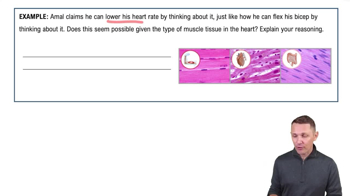
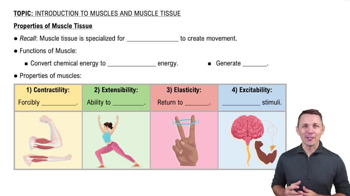
Three types of muscle tissue
Puoi toccare per girare la carta.
👆
Three types of muscle tissue
Skeletal
,
cardiac
, and
smooth
muscle differ in structure, location, function, and activation.
Avanzamenti del tracciato
I pulsanti di controllo sono stati cambiati in modalità "navigazione".
1/21
Video consigliati
6:31
Types of Muscle Tissue
16756
views
454
rank
1
comments
2:00
Introduction to Muscles and Muscle Tissue Example 1
14776
views
294
rank
4:36
Properties of Muscle Tissue
23074
views
664
rank
2
comments
Termini in questo insieme (21)
Nascondere definizioni
Three types of muscle tissue
Skeletal
,
cardiac
, and
smooth
muscle differ in structure, location, function, and activation.
Muscle fiber
An elongated muscle cell, also called a muscle fiber, found in skeletal and smooth muscle.
Connective tissue sheaths in skeletal muscle
Endomysium
surrounds each muscle fiber,
perimysium
surrounds fascicles, and
epimysium
surrounds the entire muscle.
Sarcomere
The smallest contractile unit of muscle, between two Z discs, composed of thick (myosin) and thin (actin) filaments.
Thick filaments composition
Composed of
myosin
molecules, each with a rodlike tail and two globular heads that form cross bridges.
Thin filaments composition
Primarily composed of
actin
with regulatory proteins
tropomyosin
and
troponin
bound to actin.
Role of calcium in muscle contraction
Calcium binds to troponin, causing tropomyosin to move and expose myosin binding sites on actin, enabling contraction.
Sarcoplasmic reticulum (SR)
A smooth ER that stores and regulates intracellular calcium, surrounding each myofibril and forming terminal cisternae.
T tubules function
Invaginations of the sarcolemma that conduct action potentials deep into muscle fibers, triggering Ca2+ release from SR.
Sliding filament model
Thin filaments slide past thick filaments, shortening sarcomeres and causing muscle contraction.
Neuromuscular junction
Synapse between a motor neuron axon terminal and a muscle fiber's motor end plate where acetylcholine is released.
Acetylcholine (ACh) role
Binds to receptors on the sarcolemma, opening Na+ channels, causing depolarization and initiating muscle action potential.
Excitation-contraction coupling
Process linking muscle action potential to contraction via Ca2+ release from SR and exposure of actin binding sites.
Cross bridge cycle
Myosin heads attach to actin, pivot to pull thin filaments, detach with ATP binding, and reset for another cycle.
Motor unit
A motor neuron and all the muscle fibers it innervates; size varies with muscle function.
Muscle twitch phases
Latent period (excitation-contraction coupling), contraction period (cross bridge activity), and relaxation period (Ca2+ reuptake).
Graded muscle responses
Variations in contraction strength achieved by changing stimulus frequency or strength (recruitment).
Isotonic vs isometric contraction
Isotonic
: muscle changes length and moves load;
Isometric
: muscle tension increases without length change.
Sources of ATP for muscle contraction
ATP is regenerated by creatine phosphate, anaerobic glycolysis, and aerobic respiration.
Muscle fatigue causes
ATP deficit, lactic acid buildup, and ionic imbalances leading to inability to contract.
Muscle tone
Constant, slight contraction of muscles maintained by spinal reflexes to keep muscles firm and ready.
 IndietroIndietro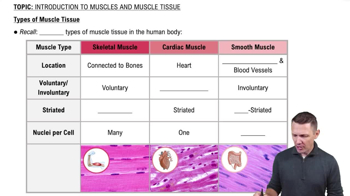
 6:31
6:31